
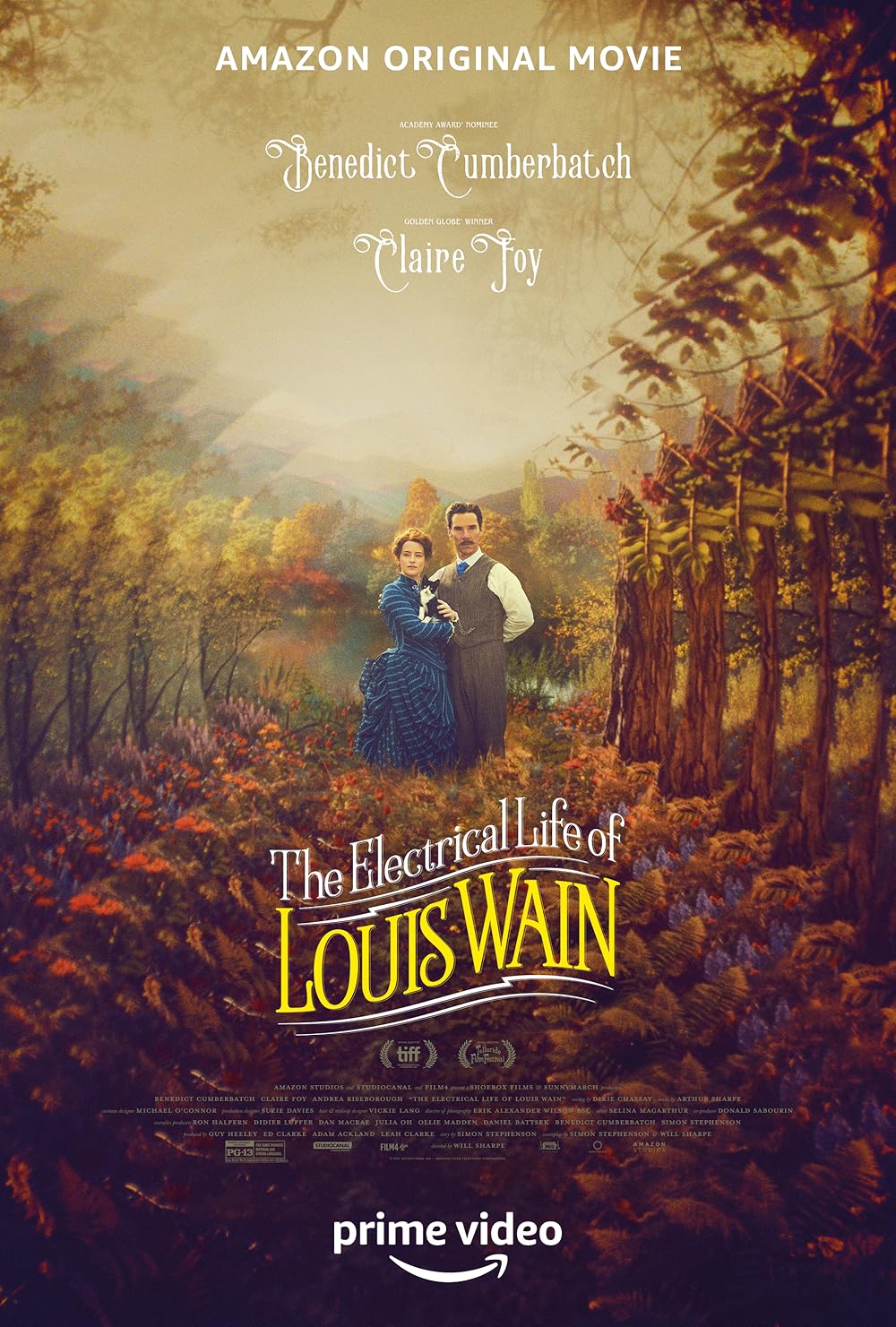
When we look at them critically, there’s nothing quite like an artist’s mind. In order to be creative, one needs to possess some kind of madness, even if it is one that is borne from obsession with a particular subject. We all create art for different reasons, some having more motivation to do so than others – and there have been numerous narratives constructed in every medium that attempt to get to the root of what inspires and motivates some of history’s most iconic and creative individuals. Louis Wain is not a name too many people know, since his style of art was more amusing than it was praised, with his prolific career of depicting almost nothing other than cats making him quite an enigmatic figure, someone whose life was more anecdotal as a result of his style than it was actively explored. However, he has now mercifully emerged from the shadows of the past in the form of The Electrical Life of Louis Wain, the extraordinary and moving biographical drama written and directed by Will Sharpe, who endeavours to voyage into the artist’s life, exploring his early and formative years, as well as his later life, looking at his tendency to use his craft to process some extraordinarily difficult experiences, his drawings being a form of self-imposed therapy used to fend off the feelings of grief, loneliness and poverty, all of which were constant burdens on a young man whose spark of genius manifested in these striking images that may seem trivial at first, but carry a much deeper significance when we look at them critically, having realized the situations that inspired their creation, and the methods undertaken to channel his own personal difficulties into some of the most extraordinary works of art ever produced.
Sharpe is one of the most exciting young filmmakers working today, having done exceptional work in both film and on television. His directorial debut, Black Pond, was one of the most fascinating works of speculative crime fiction (presenting audiences with a disquieting but oddly comical glimpse into the lives of those who commit murder), and television shows such as Flowers and Landscapers serve to be nihilistic deconstructions of cherished institutions, such as family structure and social decorum. He is rapidly becoming someone who is impossible to ignore, and The Electrical Life of Louis Wain is just further proof of the steadily-growing fact that Sharpe is consistently turning in astonishing work. As arguably his most compassionate film to date (with the genuinely bizarre, darkly comical cynicism that exists in most of his other projects being completely missing here), the film is an extension of some of his more profound curiosities, keeping with the spirit of looking into the minds of ordinary people, and repurposing their experiences as being more than just daily activities, but the growing discomfort with a hostile world, which ultimately culminates in an act that would define them – but unlike the more sardonic projects he made previously, which saw characters engage in immoral acts or outright debauchery, The Electrical Life of Louis Wain focuses on a man who found his life converging into years of artistic expression, using his previous experiences as the fuel for his creativity. Everything that surrounds him is merely potential material to be used for his next work of art – and considering his distinct way of envisioning the world, contrasted with his peculiar style (which rarely reflected reality directly), there are enduring connections made by Sharpe between Wain’s artistic career, and his perspective on the world, leading to this absolutely gorgeous ode to creation.
At a cursory glance, The Electrical Life of Louis Wain may seem like a painfully obvious vehicle for Benedict Cumberbatch, who has made a career out of not only appearing in period pieces, but playing tortured geniuses or individuals that don’t operate within the realm of what is considered “normal”. Just focusing on the premise, this film seems to be rather uninspired with the casting – until we realize the comparisons between this character, and the ones played by the actor in the past, are truly only marginal, with Wain being one of Cumberbatch’s most fascinating portrayals. Coming in the same year as arguably his best performance, The Power of the Dog (where Jane Campion also managed to use Cumberbatch’s unique approach to acting in interesting ways), he is turning in a very different kind of performance, playing a character who is far more compassionate and compelling than the disturbed, socially-aloof individual that we often find him being typecast as. Playing an obscure artist whose life was a continuous stream of challenges, Cumberbatch is crafting a very precise characterization, especially in dealing with the subject’s mental health issues, which are actively explored, but never in a way that is exploitative, with both the actor and director deserving kudos for how genuinely respectful they are to someone who suffered from a condition that was nearly a century away from being considered real. To support Cumberbatch, Sharpe employs a large ensemble of recognizable actors, all of which turn in wonderful performances – Claire Foy and Toby Jones have the largest roles, but brief appearances from Richard Ayoade, Taika Waititi, Nick Cave and a variety of others add to the rich and evocative tapestry of humanity that Sharpe was striving to achieve, which he does with nothing less than flying colours.
The Electrical Life of Louis Wain feels like one of the most genuinely moving films made solely on the subject of artistic expression. Every film made on an artist portrays their process differently – whether it be their source of inspiration, or the methods they use, each work is created differently and for a variety of reasons. For Wain, art was a form of counselling, a way for him to address the inner demons that frequently threatened to tear him apart – but rather than falling victim to these dissenting internal voices, he maintains his sanity (or whatever remains of it) through creating images of an ideal world. Undeniably, Sharpe doesn’t avoid taking several artistic liberties – the film is a well-constructed work of magical realism, the boundary between reality and fiction being paper-thin, and constantly the subject of interrogation by a director with a very particular approach to exploring the world that surrounds the main character. For every artist, there comes a moment where life becomes art, and art becomes life – the well-defined borders between them begin to blur the more one becomes lost in their process of creation. This makes the inherent sadness at the heart of the film even more profoundly moving – The Electrical Life of Louis Wain is a tragic tale told in the form of a colourful odyssey into the main character’s mind. This forces Sharpe to not trivialize his struggle, but also not present it as an entirely morbid, languid psychological drama. There was always colour in Wain’s life, it just often had to come from within, where he filtered his sadness (which ultimately lingered with him until his tragic demise) into works of incredible beauty – if he could bring happiness to someone else through his work, then he had accomplished exactly what he intended to do, which is ultimately what makes this film such an extraordinary piece of human storytelling.
Without any hesitation, The Electrical Life of Louis Wain is one of the most heartening and beautifully poetic testaments to the power of art ever to be put on film. It is a compelling story of a man whose life evolved into being all about art, a story delivered in stunning, vibrant colour which underlines the melancholy that persists throughout the film. It’s not a particularly easy film, since it does present the very sad existence of the main character in detail – every moment is filled with a kind of carefully-calibrated complexity, one that feels genuinely quite insightful in looking at the main character’s journey, both physically and mentally. It’s a beautiful film, but one that doesn’t shy away from the difficult subject matter. It’s poetic in the way that not many films tend to be, and the humour is rare but potent when it appears, serving as a way of breaking up the tension and showing the surreal philosophical meanderings of a man whose perspective on the world was a lot more complex than most would expect. Sharpe is such a gifted director, with every one of his projects being a worthy work of unhinged brilliance – he is steadily growing into one of the best directors of his generation, someone who is patiently awaiting his breakthrough, since his ability to take a story like that of Louis Wain, which is more anecdotal than anything else, and turn it into one of the most extraordinary and achingly beautiful odes to the human condition, is proof enough of his exceptional gifts, and a reminder that some of the best talents are those lurking just out of view – and this is certainly fitting, considering the subject matter of the film.
 The Postmodern Pelican