
There’s a pivotal scene in Bad Influence where the main characters are engaging in a violent crime spree, while the song “Downtown” by Lloyd Cole plays over their antics, which grow increasingly more dangerous the more they become inebriated by both substances and the sheer power afforded to them in that moment. The song contains the lyrics “I want to take you right down/I want to see a touch of evil in your eye”, which may seem like director Curtis Hanson’s way of cleverly referencing the activities of these two sordid young men, but in reality sets the tone for what was to become one of the most demented psychological thrillers of its era. The tale of two wayward young souls – one a good-natured but meek yuppie, the other a mysterious drifter with a penchant for crime – growing close and becoming friends, is one that has found its roots in many similar films, but none of them quite as effectively exploring these ideas as well as Bad Influence, which is the rare thriller that is about both the small details and broad strokes, using them equally to paint a vivid picture of the darkest recesses of the human condition. This film is a twisted and sordid affair, but one that uses its setting exceptionally well, both in terms of how it looks at the darker side of Los Angeles, as well as the transition between decades, occurring on the very cusp of two distinct temporal moments that signalled enormous change, particularly in the mentalities of those who lived through the era, which are perfectly preserved in the fabric of this film, which takes us on quite an intimidating journey into the deepest voids of existential paranoia, all the while seeming so beautifully deranged in its own unique way.
Bad Influence is a film about some truly despicable people going about their lives in a way that finds them avoiding consequences, regardless of the depths to which they seem willing to go. Hanson was an extremely gifted storyteller, and while his work as a director is mostly unheralded outside of a couple of films for which he is known, his ability to take a genre as predictable as the crime thriller and find new ways to surprise the viewer is impressive, only matched with the genuine sense of morality that is provoked throughout this films, stirring thought and discussion about issues much larger than just the exploits of some criminals and their efforts to evade capture. Bad Influence is designed as a film that asks some deep questions, shown through the positioning of the main character a man of genuine principle, but who falls apart at the seams the more he realizes that he can get away with anything, granted he genuinely believes what he is doing has purpose. This story demonstrates the very extent to which we can descend into unhinged debauchery before being confronted with a simple choice: we can either walk away while there is still time, or we can become the very danger that we would have avoided before being introduced to this enticing but malicious corner of the world. More terrifying is how it implies that the root of villainy is not restricted merely to those who are born with psychopathic tendencies, but that they can also develop as a response to one’s surroundings, which is the central theme of Bad Influence, which does a much better job at the cliched idea of society corrupting an individual to the point of madness, which is a theme far too common in contemporary media, but which Hanson effectively reconfigures into this darkly comical but genuinely terrifying testament to the depths to which someone can sink if they’re driven so much to the point of insanity as a result of external forces, it seems to be the only way forward
Few filmmakers managed to capture both the allure and terror of Los Angeles better than Hanson, who may not have redefined the film noir genre, but certainly contributed to the more recent version, which often falls under the broader umbrella of neo-noir, whereby the combination of older techniques and modern sensibilities and settings made for riveting, if not profoundly disturbing, viewing for anyone who dared to surrender to Hanson’s vision. Setting Bad Influence in Los Angeles was a smart choice, especially since noir adores few locales more than it does the City of Angels, with the dark, urban nature of the landscape lending itself to the brooding, metropolitan angst felt by anyone who has experienced those familiar twangs of existential despair that comes with being perpetually surrounded by people in a place defined by its artificiality. It was the reason L.A. Confidential was such a resounding success for Hanson a few years later, since that served as something of a dress rehearsal for the peculiar, crime-filled existentialism of Bad Influence, which may be set in the contemporary era, but is still profoundly ingrained in a particular kind of film noir, which focused on contrasting the individual’s psychological state with the labyrinthine nature of their surroundings. It makes this film such a tremendously interesting artefact of a particular time and place, and Hanson utilizes Los Angeles well, oscillating between the sun-baked beaches, dingy middle-class apartments, and fog-kissed streets, all of which serve as the stage for this enthralling game of cat-and-mouse between the two main characters, who represent archetypes much deeper than the surface-level enemies that we often encounter in such stories. Bad Influence may be predictable, but it is never uninteresting, especially in the moments where it seems to be doing something genuinely different from what we had seen done before, while not straying too far from the formulae that worked, which makes Hanson’s work so captivating, since he was always willing to push boundaries, while acknowledging the elements that work so incredibly well at the same time.
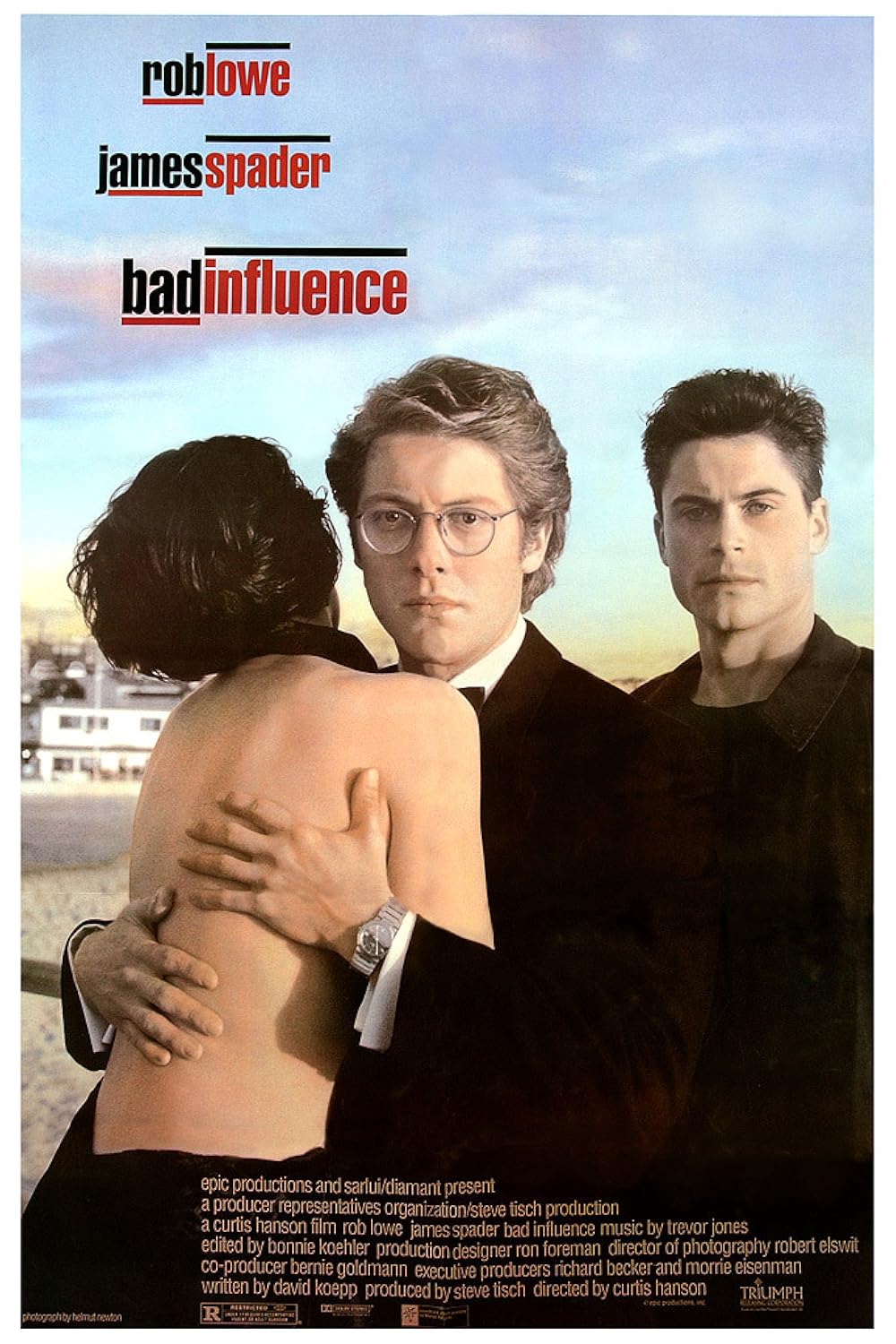
While he may not frequently receive the widespread acclaim he deserved, Hanson knew how to make a decent film, and part of that comes in the casting process. Whether choosing an actor based on their ability to play a particular kind of character, or the inverse (where he casts someone against type for the sake of experimenting with what they had done previously), his films are always well-composed when it comes to the performers tasked with bringing his world to life. Here, we have James Spader and Rob Lowe in the lead roles, playing parts that are almost the complete opposite of one another – Spader (who was more accustomed to playing smarmy, antagonistic individuals) is the charming and good-natured stockbroker who accidentally falls into a plot that sees him associating with an erratic stranger, played by Rob Lowe, who abandons his heartthrob image in exchange for one of the great villains of the 1990s. Casting these actors in roles that were not only unexpected for them, but also across from each other in such a dark and emotionally-complex film (both of them being some of the last remaining vestiges of the Brat Pack and its associated movements) makes Bad Influence all the more fascinating, since it sees a pair of well-known (and truly beloved) young actors playfully deconstructing their image in favour of occupying radically different roles, the result being a daring and provocative pair of performances that drive the entire film, adding humour and pathos where it was necessary. Without the spirited performances turned in by the actors, there’s very little doubt that this film would’ve been a much less-effective work, especially in how the characterization of the central and peripheral characters contributes to the entire premise of the film.
Despite its subject matter, Bad Influence is not the proverbial film about “good people doing bad things”, which is a trite and unconvincing topic that never really feels all that interesting when we break it down to its foundational components. Hanson has far too much respect for both the genre and the people in it to make yet another derivative thriller about how an initially well-meaning friendship morphs into one defined by extortion, manipulation and murder – and while it may not reinvent the genre (and can sometimes feel quite predictable, especially in how anyone who has even a slight amount of experience of the genre will be able to predict where it heads almost immediately, the moment Lowe enters the film), it is still a remarkably entertaining film, the kind that feels genuinely compelling for reasons beyond trying to accompany the main character on a journey that seems to have a grisly ending. The narrative allows us to get unfettered glimpses into the lives of these characters, who feel far more realistic than those in similar films, while still keeping the viewer at a distance – a haunting and genuinely terrifying psychological thriller with slight comedic undertones, Bad Influence is an astonishing film, and one of the more potent satires of its era, the kind of intense but well-crafted drama that terrifies and entertains in equal measure, allowing us to see the effect of societal pressures on someone without the foresight to question his own behaviour before stepping away, as well as someone who has gone far beyond that point, with the eventual collision between the two making for a truly mystifying but fascinating document of a time and place, as captured through the lens of someone with a profound interest in the darker sides of humanity, shading them in through his own unorthodox methods that made Hanson such a compelling filmmaker.
 The Postmodern Pelican