
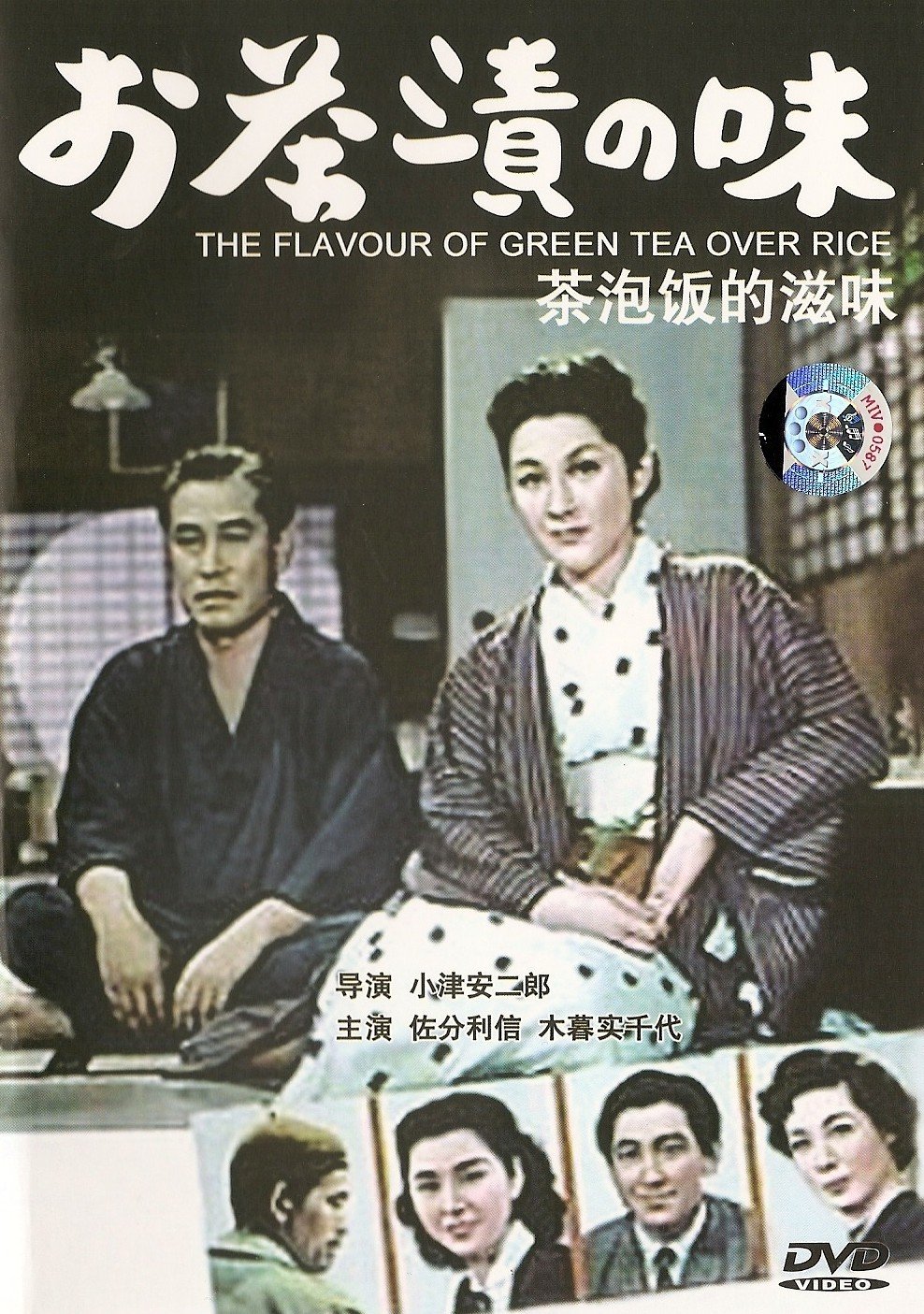
Many critics and viewers consider the peak of Yasujirō Ozu’s career to be Tokyo Story, an opinion that is difficult to go against, with the general consensus being that not only is this one of the prolific Japanese master’s finest works, but it is also one of the greatest films ever made. However, Ozu was not an artist who made works in isolation, and anyone who has seen a few of his films knows how they all exist in dialogue – and while Tokyo Story may be his masterpiece, every film he made leading up to it was something of a dress rehearsal for what was to come. The film immediately preceding it is one of the director’s most compelling, albeit one that isn’t often remembered outside of Ozu aficionados and those who are interested in this era of cinema in general. The Flavor of Green Tea Over Rice (Japanese: お茶漬けの味) is a fascinating film, a beautiful and tender combination of romantic drama and hard-hitting social commentary, supplemented by a few tender touches of comedy that tie everything together. As we’d expect, the film focuses on a few key themes, in this case the concept of marriage, and the cultural divide that existed in post-war Japan, and executed with the director’s distinctive simple but beautiful style, The Flavor of Green Tea Over Rice is one of his most delicate excursions into the human condition, a quiet meditation on the different perceptions of what a relationship should entail, and the extent to which different people are willing to surrender to their desires, especially in contrast to what is considered customary within their culture.
It seems redundant to mention that the foundation of The Flavor of Green Tea Over Rice is set firmly within the theme of tradition in opposition to modernity, since this is a subject that Ozu has rarely (if ever) failed to include in his films in some capacity. Speaking from a personal level, as beautiful as these dramas may be in their depiction of the human condition, what constantly drives me to seek out Ozu’s work is his method of representing his culture, making the most intricate details of Japanese society accessible to outsiders, while still clearly honouring his origins. He was a director who was obviously fiercely proud of his culture, to the point where his entire career was propelled by these simple, delicate glimpses into different sides of it. Even when dealing with the most controversial subjects (and as we have seen on occasion, Ozu is not afraid of infusing his films with some bleak conversations), there is a sense of patriotism – the director isn’t critiquing his country, but rather the small quirks that define society, challenging them without forcing us in a particular direction. The concept of arranged marriage in the 20th century is an abstract concept to western audiences, something that we associate with the most exotic cultures, a foreign practice that doesn’t hold much credence from a contemporary perspective – but as we see in The Flavor of Green Tea Over Rice, it is one that is far more intricate than we’d initially imagine, and Ozu guides us through the topic with his usual blend of quiet drama and sparkling wit, which makes for quite a captivating journey into the heart of this very personal subject.
Ozu’s perspective on love is always valuable, since he was capable of making very rich and evocative dramas that centre on the concept of falling in love – but he could also easily make one that looks at the opposite end of the spectrum, focusing on the challenges that come when a longtime couple find themselves drifting apart. The Flavor of Green Tea Over Rice is situated at the intersection of both, since it focuses on two couples – one a middle-aged married couple that find themselves growing bored with their docile domestic life, and another a pair of young people that are united not by their own common ground or a spark of attraction between them, but rather as a result of their parents arranging for them to get married. The film oscillates between the two stories, as well as allowing them to overlap consistently, each one informing the other and helping resolve the quandaries of both parties (in this case, the women in the relationship, as their perspective is the one Ozu focuses on). We learn best from experience, and the director curates two wildly different situations for the characters to work through, where they are divided by a generational gap at the start, which gradually grows narrower as they influence each other. It’s a fascinating approach that Ozu made use of often, using the concept of parallel lives to inform both the characters and the viewer on some deeper social or cultural subject that comes to fruition through his absolutely gorgeous method of unravelling these themes. It’s a deeply captivating and often melancholic way of storytelling, but it works with the tone of films and the stories they tell, which became one of Ozu’s most significant traits as a filmmaker.
As was often the case, Ozu uses the general narrative surrounding these stories to infuse his films with a slightly deeper meaning, and while The Flavor of Green Tea Over Rice is a film that looks at different kinds of relationships, this is mostly a story of a changing Japan, a subject that the director had an enormous interest in for his entire career. It’s difficult to find a film Ozu directed that didn’t feature some degree of commentary on how traditions are fleeting, and gradually being replaced by modern practices that threaten to overtake the customs that have always defined society. He often shifts between encouraging such changes, and lamenting them, depending on what exactly is being portrayed. In The Flavor of Green Tea Over Rice, the change is seen as positive, since it is giving women the power to control their own lives, rather than having it dictated by others, and as we saw frequently throughout his films, Ozu always had a penchant for exploring the growing independence of women in post-war Japan, and how their gradual ascent to taking charge of their own lives, rather than merely being fragile objects, is well-represented in his work. There are a lot of insightful discussions conducted throughout the film, especially in terms of the performances given by Michiyo Kogure and Keiko Tsushima, who command the screen and interpret Ozu’s dialogue with incredible precision, and it all leads to an absolutely stunning climax where every detail found in the previous two hours comes together in a gorgeous display of two women realizing they can step over cultural boundaries by taking charge of their own life – and in the end, regardless of the choices they make, they’ll find happiness along the way.
Understandably, The Flavor of Green Tea Over Rice has often lingered in the shadow of the director’s more notable works, since it is a relatively small-scale affair that doesn’t make any broad statements, at least not in terms of a surface-level analysis. It’s only when we’ve been immersed in this world that we realize the extent to which Ozu was able to venture in telling this story, where the smallest details resound with the most consistency. It’s a very interesting approach, albeit one that can sometimes be a bit too subdued, especially when he’s dealing with a subject as bold as romance. However, there is very little here that dissuades us from proclaiming this a minor masterpiece – Ozu’s writing and direction are as beautifully assured as ever, and the intimate, character-based details lead to a striking story of individuality in an era where adherence was paramount to one’s place in society. It’s a moving film, one that takes us on a lovely voyage into the heart of Japanese society in the years following the war, where mentalities were shifting alongside the reconstruction of a country that had both its physical and psychological strength challenged – and Ozu, being one of the foremost social critics in art at the time, recorded the experience of the post-war years with precision, honesty and a kind of subtle beauty that continues to remind us of the many reasons why he was the revered master we claim him to be to this very day, where his impact continues to linger, even in relatively small ways.
 The Postmodern Pelican