
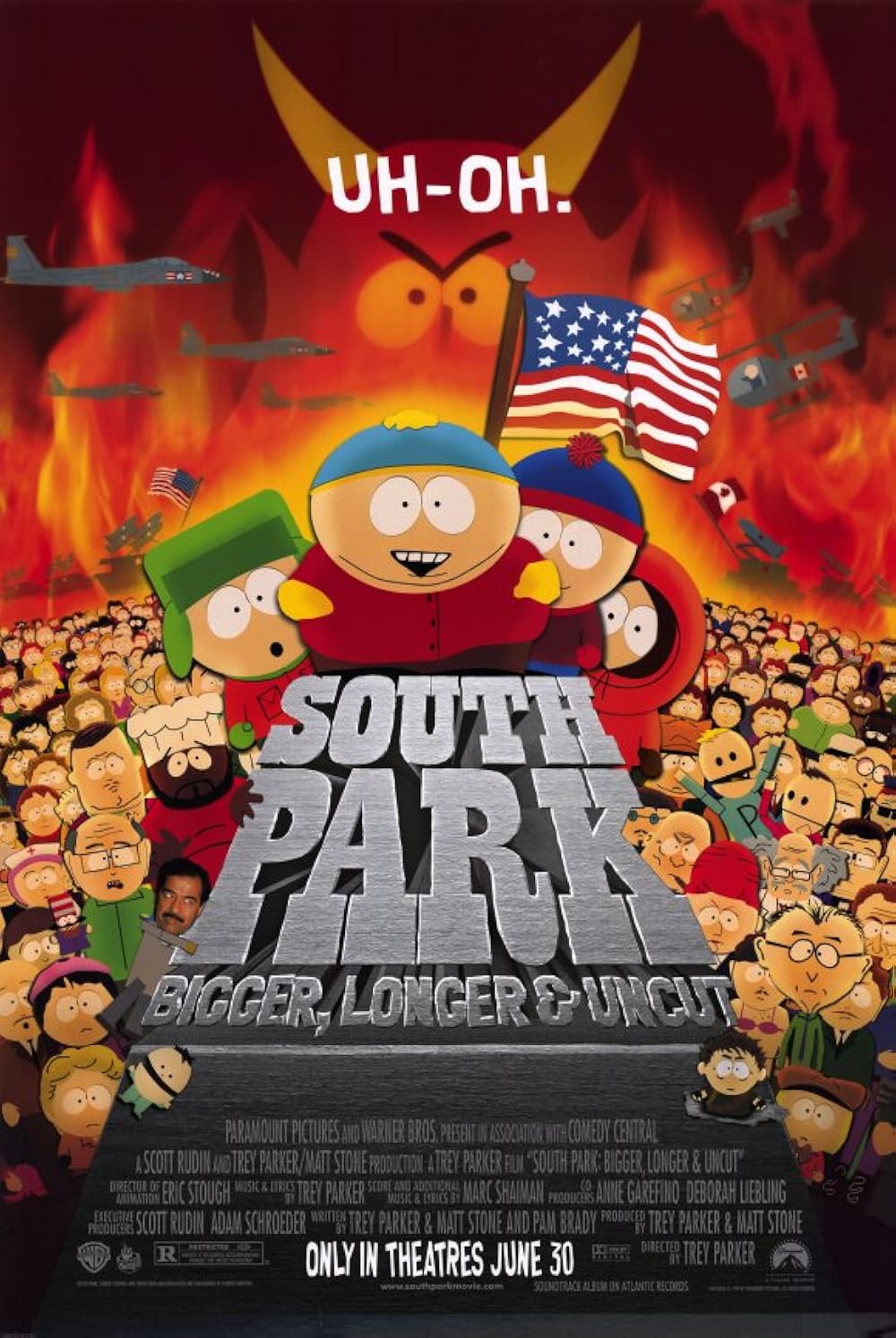
Whether you like it or not, South Park has left a lasting cultural impression on the world of entertainment, with the quirky animated comedy about four foul-mouthed pre-teens in the fictional titular Colorado town having been a constant presence for nearly a quarter of a century now. I am in no way a firm adherent to this show, being only a casual viewer (and one of those deranged individuals that far prefers the creators’ other work, particularly their more experimental projects) – but it’s foolish to deny that what they’ve done to the world of comedy has changed it in several ways, for better or worse. Like any long-running show, what starts out as subversive and unique eventually becomes part of the establishment, losing some of its edge, even if it doesn’t fall off the rails. However, at their peak, Trey Parker and Matt Stone were turning out some of the most impressive content in relation to this show, which culminated in arguably the best piece of media to feature this peculiar quartet. South Park Bigger Longer & Uncut is one of the rare animated films that has remained consistently brilliant since its release, being packed with surprises that make the first viewing such a revelation, and every subsequent visit into the world of this film all the more enthralling, since there are always new details to be found in the dialogue and visual design, which are carefully curated by the two creative minds behind the film. More than anything else, this film remains as funny today as it did when audiences were left at a loss for words in 1999, being one of the most biting satires ever released, which is a badge of honour for a film so deeply ingrained in conveying a particular message, and having fun in the process. Intricately constructed, but never self-serious in the way that imitators have tended to be, South Park Bigger Longer & Uncut is a triumph, and a film that has not shown even an iota of irrelevancy since its original release.
Animated films tend to age far better than their live-action counterparts, for a variety of reasons. Primarily, these are films that tend to be works of unhinged passion, with the process of animation taking longer than most films, and thus seeing filmmakers infuse every bit of effort into the creation. They also tend to be much more universal, since there’s a quality to seeing these scenarios acted out by abstract constructions, rather than real human beings, that fascinates us as filmgoers. In terms of South Park Bigger Longer & Uncut, the reason it has aged is much more simple: this is an undeniably funny film, one that touches on very potent issues, but filtered through the vulgar lens that has entertained audiences for decades now. The writing is razor-sharp, with every joke landing in the exact way it was intended – the brief but cutting remarks take us by surprise, and the longer jokes never overstay their welcome. South Park has rarely struggled with finding new methods of evoking laughter, and through the equal blend of contemporary references with more universal issues woven into the fabric of the story keeps it refreshing and funny, and always invites us back for another look, which can be even more rewarding, since (despite knowing all the twists and turns), we can still look forward to some of the more interesting elements of the story, which become the foundation of why South Park Bigger Longer & Uncut has remained such a cherished film, even amongst those (like myself) who are not entirely enamoured with the show that inspired it – it stands on its own as a perfectly strong effort that can easily be detached from the decades of content associated with this series, and while they may enrich the experience (especially in terms of specific references), this film is more than sufficient in understanding the deep appeal of the show.
Interestingly, South Park Bigger Longer & Uncut is not actually shocking for the sake of it, and in many ways actually makes good use of the restrictions (or lack thereof) imposed on them when transitioning these characters from television, which is dominated by very stringent rules on what can be broadcast. Film may not have such strict conventions, but there are guidelines, so part of the experience of watching this film is seeing how Parker and Stone manage to push the boundaries and present us with something we have never seen before, while finding new ways to circumvent the morals and standards that define contemporary American media, showing nothing but umbrage to it, but never being entirely mean-spirited, actually acknowledging the value of the opportunity they’ve been given. There are few films on which an R-rating is bestowed that is more hyper-aware of such a fact than South Park Bigger Longer & Uncut, which gleefully places the most foul language and excruciating insults in the mouths of its characters, centring the entire film around the theme of censorship, something Parker and Stone have been on a crusade against throughout their entire creative career, both individually and together. The film doesn’t just push the limits, it single-handedly destroys it, presenting us with a far more unsettling image of the contemporary media landscape, but one that is so entertaining, we don’t actually realize the extent to which it tackles some extremely dark subject matter – and any film that can feature the likes of Satan and Saddam Hussein as the main antagonists, and still not have them be the most unlikable characters, is clearly doing something radically different from what we had seen before.
Parker and Stone very cleverly design South Park Bigger Longer & Uncut as a musical, not only because this is a genre that many appreciate, but also since it allows them the chance to further satirize the media in a way that feels authentic, and most of us can easily understand. This works alongside the more provocative subject matter, because there is nothing quite as family-friendly as an all-singing, all-dancing affair (especially one that is drawing from the likes of Oklahoma! and Chitty Chitty Bang Bang as inspirations for its music), which contrasts sharply with how unsettling the material being explored is. Credit must be given to not only Stone and Parker (who are exceptionally talented when it comes to making music, as evident by both South Park and their other endeavours), but also to composer Marc Shaiman, who works with them to bring the world of South Park Bigger Longer & Uncut to life through music. So much of the music is unforgettable, which is a particular problem when we have one of these songs stuck in our heads, knowing that accidentally reciting the lyrics could result in leers and jeers in the best-case scenario. The decision to structure this film as a music was quite a good one, since it not only demonstrates how South Park Bigger Longer & Uncut was much more than a feature-length episode of the show, but rather something else entirely, a film that keeps the same controversial spirit of the source material, but working it through a larger set of ideas that ultimately make for a tremendously entertaining film, rather than just a longer version of the stories we would find on television, which was far more limited than film at the time in terms of what could be shown.
South Park Bigger Longer & Uncut feels less like an attempt to capitalize on the success of the original show, and more as a way of bringing these characters to the big screen in a way that feels genuinely interesting. It’s difficult to know who the target audience for this film were, since fans of the show will certainly get everything out of this film that they’d expect, while detractors will likely admit that, despite the show often going too far, the film is more measured, not avoiding provoking some really bizarre and polarizing material where it is necessary, but also not outwardly and intentionally courting controversy, at least not anything that it knew it wouldn’t be able to handle if the release backfired. As one of the few instances of a television-to-film adaptation, South Park Bigger Longer & Uncut that is actually doing something of value (rather than just replicating the pattern of the original series, albeit on a much larger platform), there’s always value in what we witness here – and as one of the most scathing commentaries on the nature of the media and censorship, the film is a remarkable satire that is far more than just foul language and inappropriate jokes – these elements are certainly present, but they’re far from distracting, working with the impeccable writing to create a hilarious and irreverent dark comedy that is governed by both a sense of unimpeachable fun, and a complete disregard for the status quo. If there was any further reason to celebrate the demented genius of Trey Parker and Matt Stone, you’d be hard-pressed to find a better example than South Park Bigger Longer & Uncut, a film that dares to offend, and has a great time doing so.
 The Postmodern Pelican