
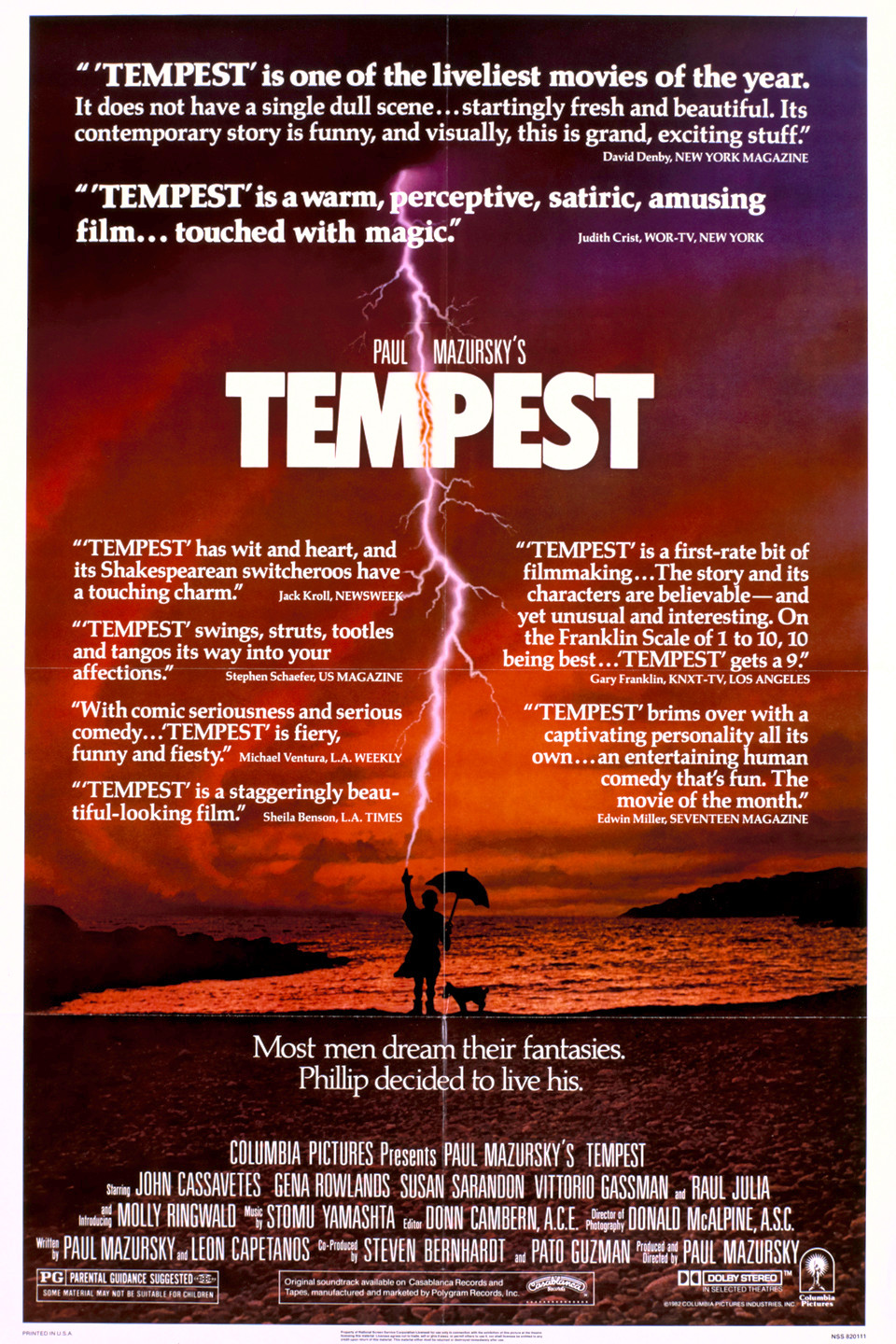
Throughout a career that saw him essentially redefining how comedy is made, particularly in his approach to looking at some very serious subjects through his off-kilter brand of melancholic humour, Paul Mazursky made some terrific films. One of the great stalwarts of a particular era in American filmmaking, he was not someone afraid to push a few boundaries when it was necessary, resulting in many cherished works that are consistently perceived as outright masterpieces. Yet, it’s those that don’t receive such effusive praise that are sometimes the most interesting, as is made very clear throughout Tempest, the director’s ambitious attempt to pay homage to the eternal bard himself, William Shakespeare, adapting the namesake play and bringing it to the modern era. Tempest is not the peak of Mazursky’s style – it has many of his distinctive traits (a very sardonic view of the everyday lives of coastal elites, the trials and tribulations of a couple engaged in a loveless marriage, scathing humour centred around inconsequential flaws in the socio-cultural system), but it is the director at his most audacious, taking The Tempest and reworking it into a continent-spanning odyssey that invites us on this very unconventional journey. Perhaps it isn’t as successful as one may have imagined it could’ve been – there are clear references to the fact that Mazursky thought he was crafting his masterpiece here, particularly in the scope of the production, which is normally reserved for those who genuinely believe what they are doing is destined to be their greatest work. However, Tempest is not without merits – in fact, it has them in abundance, it just takes a bit of work, and the ability to suspend disbelief and just follow the director’s vision, to fully uncover.
Few of Shakespeare’s works have been more prone to experimentation than The Tempest, mainly because it isn’t the story itself that is of interest to many artists, but rather its themes. It is far more malleable than many of the esteemed playwright’s other works, especially in how it doesn’t set a very particular set of narrative boundaries, instead focusing on the smaller details that surround these characters. As a result, Tempest is a different kind of adaptation, one that is much smarter and more insightful than more direct attempts to revisit Shakespeare’s work. Mazursky and co-writer Leon Capetanos approach the original text in a different way – instead of taking the source material and transposing it to the contemporary era, simply modernizing certain concepts along the way, they instead use Shakespeare’s work as a rough guideline, extracting only the most vague skeletal structure of the original play, and using it alongside a story that was inspired by it, rather than attempting to directly replicate the story in a contemporary setting. The details that remain common between the source material and Mazursky’s adaptation are therefore a lot more fun to find – they’re normally restricted to brief references, mainly coming about through interactions between characters. It also takes until the beginning of the third act (which is where the dramatic conflict begins to arise) to fully manifest, whereby the titular tempest is evoked by our protagonist. It’s an engaging and spirited retelling of the original story that proves that adaptations do not always need to be faithful, but instead can trade in strict adherence to the source text, granted they do something interesting with the material, and Mazursky certainly does not let this opportunity go to waste in any conceivable way.
While the quality of his films may sometimes vary, one component of Mazursky’s directorial vision that remains consistent is a particular aptitude towards casting his films exceptionally well, even when the roles are occupied by someone we may not have expected. In casting the roles of Phillip and Antonia, Mazursky chooses not only a real-life married couple, but arguably the most elegant duo in Hollywood at the time, John Cassavetes and Gena Rowlands. One of the rare late-career acting performances from Cassavetes in a film that he did not direct, Tempest is undeniably his finest work as an actor, rivalled by only perhaps the film he and Rowlands would make in a couple of years, which also served as his swan song as a director. Here he is liberated from the burden of having to guide the production, and turns in an absolutely spellbinding performance as the character who serves as an analogy for Prospero, the mystical recluse who is able to control the weather. Rowlands is just as excellent in one of the rare instances where she plays a more villainous character, her Antonia being a spoiled and resentful high society sycophant who will do anything for some combination of wealth and influence. As the leads of the film, the pair are as excellent as ever – and they’re joined by a formidable, international cast, all of whom are turning in stellar work. Raúl Juliá is a riot as the eccentric hermit who finds his tranquil island existence disrupted by these Americans and their disregard for the past, while Vittorio Gassman (considerably older, but just as dynamic as he was at his peak) is the wealthy businessman who serves as the catalyst for the events of the film. Tempest also features an early performance by Susan Sarandon, who is at her most beguiling, and serves as the introduction to Molly Ringwald, who was on the precipice of becoming one of the decade’s most iconic stars. For a film that has been as widely dismissed as Tempest, the cast is absolutely incredible, and they’re turning in excellent performances that perhaps warranted slightly more attention on the part of the narrative.
One of the few discernible flaws in Tempest is that it tries to cover far too many bases, and ends up squandering most of them. This is a film designed after an existing work of literature, which is dense enough to warrant an entire film on its own. Mazursky then undertakes the intimidating task of situating roughly half of the film in the immediate past, where there is a solid hour of exposition and background, which could’ve easily been elided to a considerable extent in favour of more time spent on the island, which is where the most rivetting material is found. Understandably, the director was aiming to showcase the contrast between the hustle and bustle of New York City and the tranquillity of a deserted Greek island – and the film almost entirely succeeds. However, we can argue that Mazursky, much like his protagonist, becomes too involved in the details, he misses the bigger picture – entire passages of promising material seem to have passed him by, which could’ve strengthened the film and made it an absolute masterpiece. At nearly 150 minutes, Tempest is already long – but had there been a bit more care taken in exploring some of these fascinating concepts, the director could’ve easily have justified an even longer running time if it meant more time is spent with these characters that we grow to adore. Mazursky is clearly aiming to make an existential epic, so it is bewildering why he stopped just short of actually achieving it – much like the characters peer down into the ocean from the jagged cliffs of this island, Tempest is aware of its greatness, but seems to struggle with making the journey towards it. None of this necessarily harms the film, but does prevent it from being the unimpeachable masterpiece it could’ve been, partially earning the ambivalent response it has received over the decades. However, this is still an excellent film, just one with a few minor flaws that were easily fixable.
Tempest has many compelling qualities, but the one that is most enduring is the sheer ambition that went into its creation. The fact that a film directed by someone with as strong a hold on the industry as Mazursky, boasting a cast of instantly recognizable stars from both the mainstream industry and the arthouse, and featuring some of the most beautiful cinematography of the era (credit must be given to Donald McAlpine for managing to capture both the urban landscapes of New York City and the achingly beautiful locales of a rural Greek island), remains relatively obscure is bewildering. Despite its narrative issues, which are barely notable enough to render this as anything close to a bad film, Tempest is about as entertaining as a film like this can possibly be, consisting of some of the most daring conversations of the era. The film questions issues surrounding marital troubles (and the inevitable divorce that come in many cases), the troubled relationship between parents and their maturing children, and the existential quandaries of someone seeking a better life for themselves, all come together to form this exquisitely beautiful, and outrageously funny, philosophical epic made by someone we’d not normally expect to engage in something so outwardly challenging (normally keeping these conversations to more intimate setting, as seen in his previous and subsequent work). It’s a striking film, filled to the brim with curious complexities that stir thought and evoke emotional responses that we may not predict from a mere cursory glance – and yet, it manages to be such a wildly interesting experiment, even when it isn’t operating at its peak, it is at least entertaining – and as we work through the film, we manage to make sense of the madness, perhaps even starting to feel that familiar plucking of the heartstrings that Mazursky does so well. All of this ultimately results in the steadily growing demand for Tempest to receive another evaluation, since it may be bold and brash, but it has ambition that is almost unmatched, and a sense of humour that makes it a film that possesses an abundance of potential, granted curious minds give it the chance it so wholeheartedly deserves.
 The Postmodern Pelican