
Any cursory summary of the career of Jim Thompson will doubtlessly mention how he was a writer who transformed pulp fiction into art. His particular brand of hardboiled, Southern-fried crime fiction has captivated audiences for generations, with the off-kilter humour, graphic violence and twisted narratives making them far more complex than other supposedly cheaply-produced works of fiction. It’s hardly surprising that Thompson’s work would make its way to the screen in some form, several of his novels being adapted into films in both the author’s native United States and across the pond in Europe, where his brand of rugged, detached masculinity seemed to strike a chord with a new wave of young filmmakers in the 1970s and beyond – as well as being seen as quite controversial, the overt violence (particularly against women) and often cruel, unforgiving demeanour making his work an acquired taste. The Killer Inside Me is one of the more recent adaptations of his work, and one that has continued to stir controversy over the course of the last decade since its release, and understandably so, since some of the imagery is extremely disturbing. The story of a well-regarded police officer who just so happens to be a vicious sociopath who will kill anyone he vaguely considers a threat (or even just a minor inconvenience) is not an easy one to tell, but director Michael Winterbottom, a very gifted filmmaker in his own right that has proven to be extremely versatile behind the camera, had his work cut out for him when adapting The Killer Inside Me and turning it into this fascinating but unsettling character study of a man who will not only kill without feeling an iota of remorse, but genuinely take pleasure in doing it, which is perhaps the most terrifying aspect of this entire film.
The Killer Inside Me is a film that exists not to entertain, but to intentionally disturb. This isn’t even a film that uses horrifying imagery as a way of infusing the story with some deep social commentary – this is a brutally violent film that presents us with an endless stream of graphic moments just for the sake of challenging what can be shown on screen. This is obviously a trait inherited from Thompson himself – as artistically-resonant as his work may be, it was always defined by his undying, nihilistic disregard for decency. He would write the most graphic and upsetting scenes just to push the envelope, since he knew that he was not writing for the broader population, but rather those who were drawn to these extreme depictions of violence, in a way that others would find themselves getting lost in the world of fantasy or science fiction, since it offers a moment of escape from reality. This isn’t to suggest those who find his work, whether his original texts or their adaptation, captivating are necessarily harbouring deep feelings of psychopathic rage – there have been many fascinating discussions had about the cultural obsession with true crime stories, and how the most grisly details presented in a vaguely artistic format can be absolutely riveting, even if any logical person would find it repulsive. This is where The Killer Inside Me succeeds, both in terms of the original novel and this adaptation, whereby Winterbottom seems to be actively protesting against the more toothless, subdued version made in the 1970s, and instead attempting to veer closer to Thompson’s original text, which is given the adaptation it deserves, the director taking this perverted tale of toxic masculinity and unhinged psychopathy, and turning it into an engaging and terrifying film.
While he may not often be celebrated as such (at least in terms of his non-comedic work), Winterbottom is a director with an extensive range, having worked in numerous different genres over the course of his prolific career in both film and television. The Killer Inside Me is not any different – and while the thought of a quintessentially British director adapting a work as deeply-rooted in American culture as those written by Thompson may be, it manages to succeed without any clear difficulty. Perhaps the fact that the director was an outsider factored into the reasons the film managed to be so effective, since there is always a sense of detachment – neither Winterbottom nor screenwriter John Curran (who had the unenviable task of turning the novel into a coherent screenplay) are interested in telling a story that allows us to get into the head of this killer. Unlike other films that attempt to present the world through the eyes of a sociopath, there is very little reason for us to know the thought process lurking in the main character’s head. Any attempt to justify his behaviour or actions would’ve removed the one component of the film that is most fascinating – we can never understand what drives someone to become a murderous criminal, especially one that seems to enjoy taking the lives of others. The Killer Inside Me never blames society for turning Lou Ford into a killer, nor does it try and humanize him and present him as someone who was the product of his environment. Instead, it shows how someone can lead a happy, fruitful life that is filled with simple pleasures, and still be filled with a vengeful desire to commit murder – it’s the rare kind of character study that truly embraces the villainy of the main character without ever once daring to present him in even the most vaguely positive light.
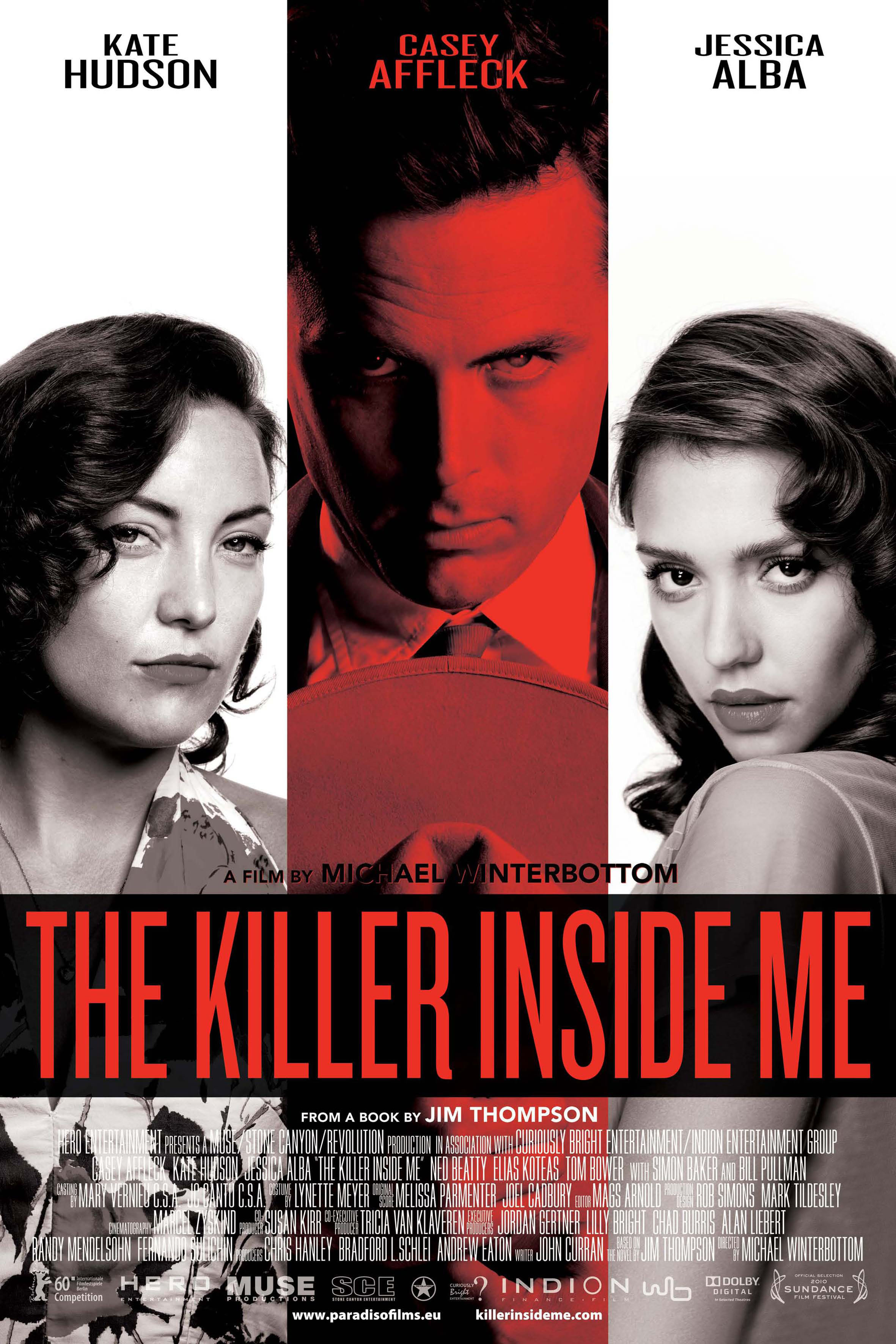
There have been many concerted efforts to bring The Killer Inside Me to the screen over the years, stretching back to when Marilyn Monroe and Marlon Brando were considered for the main roles – and while there is the aforementioned 1978 adaptation, it pales in comparison to the original text, lacking the nuance and interesting approach to the subject matter. Since then several major directors have attempted to make a more faithful adaptation, and numerous significant actors were sought out to play the leading role. Winterbottom took a risk in casting Casey Affleck, but one that worked out spectacularly – not only had Affleck played a murder named Ford before (in The Assassination of Jesse James by the Coward Robert Ford, albeit one where his actions were more understandable), but he possessed the vaguely menacing complexity required of the character. There is an enormous boundary between Affleck and the viewer, the actor making sure to adhere to the film’s approach to never allowing us to get too far into his head – there are glimpses of his psychological state, but it is all done from a distance, which helps the film establish a very clear and concise tone to its characterization of the main character. The rest of the ensemble is in service of Affleck – memorable performances from Jessica Alba and Kate Hudson (as Ford’s love interests and later victims), Ned Beatty and Elias Koteas set a firm foundation for the film’s weaving of a vivid tapestry of this small Texan town that is shaken by a string of murders. Winterbottom has a knack for working well with actors, and even in a film centred mainly on a single character, he extracts fascinating work from a strong cast, all of which are turning in solid performances that help bring this story to life.
Affleck may be the central character, but the star of The Killer Inside Me is the violence that underpins nearly every scene and informs much of the story – not a moment in this film goes by without some degree of harm coming to one of the characters, whether it be physical or psychological. It’s not the actions of Lou Ford that keep us interested, but his clear inability to move beyond this behaviour. Winterbottom does this through some very stylish directorial decisions – unlike the source material, which is written through a very gritty, rough lens, this version of the story is one that is actively attempting to be more traditionally profound in terms of its artistry, which actually works in favour of evoking the themes at the heart of Thompson’s original story, since the main intention of the novel is to show the metaphysical journey of this psychopath. The actual events in The Killer Inside Me are secondary to the more internal process that Ford is undergoing, and through the stream-of-consciousness approach, where there are far more questions than there are answers, and the explanation for many important events only come much later in the film, there’s an emphasis on looking at what drives this character to commit these heinous crimes, which only start to compound the more he finds himself enjoying the process. The Killer Inside Me is really only about a few moments in the life of Ford, the audience not knowing much about him or his domestic life outside of his relationship with a few other characters who turn out to eventually become victims of his crimes, whether directly or indirectly – and in presenting us with only a fragment of his enigmatic existence, there’s an even more complex sense of mystery lingering over this film.
The Killer Inside Me is a strange film – we’re intentionally kept at a distance, which seems to be an active choice on the part of the director and screenwriter, who take on Thompson’s fascinating text, but never try to decode the intentions that underlie his unforgettable imagery, instead focusing on a starkly objective foray into the demented activities of a man who, on the outside, appears to be a hardworking, upstanding citizen, but turns out to be a sexual deviant with deeply perverted desires, which eventually lead him to surrender to some homicidal tendencies that at first give him pleasure and help him satiate his lust for revenge, but eventually become the subject of his downfall, which the film intricately tracks. This is not an easy film to watch – Winterbottom, as entertaining as many of his other films may be, has never quite been against depicting the darkest and most subversive subject matter in vivid detail, and while the violence at the heart of this film is not graphic to the point of being needlessly excessive (always serving a purpose to the story, rather than just existing for the sake of shock value), the conditions in which it occurs is nauseating. As a detailed but profoundly disturbing character piece, The Killer Inside Me is a fascinating document, a provocative crime thriller that is executed with the same ghastly terror of a psychological horror, each new scene adding to the fear that resides at the heart of the story, which aims to be a purely fictional piece that dares to suggest that even beneath the most idyllic communities, there is always the possibility that dark secrets are hiding just out of sight.
 The Postmodern Pelican