
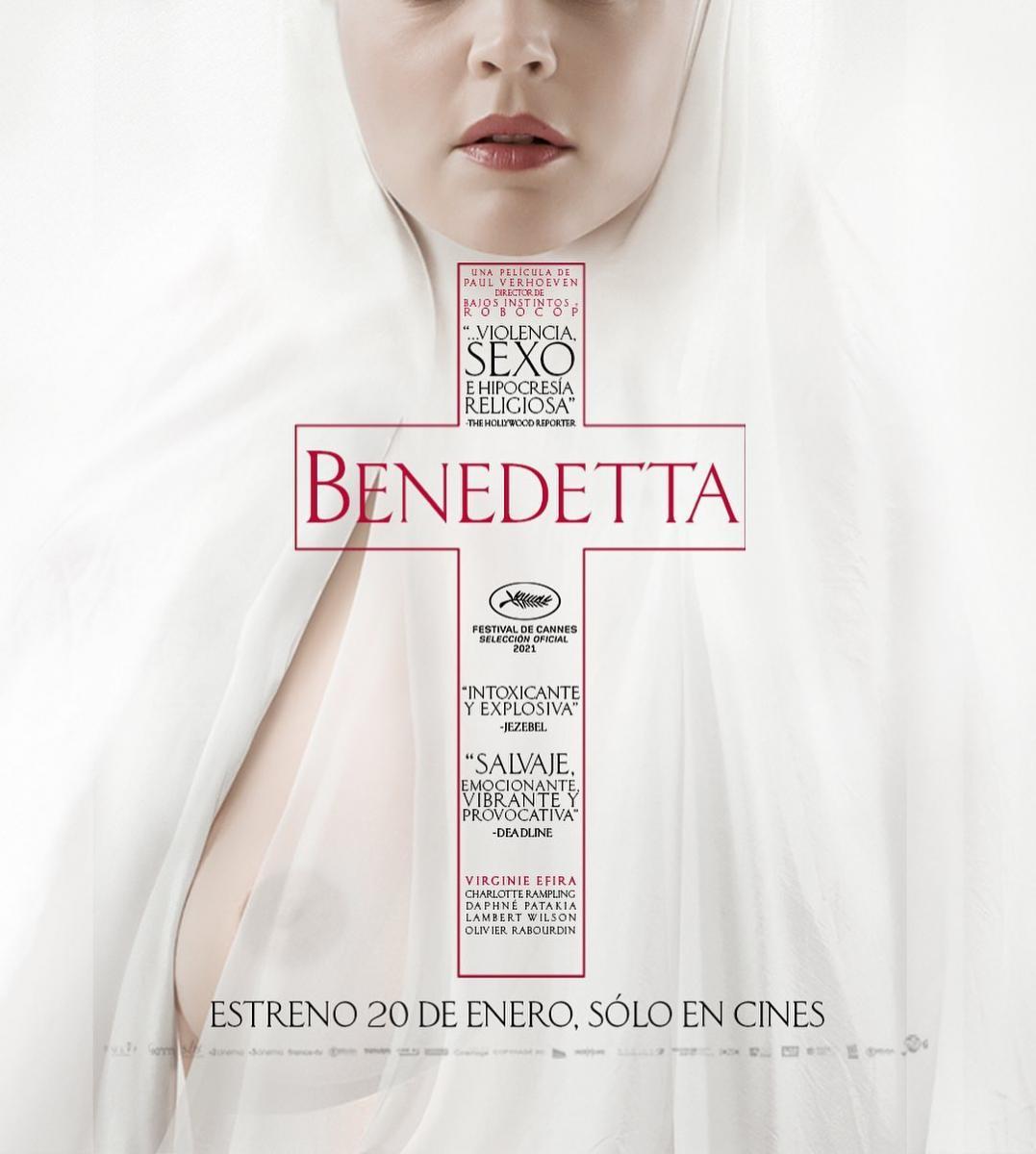
It’s difficult to think of a director better suited to tell the story of Benedetta Carlini, the 17th-century Italian nun who was reviled and nearly executed for her same-sex affair with one of her fellow sisters, than Paul Verhoeven, who has made something of a career out of controversial subjects. Benedetta’s decision to engage in this affair was certainly enough to make her the subject of scorn amongst both the clergy and the general public, should such a scandal become known, which is exactly the kind of narrative that Verhoeven, a well-known admirer of the controversial and self-identified provocateur, would find genuine potential in. Working with David Birke on the screenplay, which was inspired by the non-fiction historical text Immodest Acts: The Life of a Lesbian Nun in Renaissance Italy, the director tackles the story in a way that is very much true to his sensibilities, turning it into a daring and endlessly strange biographical drama that is as dogmatic as it is darkly comedic – and throughout the film, Verhoeven is playing with both form and content, using the historical roots of the story to comment on broader mentalities, transporting us back to the post-Renaissance era, where concerns surrounding morality and sexuality stood in stark contrast with the more liberal sensibilities that occurred behind closed doors – it was often those who preached the most strict and unforgiving adherence to dogmatic laws that engaged in the most sordid activities when obscured from public view. The director relishes in his ability to bring this supreme irony to the screen in a film that feels both epic and intimate, historical yet sensational – and more than anything else, Benedetta is a fascinating document of a time and place that has been lost to history, but not entirely from our consciousness, many of these themes still resonating in a way that hints at the very modern meaning behind the film, and its real-world inspirations.
Verhoeven is not a difficult director to admire, granted one has something of a sense of humour and an ability to separate his brand of off-kilter storytelling with genuine works of bad taste, since much of his career has made him out to be an artist who lacks a filter. Not a director that can ever lament being misunderstood, or having his work unfairly maligned, he has made a strong career out of telling the stories that others outright reject. Looking at his films, there are many that are not all that good, but even more that are quietly excellent, ones that may trade decency for spectacle. Benedetta seems primed to join these films – but oddly enough, Verhoeven seems to have grown tender in his old age, choosing to take on films only every few years, each one of them growing increasingly more sophisticated. While it may not be as classy as one would expect from a film based on religious events, Benedetta is unmistakably a more level-headed effort from the director, who doesn’t resort to the same set of bizarre choices made in earlier films. Perhaps the most revolutionary, boundary-pushing decision Verhoeven has made is taking a story like this one, and somehow making it elegant. It’s not entirely without its moments of forthright debauchery – after all, Verhoeven has a very distinct style that he would rather adapt to the specific social and cultural milieu than risk abandoning entirely, so prospective viewers can rest comfortably knowing that the great Dutch provocateur is indeed up to his old tricks once again, just filtering them into a more nuanced and interesting package than many of the films he did previously. This isn’t a sign that the director is suddenly becoming respectable – he’s still got the same penchant for the deranged, it’s just done in a way that is vaguely more sophisticated than we’d expect. It may take away some of the shock value we’d expect, but it seems like a logical move for the director – if a revolutionary artist remains active for long enough, they tend to become part of the institution, and not even Verhoeven could escape this inevitable fate.
Benedetta is a film built on contrasts more than anything else. Verhoeven takes something like religion, particularly 17th-century Catholic dogma, and places it in direct opposition to a ferocious exploration of sexual desire. This is already a film that has courted enormous controversy, which has only strengthened its message – the puritanical views expressed by a small fraction of the contemporary audience directly mirrors the reactionary violence of the characters in this film, who take opposition to the supposed tarnishing of the sacred law, despite being just as immoral as the act engaged in by Benedetta and Bartolomea, if not even more so. It’s a fascinating perspective on a purely social and cultural level – while it may not always be the most effective in terms of being dignified (despite never purporting to be), Benedetta has a lot of interest in the actual mechanics of the church, and how someone who is simmering with an insatiable desire, not only for the touch of flesh, but that of one of her fellow nuns, may have felt during this era, where the simple expression of desire was punishable by death. There is an element of the profoundly carnal that dictates this film, a visceral approach to how Verhoeven depicts Benedetta’s journey, from innocent young nun to possibly the most reviled woman in her small town, which is filled with some questionable characters. Consistently and without any difficulty, the film engages in a spirited dialogue between the holiest of texts and the people that dare to go against it, whether intentionally or purely through following their own interpretation of the scripture. It’s not the first time we’ve seen someone use the Holy Bible and its teachings as a rough guideline, rather than a genuine set of rules that must be adhered to with the most stringent dedication
We can wax poetic about how Benedetta engages the principles of the Roman Catholic church and their approach to morality, but we also need to remember that this is a film by arguably one of the most provocative voices in contemporary cinema. Verhoeven was never going to make a film that was entirely straightforward. Instead, he takes the original text and manipulates it into doing his own bidding, forming it into a deranged dark comedy, the likes of which quite simply do not exist outside of his own orbit. He may have imitators, but there’s nothing quite like a genuine piece of satirical drama written and directed by Verhoeven, whose interest in these subjects always finds a way to intermingle with his tendency towards the deeply erotic. Benedetta has a particularly strange tone – the balance between the desperately bleak realities felt by the characters in the real world, and the absurd fantasies that occur within the protagonist’s mind when she is experiencing one of her fantasies (where she has supposedly been told she is the girlfriend, then later wife, of Jesus Christ himself) is hilarious and bizarre. At first, we aren’t ever sure if we should be laughing, since it is executed with such candour, we are led to believe Verhoeven is absolutely serious. Only as the film progresses do we realize how much fun the director was having – he leans into the inherent absurdity, almost as if he was questioning why such films have to be serious. The 17th century may have been mired by misery caused by poverty, plagues and pestilence, but that certainly does not warrant a dour film, and in the same ways that he is engaging with the original text to explore the dark side of the church, he also creates an operatic comedy that contains a very sardonic sense of humour that may be surreal, but is entirely intentional, somehow adding an abundance of nuance to a film that only benefits from this offbeat approach to religious commentary.
Without strong collaborators, Verhoeven would not really have much of a career, with some of his actors turning in career-best work. I always admire when an actor can work with a director who possesses the bizarre sensibilities as Verhoeven, since they are likely fully aware of the fact that they’re going to be pushed beyond their limit, and as a result will very likely come to reach a new kind of performance. Virginie Efira has been rapidly making her way through contemporary French cinema, almost like a ferociously talented cyclone that exists purely to prove her gifts as an actress. Playing the titular role of Benedetta Carlini could not have been an easy task, since it required the actress to bare it all, both literally in terms of the physical depiction of the human body, and metaphorically, as we engage in an emotional tug-of-war between her innermost desires, and the conventions of the church in which she has pledged her existence. Efira is exquisite, giving one of her most spirited performances, finding the perfect balance between subtle and hysterical, making her interpretation of the character one defined by multiple layers. She’s supported by a terrific cast, all of whom are doing splendid work – but two in particular stand out, namely the legendary Charlotte Rampling (giving her best performance in several years) and Daphne Patakia, who plays the young and impressionable nun who incites the spark of lust in the otherwise dignified and puritanical Benedetta. Both are excellent, and complement Efira perfectly – like the lead, neither of them resort to excess in any discernible way, choosing to instead style their performances along the lines of what such characters would experience at the time, playing to the rafters very rarely, and only when it was absolutely necessary, leading to a strikingly beautiful, and honestly quite bewildering, set of performances that fit perfectly into this peculiar version of the world.
When it comes to genuine fondness for the material, Verhoeven is one of the most admirable artists – very rarely do we find filmmakers who become so invested in the stories they tell, you can feel the heart and soul reflected in their artistic process. He just has the unfortunate quality of finding the most perverted and deranged stories entertaining, which is why he has amassed something of a reputation for being a provocative filmmaker, someone who relishes in his ability to stir trouble by telling the stories that very few other artists were willing to do. Benedetta is one of the director’s peaks, a scintillating and fascinating historical drama that transposes his penchant for erotic imagery and subversive commentary into 17th century Italy, where we witness the trials and tribulations of a young nun who only longs for the most fundamental pleasures, which are vehemently opposed by her superiors, who see any craving for the flesh, same-sex or otherwise, as malignant and cause for punishment, even if it means execution. It’s a beautifully made film, the striking imagery and peculiar approach to visually composing the landscapes contrasting with the very dark and maniacal story. It’s both an artistically resonant film, and a work of art that pushes boundaries, which is precisely where the film thrives with the most consistency. Verhoeven is an absolute genius when it comes to cinematic depictions of debauchery, and Benedetta represents this renegade spirit perfectly. He may have transitioned to a more elegant method of storytelling, but the same filmmaker, who skirted controversy and delighted in shocking his audiences, lingers in every frame, making Benedetta one of the year’s most enthralling films, both on a narrative and visual level, as well as in how it just dares to be bold, disregarding anything that doesn’t help further our understanding of this strange but captivating parable of desire and its consequences.
 The Postmodern Pelican