
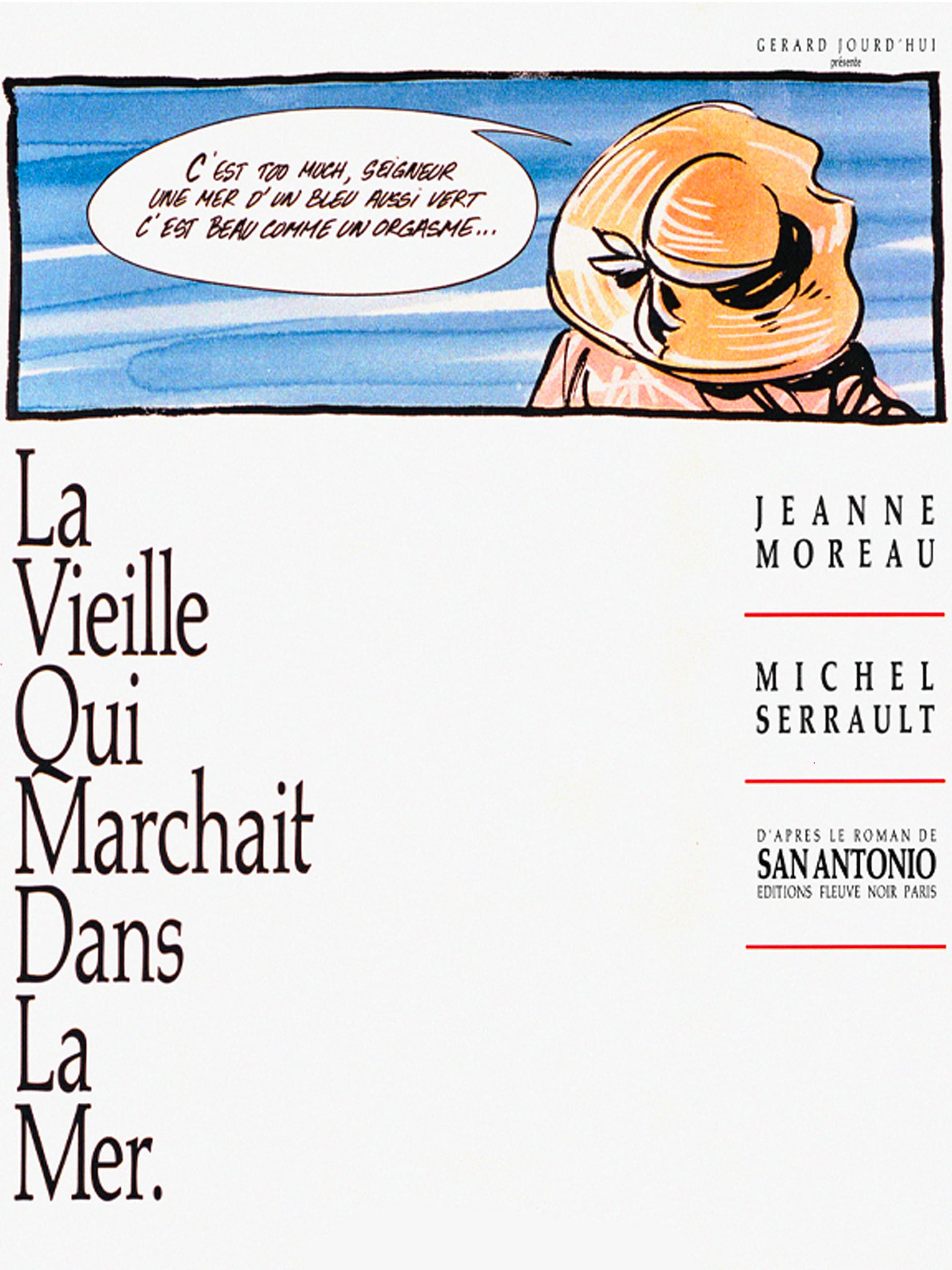
Romance, espionage, intrigue and geriatric humour – these are all themes that are found throughout The Old Lady Who Walked in the Sea (French: La vieille qui marchait dans la mer), the perplexing but utterly delightful comedy written and directed by Laurent Heynemann, who puts together one of the most charming films of the 1990s. Set in a variety of gorgeous locations throughout the French Riviera, the film tells the story of a mysterious woman, who goes only by the name Lady M (Jeanne Moreau), a notorious socialite who has clearly never worked a single day of her life (unless you consider making a living through thievery as a career, in which case she has been thriving for decades), and her two beaus – her longtime partner (Michel Serrault) who has stuck by her for decades, and a much younger lover (Luc Thuillier) she encounters on her vacation, both of whom are continuously roped into her elaborate schemes to steal the most expensive possessions from the elite that populate this area. Filled with the kind of gentle humour and beautiful filmmaking of many classic romances, The Old Lady Who Walked in the Sea is an oddly gripping blend of comedy and thriller that never avoids asking some of the more provocative questions, all the while being the epitome of old-fashioned glamour and elegance that is almost entirely synonymous with its leading star, who is giving one of her finest performances – and with some very clever storytelling details, and an overarching sense of quaint social commentary, the film manages to be a strangely multilayered story that is just about as deceptive as its main character, the director working closely with his collaborators to make this evocative, peculiar comedy that never tells us exactly where it is heading, but makes us excited about this elusive destination nonetheless.
The Old Lady Who Walked in the Sea is an absolute delight from beginning to end – the perfect collision between comedy and drama, Heynemann’s work here is truly impeccable, his style of balancing the variety of themes while still making something relatively simple being integral to the success of this bewildering but lovable story of an old woman doing whatever she can to hold onto the good life she has built for herself – perhaps through deception and trickery, but as she says, “it’s better to cry in a Rolls Royce than to be happy on the subway” (a direct reference to a similarly outrageous statement by hedonistic socialite and convicted criminal Patrizia Reggiani, who seems to be somewhat mirrored in the main character’s lust for growing her already enormous fortune by any means necessary). The film is based on a novel by the beloved French pulp fiction writer Frédéric Dard (often better known by his nom de plume, San-Antonio), and the director ensures that this already strange story is translated to film in a way that is actually quite constructive, while not losing the mystique of the original. Considering how much of this story depends on the director curating a particular atmosphere that simmers with both passionate romance and unorthodox humour, we have to praise Heynemann for being able to say so much without depending on too much exposition – telling the life story of the protagonist without dwelling on extensive explorations of her life, but rather focusing on developing her through inferences contained in the dialogue, assists massively in making The Old Lady Who Walked in the Sea such a breezy exercise in nuanced storytelling.
It would be pointless to refer to Jeanne Moreau as a legend, since those two terms are almost synonymous. One of the most prominent stars in the history of French cinema, and a defining figure in the Nouvelle Vague, Moreau was someone whose career is populated with iconic roles. The Old Lady Who Walked in the Sea is one that came very late in her career, but she is just as brilliant here as she was in her earlier years. This is a film that hinges almost entirely on Moreau’s infectious charm – she can command the screen so well, to the point where we don’t even notice anyone else, her charisma carrying the entire project and proving she’s just as much a star in her twilight years as she was earlier on, and that despite her more advanced years, she’s just as vivacious and energetic as she was when she was starting out in the industry. The Old Lady Who Walked in the Sea pays sufficient tribute to an actress who was undeniably one of the finest to ever work in the medium – every scene builds on her existent reputation as one of the great stalwarts of her nation’s artistic history, while still affording her the opportunity to reintroduce herself to new viewers, since it’s likely many may not have been aware of her stature in the industry prior to venturing into what is a very unassuming little comedy. From the first moment, it’s clear that Moreau was a legend, and that the director did an abundance of work to showcase his lead actress in all her otherworldly splendour – if it’s possible to fall in love with an actress all over again during one of her later career phases, Moreau in this film is one of the most exquisite examples, every moment she is on screen feeling like a revelation.
The Old Lady Who Walked in the Sea is the visual manifestation of a book one reads on holiday – filled to the brim with seduction, deception and a lot of off-kilter humour, all of which is baked in the sun that always seems to burn a bit brighter in these parts of the world. Like with any great novel, it’s easy to get lost in this film, Heynemann building a world of incredible mystery and comedy, which work in tandem in telling this idiosyncratic story. There’s a neverending abundance of curious details contained within this story – the characters are eccentric enough to be memorable, but not to the point where it becomes too convoluted or necessarily unrealistic, which is always a threat when it comes to stories that are defined mostly by their humour more than their more serious qualities. It makes this film effortlessly entertaining, since Heynemann is placing us in a world of absolute luxury (the locations used in this film are beautiful enough on their own to make this film worth watching – it’s not the first film to be set along the gorgeous French coastline, but it is certainly one of the most gorgeous), and allowing us the opportunity to explore it alongside the new addition to this small coterie of elderly criminals, who are motivated by nothing other than the continued addition to their wealth – and while the film does gradually become more sobering in terms of looking at themes of ageing and loneliness, it remains buoyant and entertaining. It keeps a consistently upbeat tone that allows the director to comment on the lives of these characters and their perpetual attempts to fleece only the wealthiest of their peers, which secretly masks their deep feelings of isolation, which becomes more clear as the film progresses, revealing some of the more complex subject matter that informed this otherwise exuberant tale.
It doesn’t take long to fall madly in love with The Old Lady Who Walked in the Sea, a film that makes it very clear early on that this will be a special kind of story, one centred on entertaining the audience, while still provoking some deep thought, which it does by way of sparking a few unforgettable conversations that don’t take over the film, but effectively complement it in a way that is always very meaningful. It’s not necessarily a groundbreaking film – it stays very close to conventions, and is frequently built on a few recognizable concepts that are familiar to any viewer with even the slightest knowledge of comedy. Yet, it’s at the moments where we expect this film to be very traditional that it proves to be subversive – the details embedded deep within it are worth watching out for, since they supplement the narrative and help develop it into an oddly daring comedy that is as scathing as it is heartwarming. Perhaps it plays by the rules too frequently, and could’ve benefited from taking a few larger risks along the way (the film begins to be crushed under the weight of its own quirkiness in the third act), but as a whole, The Old Lady Who Walked in the Sea is an absolute delight – it never takes itself too seriously, and is frequently invested in venturing beyond the confines of the genre, delivering an abundance of unique thrills and charming moments that help separate it from many similarly-themed films. It’s adorable, idiosyncratic and very entertaining, which is sufficient when it comes to a film that aimed to highlight the star quality of its lead performer, and just give viewers a couple of enjoyable hours, where the perfect collision of a charming story and gorgeous visuals make for an engrossing and meaningful experience.
 The Postmodern Pelican