
Here’s a novel concept – The House is one of the best horror films of recent years, and a film that is only going to grow in estimation as time goes on. Less of a singular film, and more the product of an artistic collective, whereby it is composed of three distinct films, each written and directed by a different director and telling different stories, only united by taking place in the same gothic mansion at different points in its history, The House is a remarkable achievement. Experimental but never pretentious, and consistently working towards a deeper understanding of a range of themes, the film is absolutely spellbinding – and it is all done through the most gorgeous stop motion animation, which not only adds to the incredible artistry of the film, but contributes a genuine sense of disconcerting absurdity to this film, which is drawn directly from the school of surrealism, taking its cue from some of the greatest works of fiction ever written. Simply listing the writers, painters and filmmakers that seem to be influences behind The House would take far too long, but needless to say, the impetus behind this film’s creation all goes back to the genuine curiosity the filmmakers had towards experimenting with time and space, keeping the physical setting the same, but changing the individuals that make their way through it – and whether human, beast or inanimate object, the heroes and villains of these stories make for incredibly captivating viewing, blurring the lines between fantasy and reality, horror and humour and life and death in ways that artists have been seeking to accomplish for centuries, and the fact that all of this is contained within this seemingly unassuming, quaint dark comedy makes it an even more remarkable achievement, and one that should be duly celebrated.
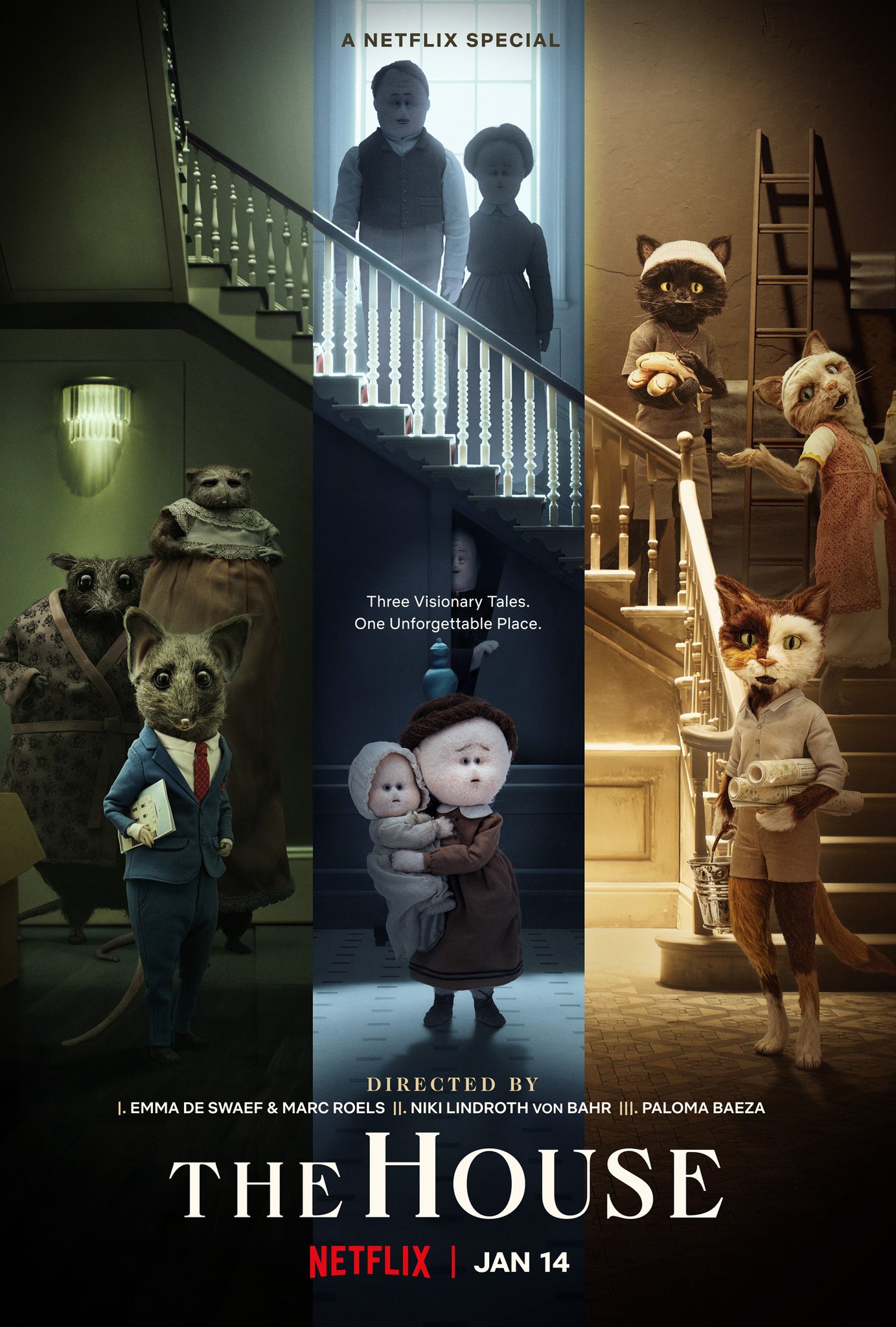
Horror is a difficult genre to write about, but a good way to start would be by looking at the stories individually. They don’t have titles, but rather are accompanied by arbitrary pieces of text that serve to differentiate them, while also hinting at the content of the story. “I: And heard within a lie is spun” is unsettling from the first moment, with the story (directed by Emma de Swaef & Marc James Roels) telling the story of a young girl in what appears to be the 19th century venturing across the countryside to live in an enormous mansion after a wealthy landowner purchases her family home, only to discover their new house is far from as comfortable as it would appear on the surface. The sensation of inescapable dread is present from the first haunting frame of this story, and the animators knew exactly how to create the feeling that we are trapped in this world. It isn’t what we can see or hear that scares us, but rather what is lingering in the dark, and the directors of the first story set the tone by showing that The House will be a film that profoundly terrifies us through manipulating reality in the smallest ways, making the familiar seem unrecognizable, and in the process creating a feeling that not even the most common parts of our lives are navigable once we find ourselves in this cycle of despair. It’s a profoundly unsettling story, and an appropriate litmus test for whether we as viewers can engage with the rest of the film, since its themes are more obvious and less difficult to decipher – if we can appreciate what de Swaef and Roels were aiming to accomplish with this story of a young girl gradually realizing that the world is as terrifying as her invasive childhood thoughts have led her to believe, then the rest of The House is bound to be just as effective.
Hypnotic and primarily driven by curiosity, The House is more than just an attempt to terrify, but rather to craft something foreboding and unsettling from familiar situations. None of these stories are more relatable than “II: Then lost is truth that can’t be won” (directed by Niki Lindroth von Bahr), about a luckless young rodent real estate agent who has invested his entire life in restoring the titular house for the sake of selling it to any of the wealthy people interested in purchasing property in what appears to now be a very affluent suburb of the country (jumping forward to the present day). While the first story was about physical entrapment, this one is heavily rooted in psychological torture, whereby the protagonist is held hostage by a pair of mysterious individuals that claim to be prospective buyers, but lack the common decency to actually undergo the actual purchase, instead forcibly taking over the house, and the young man’s life in the process. The stark contrast between the past and the present is the foundation of this story, as is the idea of maintaining social order. The use of humanised animals as motifs in the last two stories is an interesting one, since it lends the film a sense of abstraction, allowing it to filter very common ideas through the peculiar perspective of animals who act much like humans do, which only layers on the feeling of uncanny hopelessness that defines the film. The overt horror of the first story is replaced by a sense of foreboding danger, and some of the imagery here is quite literally nauseating, such as the arrival of the unwanted houseguests’ family members, as well as the depiction of how they entirely destroy this home, resorting to their animalistic tendencies, in one of the most disturbing 30 minutes of storytelling ever committed to film – and yet, it still maintains a sense of absurdist humour that eventually feels more terrifying than the actual depictions of psychological torment in the film.
Hope is not entirely absent from The House, but it does take a great deal of heartbreak to get there, as seen in “III: Listen again and seek the sun” (directed by Paloma Baeza), which is about a landlady seeking out the overdue rent from her tenants, who prefer to pay her in more abstract objects, which is initially an annoyance, until she realizes that once someone divorces themselves from the hustle of a capitalist world, and starts to appreciate the small beauties the surround them, life becomes a lot more tolerable. While still quite spooky, this story is far less horrifying, and instead intends to end the film on a more positive note, one that was absent from the absolutely unsettling conclusions to the previous two stories. Considering the two segments that preceded this one were about entrapment in some way, the idea of the film ending by a character sailing away from this house, as well as the deep history that comes with it is quite a unique way to conclude this stunning film. The way the film is structured may seem arbitrary, but it makes sense when we notice the shared similarities that underpin each segment. This final chapter is the one that ties them all together, and we genuinely feel as if we have traversed time with these people, each one of them seeming to be derivatives of the same abstract protagonist throughout, which has just taken different forms in order to look at this house and how history has caused it to change in some ways, but remain consistent in others. Every major theme comes to fruition in the final moments here, and all loose ends are tied up, even those that are a lot more ambigious (and thus require the viewer to be actively viewing each segment as both an individual story, and part of a larger project, the common elements between them being vague but meaningful once we start making the necessary connections), to the point where the eventual escape from this mysterious house feels as cathartic for us as viewers as it did for the main characters, each one of them making their escape in some way.
How one goes about describing the extent to which The House is a masterwork of contemporary horror is anyone’s guess, since it contains that elusive, indescribable quality that only the finest entries into the genre have. We don’t know why what we’re seeing is terrifying, but we certainly know that it resembles the parts of life that scare us, and have been doing so for as long as we have been conscious. The stop-motion animation evokes the feelings of nightmares, and the film is not afraid of inciting the sensation of unequivocal terror, since it carries a depth that may not be clear to viewers at first, but does leave us speechless once the intentions are made clear. The House was an ambitious project, and it would be foolish to think of it as yet another anthology that chooses a common theme and tells individual stories that are marginally related to it – each segment is insular but not isolated, and they build on one another, certain questions being asked and the answers given (albeit not necessarily in that order), and the common themes become stronger with each new narrative and artistic development. We simply can’t just look at The House as three individual stories, but rather independent components of a much wider project, which is a good way of looking at a lot of art. Using a familiar and easily understandable motif, and layering it with deep conversations that are as insightful as they are outright terrifying, the film is a remarkable achievement, and one that may take a while to fully amass the appreciation it deserves (since it is clearly ahead of its time in both theory and practice), but will undoubtedly carry a degree of importance as time goes on. It’s a film that may not be easy to notice, but once we have taken the time to sit through these three stories, unpacking its themes and engaging with the discourse it evokes, it will certainly be a lot harder to forget.
 The Postmodern Pelican