
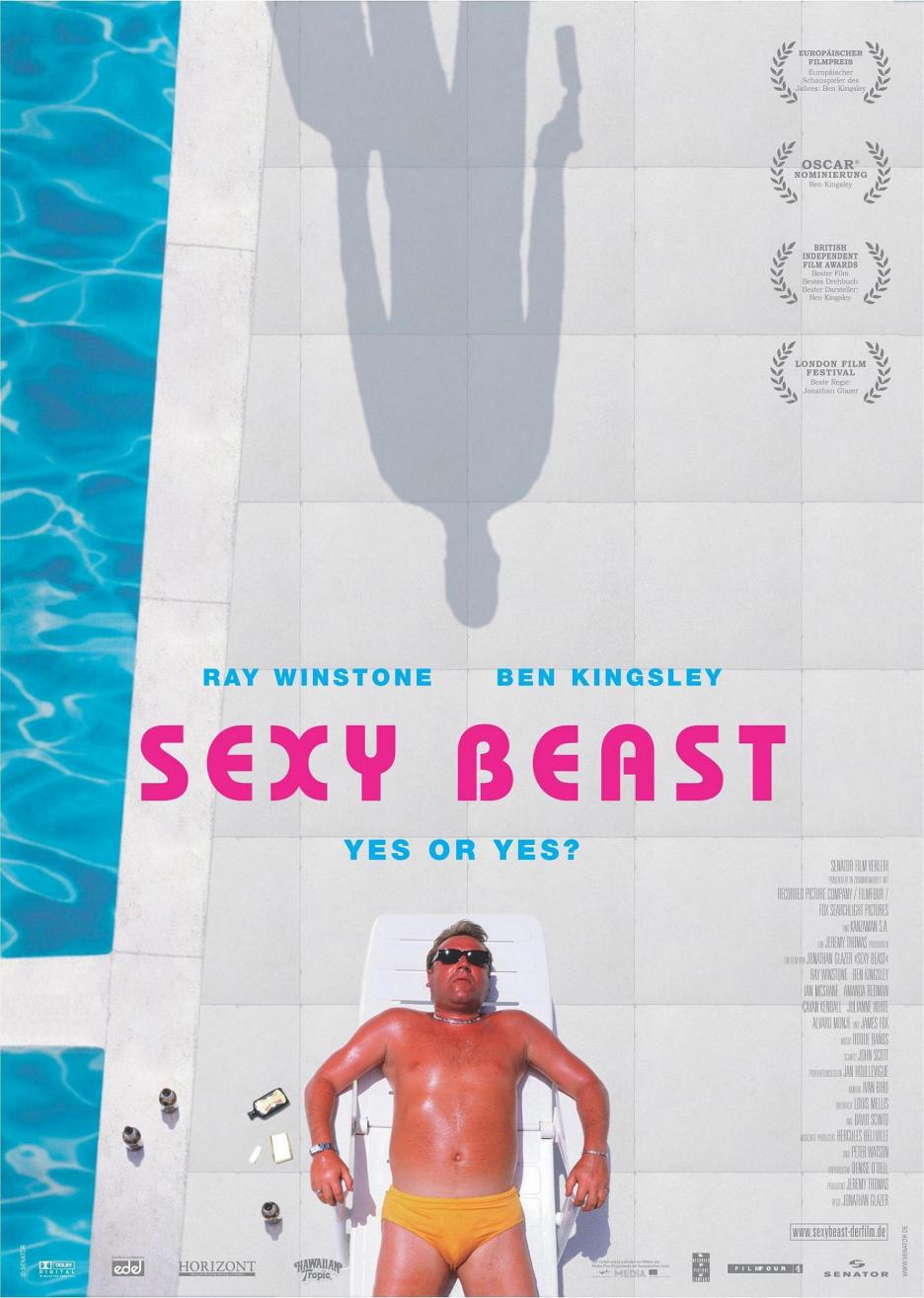
After many years of honing his craft as one of the most creative and reliable directors of music videos (an artform he helped define), Jonathan Glazer took the leap into long-form filmmaking, in the form of Sexy Beast, his feature-length directorial debut. He may have only made three films to date, but each one of them is distinct and celebrated in its own way – Birth is his most fascinating, Under the Skin his most popular – but it would appear wrong to say that Sexy Beast isn’t his crowning achievement of the trio, his subversive, pitch-black comedy being filled with the kind of irreverent humour and deeply unsettling violence that the director is both celebrating in reference to the films that inspired this one, and outwardly critiquing in the form of daring social commentary that takes a short while to actually clearly manifest. There is so much to embrace when it comes to looking at Sexy Beast, which is a film that is the rare combination of outrageously funny and exceptionally bleak, the oscillation between the two polar tones being part of why this is considered such an audacious debut – they just don’t make films like this in the mainstream, so being able to witness this brief spark of unhinged genius, even if only for a paltry 84 minutes (proving how some of the best films are those that arrive in the smallest packages) is quite a sensory coup d’etat. All things considered, Glazer made quite a splash with this film, daring to venture beyond the confines of a genre that was considered quite stifling in both the extent to which it would take the narrative, and the general methods of telling these stories in terms of both direction and artistic technique, turning this film into one of the most ambitious and brilliant pieces of subversive storytelling of the past two decades.
If anyone was going to take the gangster film genre and turn it entirely on its head, it would absolutely be Glazer. Sexy Beast is a project heavily indebted to the gangster genre, paying tribute to the past few decades of gritty, violent films centred on British criminals who will go to any lengths to get ahead of their rivals. Yet, it’s never clear if Glazer is enamoured enough with the genre to be inspired to make a film that pays homage to it, or if he was frustrated with the problems plaguing the genre to the point where he was impelled to show how these stories can be told without needing to resort to the same trite conventions. The most likely answer is that both can absolutely be true – and throughout Sexy Beast, the director showcases his keen awareness of the intricacies of the genre, referencing many of the crime thrillers that populate British cinema since the 1950s, while evolving their themes to fit into the new millennium’s desire to experiment. Considering this is a heist film in which the actual act is confined to a single 10-minute long montage right at the very end, with most of the action taking place in a luxurious Spanish villa and consisting of a series of discussions around convincing a retired criminal to take part in this heist (which would normally be contained to the first few minutes of a more conventional film), it’s clear that this film is far from traditional. It references the genre from which it was built – despite aiming to challenge the conventions of the gangster sub-genre, the film has its foundation firmly within traditional aspects of crime thrillers – and is often quite self-reflective in how it handles the nuances of a genre that many view as just being “rough and ready”, but actually is capable of a lot of introspection when some thought is put into the storytelling process.
Sexy Beast aims to represent the best that the gangster genre has to offer, so naturally one of the most recognizable actors to ever make his way through these films was cast in the lead role – with some arguing that he is the titular “sexy beast”, one of the film’s many hilariously deranged details. Ray Winstone is an institution all on his own – very few actors have built a career out of their gruff, working-class sensibilities as much as he has, with his brooding anger, salt-of-the-earth persona and sense of always being only inches away from brutally annihilating anyone who gets into his way being both a blessing and a curse for an actor who is certainly extremely talented. He has been able to make a living out of playing characters that are not particularly easy to portray, the authenticity he brings to his roles allowing him to never be short of roles. However, it has also typecast him into the same kind of character, to the point where his occasional diversions from playing such crude and violent characters can seem quite jarring. Sexy Beast is the perfect intersection between the two, serving as a direct response to those who believe that Winstone couldn’t do more than just play murderous gangsters. The best rebuttals are those that are the most obvious, and in casting him as the exact kind of character he normally plays, but filtering it through a lens of total self-awareness, Glazer is giving Winstone the role of a lifetime. Contrast this with the chameleonic Ben Kingsley, who fits perfectly into this world as the foul-mouthed, sinister Don Logan, who is the embodiment of evil – and while many gangster films are driven by the spectacle, Sexy Beast finds its brilliance through the characters, who are a lot more complex than just pawns in the broader narrative.
The aspect that makes Sexy Beast so unforgettable is the perpetual sense of not knowing where it is heading. Glazer understands how powerful the element of surprise tends to be in the filmmaking process, and how it is an excellent narrative tool when used correctly. The fact that Glazer managed to do this through mostly dialogue (since the vast majority of this film depends on a series of conversations conducted between characters) just further bolsters the clear and concise skillfulness that persists throughout the film. There’s a masterful sense of accomplishment that comes when someone can extract genuine thrills from a few characters talking – and the balance of both wildly funny situations (especially on behalf of Kingsley’s menacing criminal – he is both hilarious and terrifying, one informing the other in unexpected ways) creates a varied environment in which the director is able to insert some brutal social commentary in between moments of painfully funny awkwardness, carefully pulling apart the layers of the genre that often takes itself too seriously. Naturally, the director is far from mocking the genre, since these films are always thrilling and entertaining – he’s just adding a few layers of acerbic dark humour onto the existing conventions as a way of being both challenging and insightful, which is a remarkable change of pace. It’s difficult to describe exactly how Glazer manages to do this, but it directly spurred a new, revolutionary movement that saw more unique tales of criminal behaviour.
Somehow, between Glazer and Guy Ritchie, there was a concerted effort to bring more humour to the gritty proceedings of the gangster film. While Ritchie’s films are more explosive and entertaining, Glazer didn’t lag too far behind, since Sexy Beast is an astonishing achievement – it is economical in terms of using its time wisely (never overstaying its welcome or spending too much time on exposition, one of the major flaws of the genre), and manages to be quite a compact thriller that deftly blends comedy and gritty thrills. Taking a more surreal approach to these stories, which blend with the darker subject matter, Sexy Beast is rarely anything other than thoroughly entertaining, continuously pushing boundaries while never falling behind when it comes to offering the audience the genuine excitement required of a good, solid thriller. It may be filled to the brim with surprises, and some viewers may be expecting an entirely different kind of film, one that is far more traditional as opposed to a bold effort to detach itself from the genre that inspired it, but it’s impossible to not find something worthwhile in this film, which carefully strips away the layers of the mythology surrounding gangsters, and gradually becomes an absolute triumph of both form and content, which is always a worthy combination when it comes to challenging the artistic status quo and leaving an indelible impression – and helping usher in an entirely new movement is only an additional benefit of the many risks taken in crafting this unforgettable film.
 The Postmodern Pelican