
Somewhere in residential, working-class Tokyo sits a power station – the community surrounding it have been engaging in a spirited debate about how many chimneys the factory has. The opening narration to Where Chimneys Are Seen (Japanese: 煙突の見える場所) states that it all depends on where you are standing – for some, only one chimney can be seen. For others, it’s two or three. For a select few, all four of them are visible – and it’s all a matter of perspective. This is the foundation for this magnificent drama by the perpetually unheralded Heinosuke Gosho, who spent so much of his career crafting these delicate, insightful glimpses into the human condition, while only receiving marginal acclaim throughout his life, which was obscured by the similarly-themed works by many of his contemporaries who are more well-known when it comes to Japanese cinema. However, Gosho was never someone who would sit in glum resignation, instead producing an array of fascinating and meaningful dramas that touch on deeper issues, with Where Chimneys Are Seen being amongst the best of them. Simple but effective in the way only the strongest social realist films produced in Japan in the aftermath of the Second World War, the film is a powerful manifesto on community values and the importance of family in propelling one forward in life, told with precision and honesty, likely garnered from a long career of seeing the world change right in front of him. In short, Gosho made something of a small-scale masterpiece with this film, a relatively straightforward premise with strong social and cultural underpinnings that make it so much more interesting than we’d imagine based on a cursory glance, which is often the most pleasant surprise when it comes to this brand of simple social realism.
Classification has always been an interesting subject when it comes to this era of Japanese filmmaking – some consider Where Chimneys Are Seen to be a hard-hitting drama, while others see it as a broad comedy with a lot of depth. Regardless of where one stands on the divide (which is a lot more difficult to discern, since the tone of the film can sometimes be quite polarizing, which seems to be have been an intentional choice on the part of the director), it’s not only the message that the film is intent on conveying, but the manner in which it does it. Social realism has often been an area of artistic expression that has lent itself to considerable debate – and Gosho, in his capacity as someone whose filmmaking career was built on very intimate stories about everyday life, had his work cut out for him when telling this story of two intersecting couples drawn together by the presence of a baby, which unlocks some deep-seated insecurities and anxieties in both of them, in terms of the present issue of solving the mystery of who the baby belongs to (and when they figure it out, going in search of the true parents), as well as their own personal quandaries, which are essentially embodied in this child, who becomes something of a mascot for their fragmented lives. Gosho uses these strange but captivating scenarios as the basis for a deep and insightful exploration of society, taken from four very different perspectives – and he makes sure to take advantage of the inherent comedy that comes with such a story, as a way of complementing the very serious conversations that come about in the second half. Where Chimneys Are Seen is a marvel of tonal balance, with the director ensuring that he is producing something that is both informative and insightful in equal measure.
Driven less by a single narrative plot, and rather by a series of intertwining stories that take place in the lives of the four main characters (and a variety of other peripheral individuals that are woven into the story, being only vaguely important in terms of the community-based narrative), Where Chimneys Are Seen is an episodic film about community. Gosho’s narrative design of the film is something to behold all on its own – he’s not focused on one particular side of the story, but rather a variety of vignettes in the lives of these characters. Considering the two couples are at very different points in their lives, both individually (as working-class people in postwar Japan), and in their relationship to one another, it does lead to some bewildering plot developments, with Gosho forming the film around each individual moment, rather than being too concerned about the broader progress of the story – some scenes are effervescent and about as charming as a sweetly-sentimental comedy about everyday life can be, while others can sharply deviate into the realm of being exceptionally bleak, with scenes depicting attempted suicide, or featuring conversations about death and suffering, being just as common. For unsuspecting viewers, Where Chimneys Are Seen can be quite a polarizing piece of filmmaking – but Gosho isn’t a director who relishes in challenging the viewer beyond what he knows we’re comfortable with – and while he does incite a series of deep discussions, most of what propels this film are more universal conversations, whether it be on the subject of marital troubles, motherhood or simply the experience of falling in love, whether for the first time, or being reminded all over again about why one chose to be with a particular person. It’s a simple but effective drama with a lot of heartful discourse, which is often the difference between the success and failure of such a story.
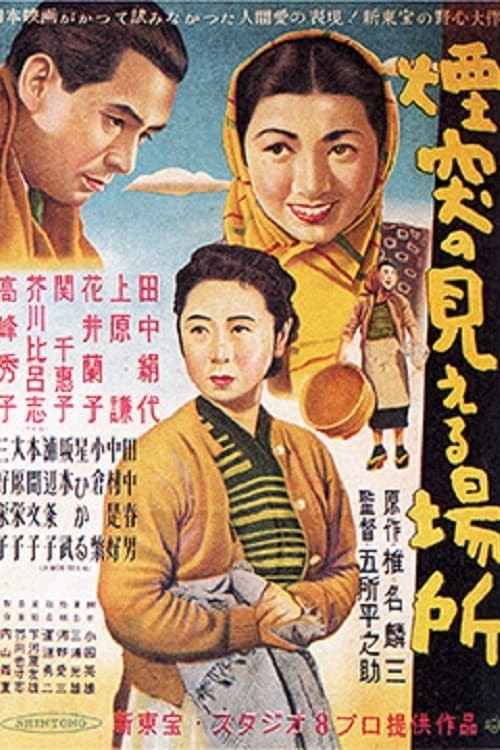
The characterization is what sets Where Chimneys Are Seen apart from many similar films – Gosho is just as focused on deconstructing the protagonists and their lives as he is presenting a deep and wide-ranging portrait of post-war Japan. Each one of these characters is memorable, a result of both the director’s keen observations on what constitutes a fully-formed individual, and the strong work being done by the actors, the central quartet being amongst the finest actors working in Japan at the time. The older couple is played by Kinuyo Tanaka and Ken Uehara, who portray characters at a very awkward stage in their lives – they’re old enough to be nestled comfortably into a lifelong relationship, but still have some remnants of youth that make them doubt whether they have made the right decision, which is called into question frequently throughout the film, and becomes the central tension for much of the story. The younger roles are occupied by Hideko Takamine and Hiroshi Akutagawa, who are much younger, and represent the more youthful inexperience that serves as the secondary theme of the film. These are four unforgettable performances from actors who understood the assignment they were given – they’re playing characters that aren’t necessarily archetypes, but they do represent four different kinds of individual that were common in society at the time. Where Chimneys Are Seen is worth our time almost entirely to see the interplay between these actors and how they interpret these characters, building their interpersonal relationships to such a point that we can’t resist becoming deeply invested in their lives, watching in awe-inspired amusement as they grow to understand one another more through the lens of a particularly tricky crisis than they ever had before.
Where Chimneys Are Seen is such a captivating portrait of humanity, delivered with an authenticity that we don’t often find so beautifully conveyed. Japanese cinema had a tendency towards irrepressible candour, frequently presenting life as honestly as possible. There’s very little reason to hide the truth behind a sheen of heightened reality (even though many postwar satires produced around this time did very well in exposing the hypocrisy of a society in flux), and we’re naturally drawn to more resonant demonstrations of life. The story itself is interesting, but it’s not the most important part of the film – the plot becomes secondary once we realize that there is more depth to the conversations that occur adjacent to it. Gosho is emphasizing the importance of community throughout this film, filtering nearly every major event in the story through the perspective of these four characters, and their relationship to one another and society as a whole. The film is never particularly overwrought with its social commentary, and while it does inspire some more difficult conversations (especially in some harrowing scenes where it becomes quite bleak, but never exploitative or unnecessarily dark), it has a good grasp on the tone, enough to allow Gosho the freedom to insert some much-needed humour in the more haunting situations, creating a deft but meaningful balance between the different aspects of the story. It’s a fascinating portrait of humanity, made with a razor-sharp wit and a very deep emotional connection to the story – and it proves what an immense talent Gosho was, so much that even something as relatively simple can be considered a major work of social realism at a time when such stories were at their peak. The more we come to learn about this world, the further we want to explore it – and anyone that can make something so straightforward, but still inspire nothing but deep and unflinching admiration and awe-inspired wonder, is immediately worthy of their place in the cinematic canon, which certainly applies to Gosho and his incredible ability to evoke nothing but undying compassion and gentle humour from nothing but the world around him.
 The Postmodern Pelican