
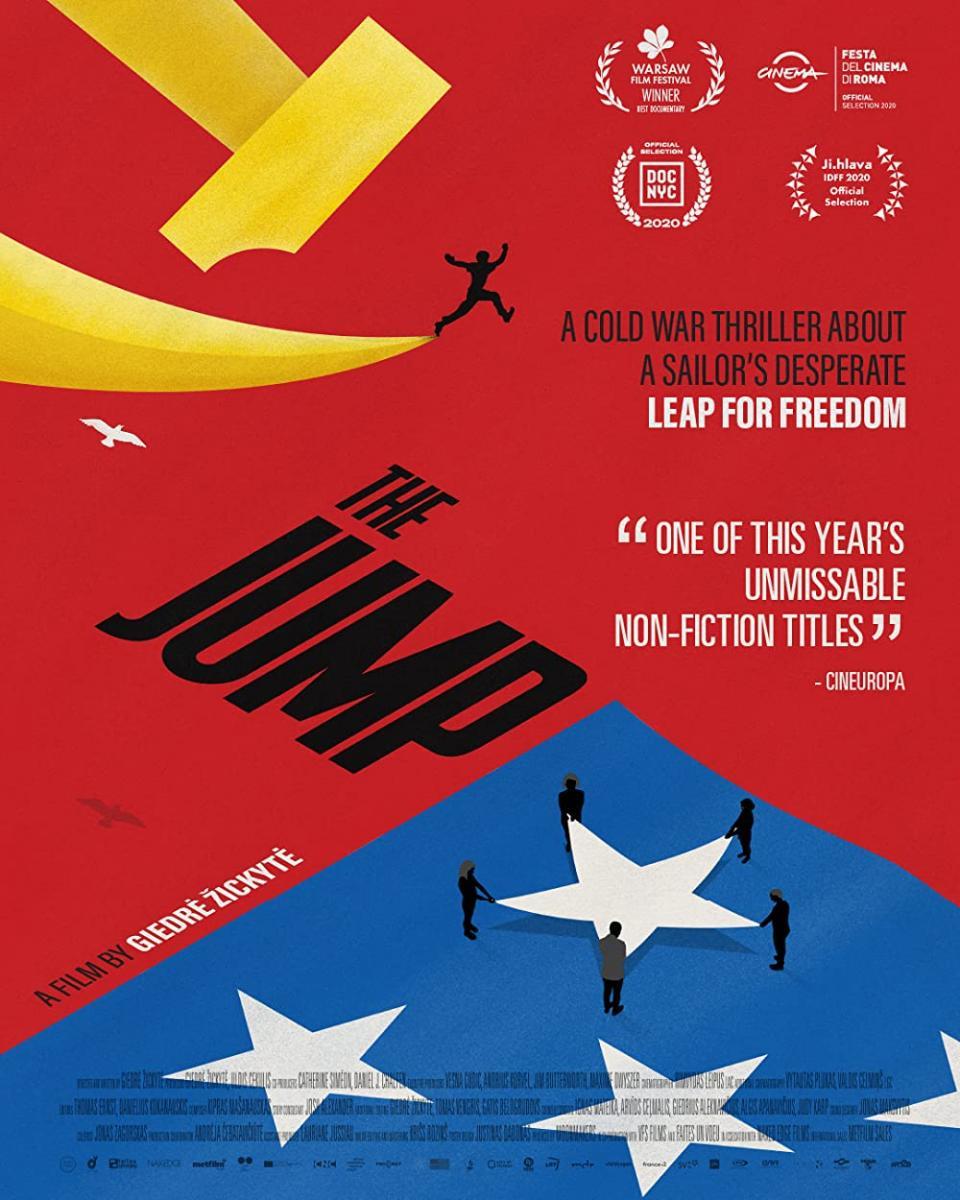
Is there any story that embodies the idea of the American Dream better than a Lithuanian fisherman trying to escape Soviet rule by literally leaping across the open waters of the ocean from one boat to another, in the hopes of defecting to the United States? What sounds like an amusing premise for a charming comedy is actually the reality for Simas Kudirka, whose valiant attempts to escape from an oppressive system made headline news in 1970, with both his literal “jump” from the Soviet vessel on which he was working to the United State coast-guard cutter making him a folkloric legend, and his immediate return back to his country’s custody (after which he was thrown into a gulag for over a decade) adding a shroud of mystery to his life. His story was previously the subject of a dramatic re-enactment on a cheap television movie in the 1970s, but has mercifully been given a more precise treatment on behalf of director Giedrė Žickytė, whose clear passion for Kudirka’s story makes The Jump a fascinating and consistently provocative documentary that looks deep into both this legendary attempt to escape, and the aftermath, in which the subject found himself faced with consequences the likes of which he had never seen before. The Jump is the kind of documentary film that proves how reality is often stranger than fiction, and with a precise directorial vision at the helm, a consistent approach to conveying its message, and an abundance of heart, the film manages to be quite an enthralling experience, a charming but heartbreaking ode to one man who managed to escape after a while, while reflecting on those who sadly were not that fortunate in finding a home outside of an oppressive political system.
The Jump functions best as a film about freedom, using the fascinating story of one individual in particular to convey the plight of millions of people who suffered under the Soviet Union. It’s not often we find films that look so deeply into the impact of the Soviet expansion in Lithuania, a nation that has had as much of a storied history as any other European country during those tumultuous years, but hasn’t found a seat at the global cultural table when it comes to exploring the different events that occurred in the country during this period – they certainly have made some terrific films, but they’re sadly underrepresented, especially in terms of their journey in the aftermath of the Soviet occupation. Žickytė thus has the unenviable task of making a film that would be seen widely, far beyond the confines of her native land, and as a result her approach was one that needed to be both respectful to the individuals involved in the story, as well as interesting enough to capture the audience’s attention, informing and entertaining us in tandem. It seems logical that the story of Kudirka’s escape would be turned into a documentary – while it is thrilling enough to warrant a dramatic recounting in the form of a narrative film (especially since the biographical film from 1972 leaves a lot to be desired in terms of honouring his story, condensing it into a fascinating but otherwise conventional wartime drama), the nuances would be lost had the director not made use of more authentic content. Forming The Jump into a documentary was a bold but understandable move, since it allowed Žickytė access to genuine materials, such as news reports and real footage that helps strengthen the story, and adds layers to what was previously an amusing piece of war-based folklore, gradually forgotten by time, but mercifully resurrected by this film.
However, the most impactful part of The Jump comes in how the story is told by the subject himself. Kudirka is placed front-and-centre throughout the entire film, most of the time being spent hearing his memories of this period, including the events leading up to the titular “jump”, and the aftermath, which is in many ways far more fascinating than the actual act that indelibly placed him in the history books as one of the many Cold War-era heroes. After all, “the jump” was literally only the start – and the film reflects this, using it as the introductory sequence that immerses us in this world, which gradually becomes a haunting portrayal of Cold War-era paranoia, the dangers of reliance on bureaucratic rule and the harsh punishment that came to those who stepped out of line and went against the status quo. Kudirka is our guide through this world – he may be in his nineties, but his mind is still sharp, most of the film consisting of him offering us his recollections of this period, giving us insights into his experiences that were previously unseen prior to his testimony here. Throughout the film, he visits many of the locations pivotal to his journey – whether it be walking us through a version of the ship onto which he jumped (including a detailed explanation of his attempt to escape, which is both enthralling and shocking – not many verbal explanations can elicit such a response), or the Russian prison in which he was an inmate for many years, or even the home he and his family settled into once they were finally allowed to enter the United States. It’s these small details, coupled with the historical footage, that makes The Jump such a rivetting and resonant documentary since the blend of well-known texts and first-hand commentary creates a vivid portrait of the main subject’s journey.
At a glance, The Jump doesn’t seem like much – as far as everything is concerned, it appears like a conventional, run-of-the-mill historical documentary, and in many ways it is exactly that. However, the areas in which it succeeds are those that are more abstract, such as in the combination of real-life footage with the subject’s own explanation of his experiences, which doesn’t only capture the spirit of the story, but gives us insights into aspects that were otherwise entirely unknown to us had the director not put in the effort to tell this story. It’s not necessarily groundbreaking, but it has a heartfulness that complements the off-beat humour in showing that this is far more than just an ordinary story of a man trying to escape from the Soviet Union, but a multilayered socio-political odyssey that takes us deep into the roots of the bureaucracy on both sides of the Atlantic, carefully pulling apart the layers of historical discourse and finding a subject who serves as both an individual with a powerful story on his own, and functions as a worthy mascot for the nameless multitudes of victims that weren’t so lucky in being able to escape. This long, years-long process is beautifully made, filled with a kind of sentimentality that is used exceptionally well, and told with the kind of precision only found in those truly invested in the subject matter, all of which is very much true of this film. If there is a lesson embedded in The Jump, it’s that nothing is impossible, and sometimes all it takes is a leap of faith, which this film embodies in more ways than one.
 The Postmodern Pelican