
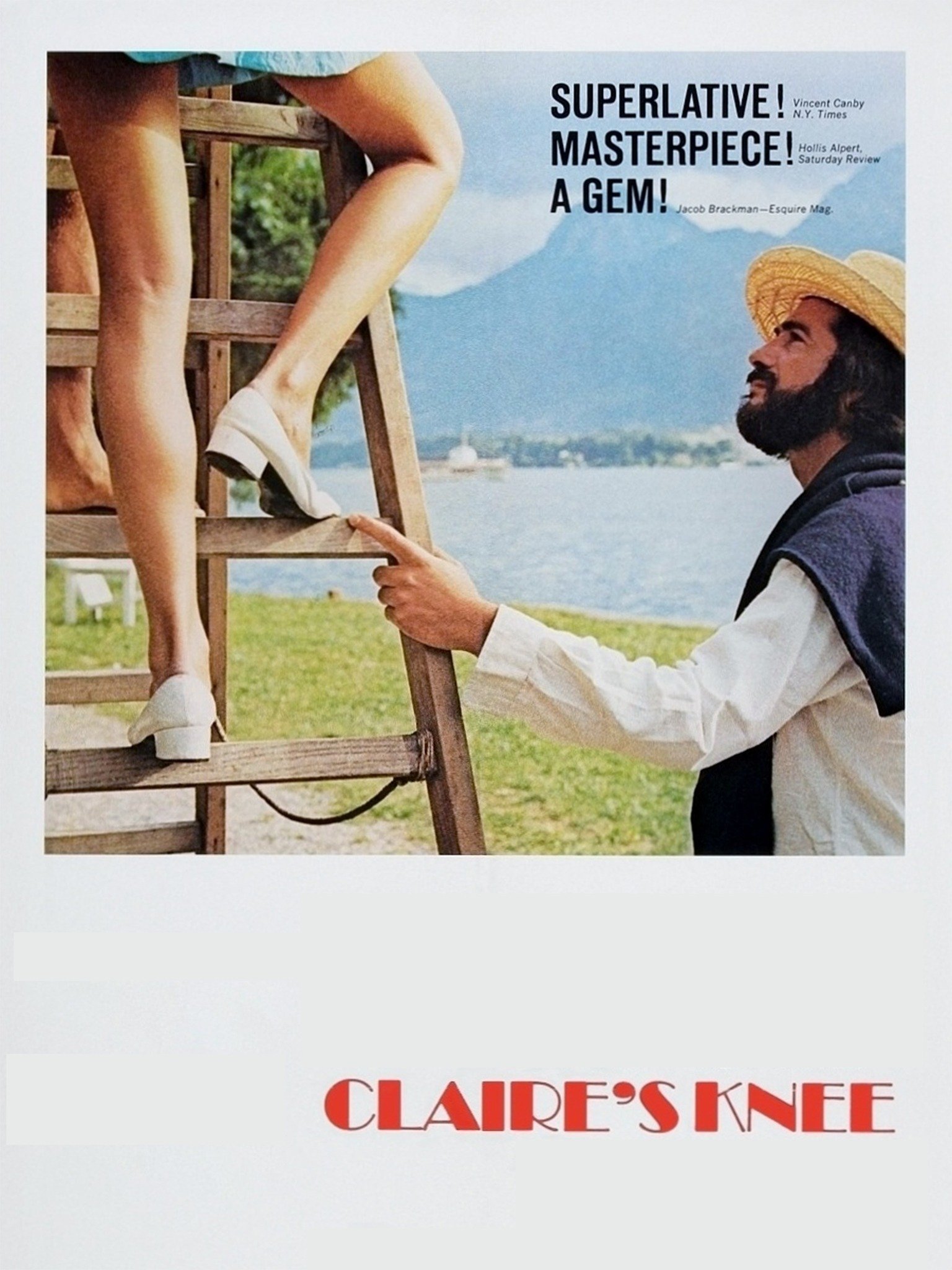
The career of Éric Rohmer is one filled with contradictions, and we can see this clearly in any of his films, such as Claire’s Knee (French: Le Genou de Claire), which is often considered one of his crowning achievements. It is a film centred on dialogue, but it is never overly verbose. It is set amongst the high society and their countryside escapes, but it is never elitist. Even its central theme, namely that of the main character developing a bizarre attraction to the knee of a young woman he encounters, is presented in a way that is entirely romantic, rather than fetishistic. Yet, it’s these contradictions that led him to becoming arguably one of the most influential directors of the French New Wave, and someone whose work remains as relevant and timely today as it did over half a century ago, when he was gradually emerging as one of the most important artists of his generation, a status he has maintained all these years, even after his passing. Claire’s Knee remains a cherished and celebrated work of contemporary realism, a handcrafted work of art made by someone whose grasp on the human condition has yet to be surpassed, only serving to inspire legions of young filmmakers to pick up a camera and capture reality in whatever way they saw it. Whenever there is a need for inspiration, a Rohmer film is the perfect source to motivate someone to venture out and find the beauty in reality – and while it may not be obvious at first, we might find that the most striking conversations come through when we least expect it, whether it be a brief discussion about an inconsequential issue, a rumination on the natural world or even the irresistible urge to focus our attention on the youthful body part of a new acquaintance, which is a concept that only someone as gifted as Rohmer could execute with such consistent brilliance.
There isn’t any one correct way of representing the world, since we each have differing perspectives – and while it may be difficult to relate to the upper-class malaise felt throughout Claire’s Knee, it’s not the setting that matters, but rather what the director does with it that counts. Rohmer had a very interesting technique – he didn’t focus on meta-narratives (often dismissing them entirely), and his films aren’t propelled by the desire to reach a particular destination – in fact, very few of his films actually tend to have traditionally conclusive markers, outside of temporal signals that indicate the elapsing of time (after all, My Night at Maud’s would lose a lot of potency had Jean-Louis Trintignant spent much more time in that squalid apartment). It’s a clear case of the journey meaning more than the destination, and Rohmer employs this technique to brilliant effect, especially in Claire’s Knee, which functions as less of a coherent narrative, and more as a stream-of-consciousness text that gives us a glimpse into the lives of a few interesting characters as they interact with each other over the course of roughly a month, weaving their way into each other’s daily routines, until they ultimately become an indelible part of it. Set in some of the most beautiful locations in pastoral France, Claire’s Knee has many merits that come through the director’s very organic approach to looking at a story, the film carefully piecing together several fascinating ideas and placing them in such a way that each conversation, regardless of how meaningless it would seem out of context, carries some deeper meaning when we view it through the lens of whatever theme Rohmer was using as the starting point for this story.
Rohmer’s artistry is less about telling a story as it is about setting down a few bold ideas, and allowing the natural rhythms of humanity to carry it along. Like most of his works, Rohmer is using a very natural method of storytelling, where an enormous amount of power is put in the hands of the actors (often drawn from a repertory cast of regular collaborators that understood Rohmer’s approach to filmmaking, and could easily manoeuvre through his stories), relying on them to deliver strong performances that remove the membrane between the viewer and the film. Realism is supposed to be so evocative, the viewer has to forget that they’re actually watching a film – being realistic isn’t enough, especially not when covering some issues that only work if the viewer is fully immersed in the world that surrounds them. It’s an immersive experience that is only helped along by the extent to which Rohmer is willing to ask us to suspend disbelief and just become lost in his world. In theory, a film like Claire’s Knee shouldn’t work as well as it does, especially not when we consider how gauche such stories often tend to be. However, Rohmer’s style has always been more focused on the metaphysical cravings of ordinary people, so this deep understanding of our inherent desires, coupled with his strict adherence to organic methods of storytelling, come together to form a film that has an enormous amount of meaning simmering just below the surface, which aids in creating an environment in which we can easily become immersed, our voyage into this world being nothing short of an absolute delight.
There’s a perpetual delight in realizing that Rohmer is inviting us to become a part of his world – his characters are recognizable enough to not be entirely detached from reality, and the stories are resonant and the discussions accessible. We feel like we are quiet observers sitting across from the table, listening in on these intense but beautiful conversations that may seem simple on the surface, but actually have unexpected depth when we start to follow Rohmer’s line of questioning, the true meaning only manifesting once we realize Claire’s Knee isn’t merely about a group of people engaging in dialogue, but rather a deeply sentimental elegy to a particular kind of moral dilemma. Considering that Claire’s Knee was part of his series known as the “Contes Moraux (Six Moral Tales)”, there is an understandable atmosphere of provocative questioning, where the director uses a motif as simple as a young woman’s knee to represent the carnal desire many people face, and the consistent need to retain their dignity and not give in to their urges. It’s an elegant exploration of lust, done with Rohmer’s distinctive blend of sophisticated drama combined with scintillating subtext, which contributes to the film’s very deep but profoundly moving discussions, inspiring a lot of hearty laughter, but also not neglecting the importance of making sure there is a depth to these conversations. The oscillation between the two are of vital importance, and help the film move along at a steady, meaningful pace, and create an environment where Rohmer manages to facilitate some very compelling conversations that mean more than we’d expect based on a cursory glance.
Claire’s Knee is often cited as one of Rohmer’s greatest films, and it’s not difficult to determine why this has become such a consensus opinion. It has everything that made his earlier films so special – deeply meaningful conversations centred on morality and issues relating to the soul of ordinary people, many of whom serve as the main figures in these stories – combined with a more progressive set of artistic traits, such as beautiful cinematography (this being the director’s second foray into colour) and set pieces that are simply stunning to look at, and which help convey the majesty of the surroundings in which the characters find themselves. However, more than anything else, Claire’s Knee brings forward the kind of techniques that would define the director’s career – an easygoing, carefree tone allows us to settle into these idyllic locations, patiently following these characters around as they meander through a quaint version of our world, pondering the big issues while gradually falling in and out of love. In many ways, this may seem simplistic and perhaps even quite reductive – but when we consider how actively engaging Rohmer managed to make these stories, and how he perpetually pushed boundaries of realism more than most directors in his generation, it’s not difficult to understand precisely why Claire’s Knee, like most of his films, has been celebrated for decades. Simple but meaningful, and allows absolutely unforgettable, there are few films that are able to captivate our attention through representing the most intimate nuances of the human condition more than this one, which is exactly why it is amongst the greatest works of its era, and an undeniable masterpiece in terms of both style and substance.
 The Postmodern Pelican