
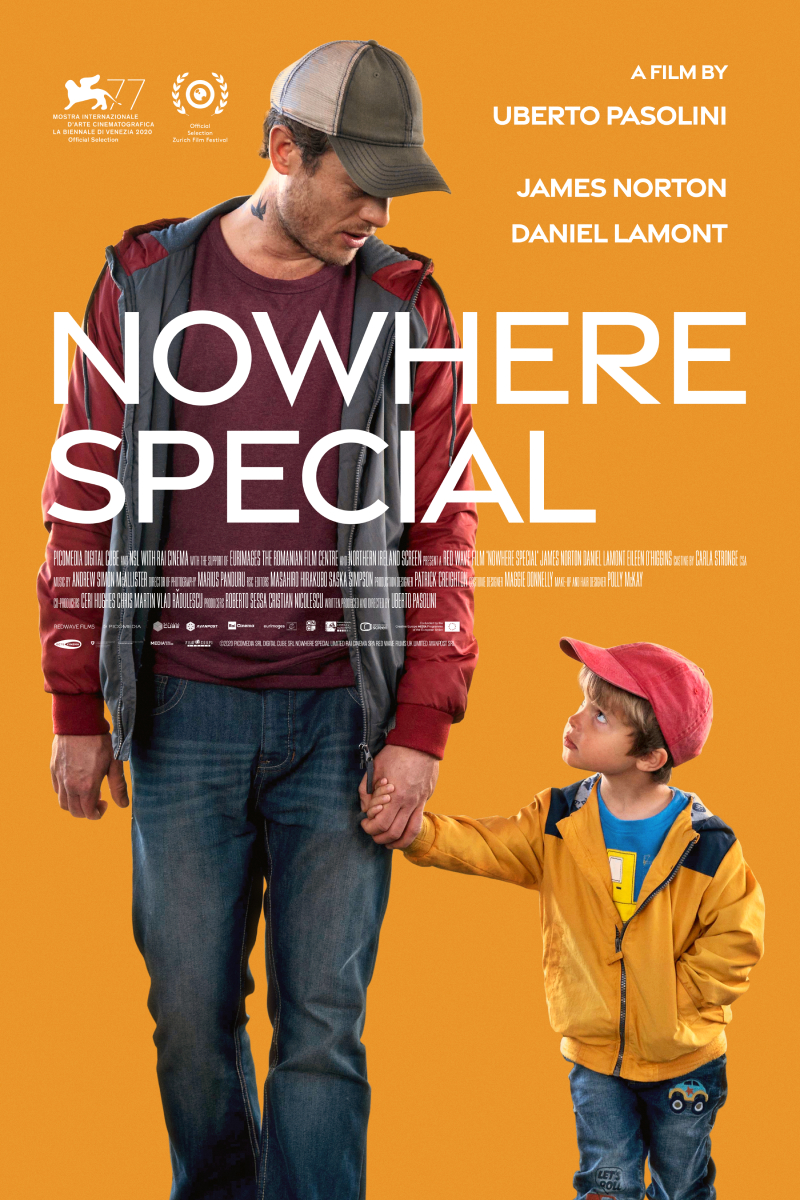
Death is a subject that has fascinated artists for centuries, with various works focusing on life’s most intimidating inevitability. The vast majority don’t question that it is going to happen to each one of us eventually, but rather the circumstances that surround it. Whether it be the actual process of coming to terms with one’s mortality, or the experience of realizing that our time with a loved one is finite, or even the very nature of how one meets their fate, there are countless discussions to be had about death, and it is normally those works that don’t beat around the bush, and instead get straight to the point, that ultimately mean the most. Nowhere Special is an incredibly simple film, but this doesn’t mean that it lacks complexity. Uberto Pasolini tells a beautiful, heartbreaking story about a man who is given only a few months to live, and has to make the difficult decision about who he is going to leave his young son with, finding the perfect family for a child who does not know that the time he is spending with his father are going to be amongst the last moments, before he is passed over to another family, while his father fades into nothingness, becoming only a memory, a voice in the back of one’s mind as they go about their life, existing in a world where the physical presence of the deceased may be absent, but they are still very much present. Bare-boned in a way that social realism often strives to be, and filled with a melancholy that is difficult to avoid, Nowhere Special is one of the year’s greatest achievements, a beautiful but heartbreaking manifesto on the nature of life, and the inevitability of death, two issues that are frequently the subject of much discussion, particularly in this film.
From the first moments, we understand that Nowhere Special is going to be a challenging film, perhaps not mentally (since it is as straightforward as it could possibly be), but rather in the emotions that are evoked throughout. Pasolini writes an achingly beautiful screenplay that calls into question the nature of life, and how we are all essentially living on borrowed time, born to lead lives of varying quality, and to experience a range of sensations, before ultimately meeting our demise, which can occur at any time. For the protagonist in Nowhere Special, he isn’t entirely sure when it will happen, but that it’s imminent, making his efforts to find the right family for his son even more difficult, since he knows that, deep down, no one will ever be able to replace the loving embrace of one’s own family – but that doesn’t mean that there isn’t a lot of value in finding a new family that will have the same love for the child. The film takes the form of a series of moments in the lives of the father and his son as they navigate their different experiences, one of them armed with the melancholy knowledge that every moment counts, and that he is intent on making sure that, whatever time they have left, is one that matters, since all those we leave behind are left with are memories, reminders of the people we have lost. It takes a lot of work to fully encapsulate all the emotions embedded in this film, but Pasolini (who has been working in the industry in various capacities for decades) makes sure that every moment of Nowhere Special feels authentic and meaningful, never wasting so much as a single frame as he ventures into this intimidating world that many have to unfortunately face.
There are certain actors that appear in a range of projects over the years, but don’t always stand out as major talents until they acquire that one role that forces audiences to reconsider them and actually start taking them seriously as immensely talented actors. James Norton has had many fantastic performances in the past, but was often restricted to smaller roles in vehicles for much more notable actors, with only a few exceptions. Nowhere Special is the film that immediately changes it, since not only is this a stunning reintroduction to a very hardworking actor, who is turning in some exceptional work, it is also one of the year’s most powerful performances. Like many independent films, Nowhere Special requires an actor in the central role that could engage with the story, surrendering to the fact that his character is deeply imperfect, and there is not going to be a happy ending. Playing a role like that of John in this film can only be described as daunting, with Norton’s face reflecting the internal pain he is able to replicate for the sake of taking on this role. Every moment feels genuine, each emotion coming through the actor’s physical movements and expressions. This is not merely a gifted young actor playing an interesting role – he immerses himself in this character’s life, delivering a spirited performance that leaves us absolutely shattered. Norton understood the intricate details required in bringing John to life, and he doesn’t waver for a single moment, ensuring that each frame of the film comes across as authentically as possible, since causing us to doubt the pain this character feels would ultimately cause the entire story to collapse, since so much of it depends on this outstanding work, which I have very little doubt is one of the very best of the year.
Nowhere Special navigates some very challenging narrative territory, and emerges as a major work of social realism. It often feels like a film that Ken Loach would make, with his particular style of using tragedy (or rather, its imminence) as a way of commenting on a range of issues. In this film, Pasolini is adopting a similar approach, using the sad story of a man trying to ensure that his son has a good future, all the while knowing that he is not going to be around for most of it. Through this narrative, the director is able to comment on matters that range from the extremely personal, such as the relationship that exists between a parent and child (especially when dealing with the subject of death), to the more socially conscious, the film deeply and critically at the adoption process, showing that while it may not be a flawless system, and often finds less-than-ideal individuals being involved, it is a mostly admirable process that gives hope to those who desperately need it, whether it be the parents who have no choice but to let their children go for one reason or another, the loved ones that are left behind, forced to adapt to a mostly new environment, and in many cases, a new life entirely. It takes its time to develop all of its ideas, but the film has a strong and undying commitment to seeing this story come to fruition, even if it means placing the viewer in a situation where we find our own emotions being tested by this film, which is much more difficult to explain in words, since so much of what makes Nowhere Special so engaging is how it uses intangible sensations as powerful tools in unravelling this narrative.
The conversations incited throughout Nowhere Special are difficult but important, since they touch on matters that are incredibly relevant to our everyday life. It may make it quite a difficult film to engage with, since it forces us to think about subjects that many of us would prefer to relegate to another time, rather than to have such challenging ideas discussed openly (very few of us want to actually be reminded of our own mortality) – but when it is done as beautifully as it is here, it’s difficult to not become thoroughly invested in the journey of these characters. In life, it is important that we sometimes stop and simply look around – we may have enormous challenges, but there is always value in simply recognizing the beauty inherent to our world, even if acknowledging these simple pleasures causes us to be reminded of how fleeting they all are. This doesn’t stop Pasolini from frequently questioning these same issues, and finding beauty in the smallest moments. Told through a series of snapshots into the lives of these two characters, who are doing their best to cherish every moment they spend together, Nowhere Special is a poignant and heartbreaking film, but also one that is frequently motivating, reminding us of the fact that death doesn’t mean our relationship with someone comes to an end, but rather reaches a new stage. Our bodies might be finite, but our souls are not – and it doesn’t matter whether one believes in an afterlife, or simply depends on the memories of those who have been lost to keep them in our lives. It’s an important lesson that is contained within this breathtaking film, which may appear quite small, but carries an emotional heft that can rival any other, giving us unique insights into the subject of life and death, and the importance of cherishing everything in between.
 The Postmodern Pelican