
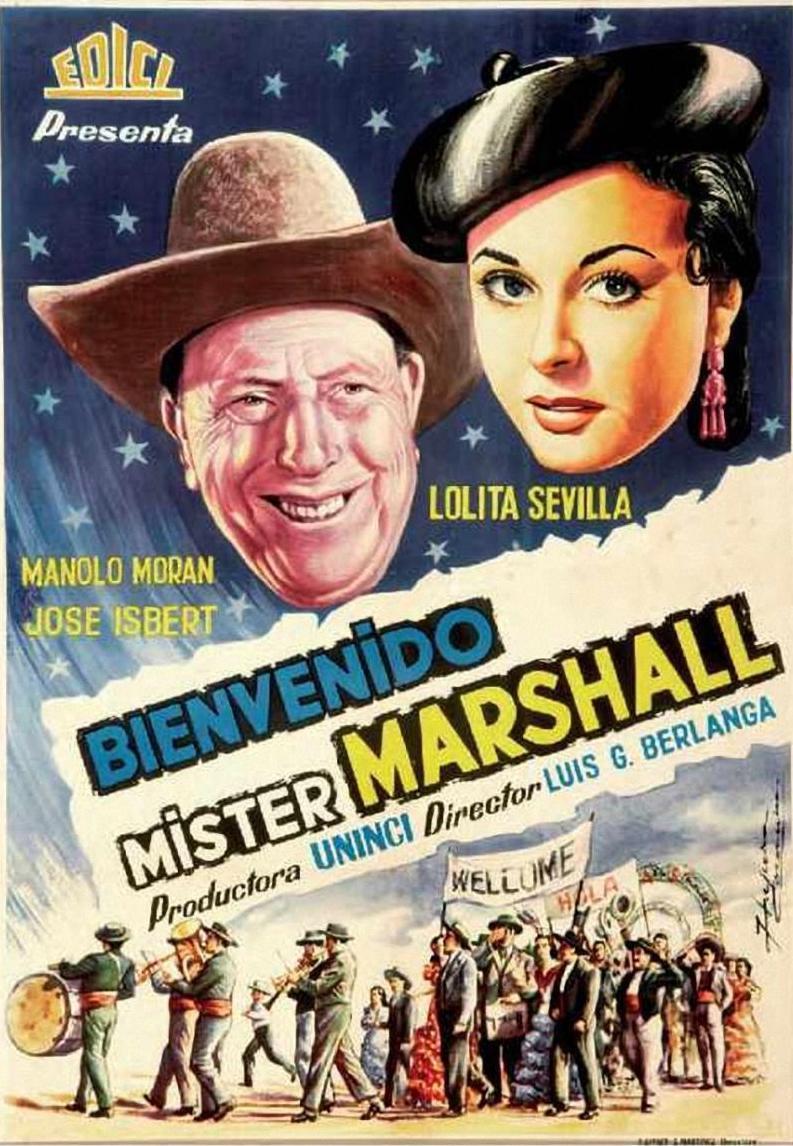
As a filmgoing culture, we were so fortunate to have someone like Luis García Berlanga, who dedicated so much of his life to making wonderful, insightful comedies that tell us as much about the culture in which he grew up as they did the most intricate details of the world at large. You can always discern a Berlanga film from his peers through a few key components – community-based stories that made use of sprawling ensembles, simple settings within the Spanish countryside, and most importantly, an irreverent sense of humour that combined mildly sardonic sarcasm with warm-hearted exuberance. Regardless of the project, these qualities persisted throughout most of his work – and there are few better examples of it in practice than in Welcome Mr. Marshall! (Spanish: ¡Bienvenido, Mister Marshall!), a lovable comedy he made relatively early in his career. Despite being one of the first films he directed, many of the components that made several of his later films such masterpieces are present here, including those mentioned above – and Berlanga, even while being a relative notice, established a keen method of observing the human condition and delivering it in the form of some truly exceptional satires that may be provocative and pointed in tone, but are never mean-spirited, designed to draw audiences further into his world, rather than pushing us out of it. For these reasons, and many others that we’ll highlight below, Welcome Mr. Marshall! is a staggering piece of Spanish-language cinema that proves what a monumental talent Berlanga was, and with many recent discussions centred on the centennial anniversary of his birth noting his genius, there has never been a better time to celebrate his unrestrained, energetic brilliance through one of his first forays into the realm of socially-charged comedy.
Community is a pivotal theme in nearly all of Berlanga’s films – while some of his more notable works (such as The Executioner) focus on a smaller group of character, he is always going to be best-known for his use of larger ensembles, where there aren’t any discernible leads, but rather a variety of interesting characters that serve as the foundation for broad tapestries of Spanish society in the way Berlanga perceived it. Almost entirely by design, Welcome Mr. Marshall! draws on the same concept through focusing on an array of eccentric individuals living in the small Castilian village of Villar del Río, who are patiently awaiting the arrival of some American diplomats, being under the overly optimistic belief that they are going to be liaising with their mayor to help the villagers under the recently-established Marshall Act, designed to provide relief to Europeans affected by the horrors of the Second World War. Naturally, this is fertile ground for an insightful, funny comedy, especially in how Berlanga weaves together some overly broad personalities, utilizing his talents at creating larger-than-life characters that may not be particularly realistic, but are always interesting and memorable. The premise is simple enough, especially in how the story jumps from one perspective to another – this is a story created almost entirely to serve a large group of characters, rather than only a few, since each individual at the heart of the film orbits around the central premise, which draws on the communal values that underpin most of what seemed to fascinate Berlanga as a filmmaker. It lends the film a deeply sentimental sense of generosity and compassion for its characters, which may not always be the most likeable, but at least resound as genuinely interesting people, both in isolation and when contrasted across from each other, a small but significant quality that comes through most effectively in the writing.
The concept of the culture clash comedy is not one that is entirely new to film, with many works of literature focusing on the collision between two wildly different groups of individuals. Welcome Mr. Marshall! takes several cues from previous works that look at the contrast between European values and American society, with much of the film focusing on how these various characters perceive the United States, carefully making use of broad stereotypes in a way that is both hilarious and meaningful. Berlanga may have been a very compassionate director, but he wasn’t one to avoid slightly more controversial subject matter, since he seemed to understand that intention is always more impactful than execution – and whether an extended sequence set in a very stereotypical Old West saloon, or more challenging material in the form of Ku Klux Klan imagery, Berlanga is painting a fascinating and darkly comical portrait of how America is perceived by outsiders. However, he never once aims for the low-hanging fruit, and consistently makes sure that every bit of commentary is supported by something that resonates on a deeper level. It’s a captivating portrait of two wildly different cultures coming into contact, and it says as much about American politics as it does the European way of life as well – the sequences where this quaint hamlet is transformed into an idyllic version of what foreigners would imagine such a village should be, equipped with traditional outfits and outdated customs, are hilarious and insightful, and proves how Berlanga was able to critique his own cherished culture as much as those of outsiders, a common theme we can see in many of his films, where he wasn’t afraid to take an approach that was more self-aware and reflective of his own cultural interests.
What is important to remember about Berlanga’s films are that they happen at a dizzying pace – they’re normally quite short, and therefore there isn’t a lot of time to marinade on particular situations. We’re thrust into his world, and we’re confronted with the choice of either holding on while he throws us into the middle of these zany scenarios, or being hopelessly lost, since he isn’t one to wait for the viewer to catch up with his mile-a-minute sensibilities. Welcome Mr. Marshall! has the exact same approach, but at a slightly more accessible pace – the opening segment is dedicated almost entirely to introducing us to these characters, as well as giving us a brief tour of the village, so that we understand the setting and the general direction the film is going to take. However, this is immediately followed by an hour of rapid scenarios that can be bewildering and cause us to become lost if we’re not paying attention – there are over a dozen different characters that serve as the foundation of the film, and they’re all occupying their own unique versions of the world, with Berlanga’s attempts to portray each of them in as limited a space as only 78 minutes resulting in a masterful work of cinematic construction. Understandably, a film like Welcome Mr. Marshall! can be challenging, since it isn’t the most relaxing piece of storytelling – it’s designed almost entirely to be disorienting, and while it is never confusing if the viewer just pays attention, it’s easy to become lost in this world. Yet, mercifully the viewer isn’t entirely at a disadvantage if they lose track of the story, since Berlanga offers such a funny, insightful portrayal of life in a small Spanish village, we can at least be amused by the charming demonstrations of everyday life at the heart of the narrative, which is still worth our time.
Berlanga takes us on a wonderfully captivating journey into the heart of Spanish society in many of his films, and while he would grow to be far more polished in later years with some of his more well-constructed films, we can still look towards the earlier days of his filmmaking career to see the origins of one of Europe’s most idiosyncratic and interesting directors. Welcome Mr. Marshall! is a peculiar film – it is caught between pointed satire and tender-hearted communal comedy, and it never rings as inauthentic in either situation, being a poignant and meaningful exploration of community values, taken from the perspective of a group of unforgettable characters that remind us of people we’ve all encountered in life, even if we don’t descend from the same background as these characters. A cultural comedy that can best be described as a Spanish-language version of Waiting for Godot (with Berlanga building the same anticipation for the arrival of the Americans, only to end with a moment of anticlimactic catharsis), the film is a wonderful piece of artistic expression that is as heartfelt as it is deeply motivating, which is one of the many striking qualities of the director’s work. It doesn’t matter that the film is rough around the edges, and feels like it was made on a slightly smaller budget – the heart and soul is present in every frame, and the director makes use of all his resources to tell this enthralling story that dives deep into the cultural origins of working-class Spain, and provides us with a revealing, insightful comedy that is as hilarious as it is endearing, a difficult combination that Berlanga achieved time after time in every one of his films.
 The Postmodern Pelican