
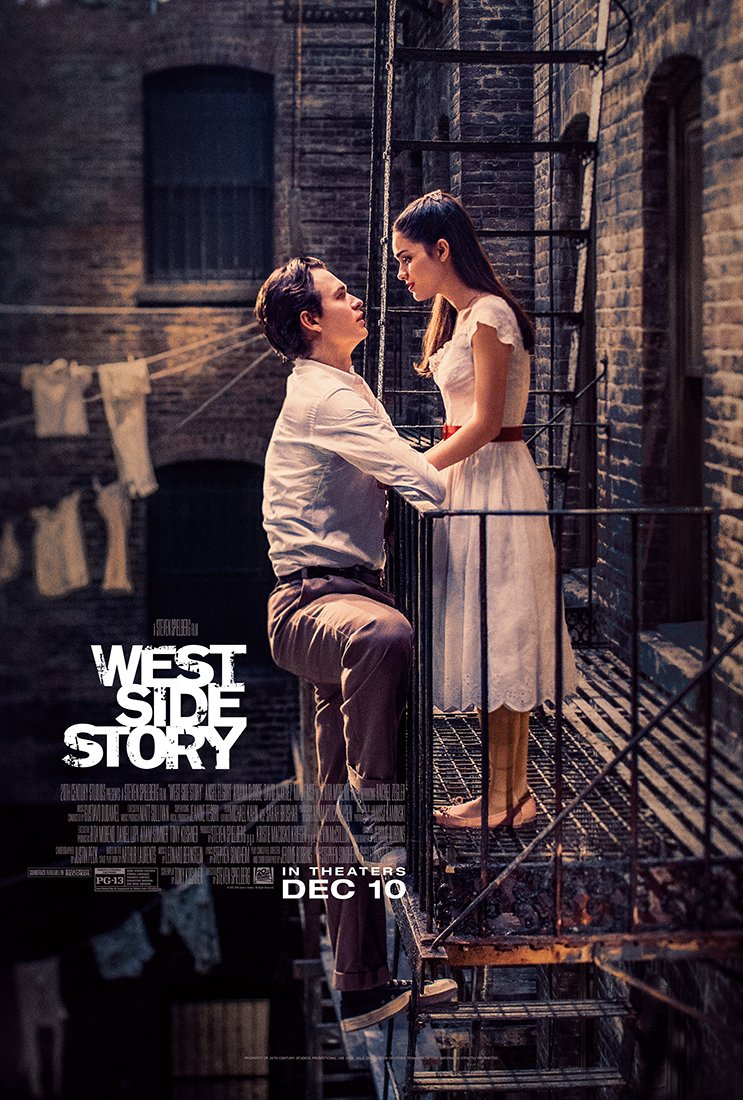
There are many reasons I (like many people) enjoy going to the movies – great performances, beautiful filmmaking and strong stories are a difficult combination to beat, especially when they’re done well. They make every trip to the cinema an immersive, powerful experience that certainly lingers on with the viewer when they’re done right. Without sounding hyperbolic, West Side Story is the reason I am so invested in this art form. I was initially dubious when Steven Spielberg announced that he was aiming to adapt the celebrated stage play – not only has the director proven himself to be far too much of a hit-and-miss filmmaker in recent years (some of his works being exceptional, others missing the mark entirely), it seemed almost impossible to improve on the perfection that was the original film version produced in 1961, where Robert Wise and Jerome Robbins took the story by Arthur Laurents, the music and lyrics by Leonard Bernstein and Stephen Sondheim, and transformed the, into one of the most beautifully engaging experiences in the history of the medium. However, I have rarely been prouder to admit defeat, since Spielberg’s version is positively brimming with life, a colourful and stunning musical odyssey that may not improve on perfection (since that would be nearly impossible to do), but brings this iconic work into the 21st century with the bold leaps of faith that the director has often shown himself more than willing to take. In short, West Side Story is one of the year’s best films, a vibrant and exquisitely constructed film that is perhaps the best stage-to-screen musical adaptation that we’ve seen in over a decade, all tied together with the pure cinematic magic that has almost entirely defined Spielberg’s career, which is firing on all cylinders throughout this film, paying tribute to the original work in wonderful ways.
Life exudes off every frame in West Side Story – in retrospect, it was foolish to doubt that Spielberg would make anything less than an absolutely stellar adaptation. He has spoken about how the original production, as well as the previous film, are personal favourites, and played a pivotal role in his development as a filmmaker, so it only stands to reason that once he got the opportunity to see his passion project realized, he would put every bit of effort into making sure it honours the works that inspired it in the first place. The director assembles an impressive cast and crew, filling it with talented individuals from top to bottom, and proving that the key to a great work of art is sometimes the spirit of collaboration. Laurents’ original story is placed in the careful hands of playwright Tony Kushner, an ingenious write responsible for some of the finest works of the past few decades, including another distinctive high-point in Spielberg’s career, the astonishing Lincoln (which was the last time one of the director’s films left me as speechless as this one did), and working closely with the original text, Kushner pays homage to Laurents’ stunning words, writing dialogue that may not be verbatim to the original text, but rather freshens it up, bringing it to the modern era, while not abandoning the incredible cultural milieu in which the story takes place. Considering the amount of work that went into something as seemingly simple as the dialogue that exists in between songs (with everyone involved knowing better than to trifle with the stunning music and lyrics by Bernstein and Sondheim, being aware that these words are beyond sacrosanct, with any significant change being comparable to fiddling with pure, historically-resonant poetry), it is hardly surprising that West Side Story would be an absolutely enchanting experience, handcrafted by people who are well-aware of the spirit of the original, as well as the vital importance of looking at such an iconic work through entirely new perspectives.
An adaptation that brought West Side Story into the current century had much work to do in terms of handling the narrative. Spielberg approaches a contemporary perspective of this story without updating it – the director does very well in maintaining the 1950s setting, capturing the aesthetic and vibrancy of New York in the years following the Second World War, which can really only come with time and space, something that the original didn’t fully manage to capture due to the close proximity to both the era and the original text. If there were imperfections in the adaptation by Wise and Robbins, it would be matters relating to casting (with many of the Puerto Rican roles being played by white actors) as well as how it handled some of the more intense socio-cultural matters. We can’t proclaim that this version erases those problems entirely, since many of them are embedded deep within the text, and removing them would present a much bigger challenge that may have ultimately caused the film to fall apart at the seams. However, it’s not always the big issues that need to be changed, but the smaller details – and being both a seasoned veteran of the filmmaking profession (with a career spanning over half a century), and very forward-thinking filmmaker who has never shown much hesitance towards exploring contemporary issues, Spielberg makes sure that his adaptation is as faithful to the source material as it is honouring the people depicted in it, paying tribute to Laurents, Bernstein and Sondheim as much as it does the populations of immigrants whose lives were the inspiration behind the original text. Small changes can bring about incredible results, and while perhaps not every issue can be considered to have been entirely ironed out, the effort put into bringing West Side Story into the 21st century cannot be underestimated, and is one of the primary reasons this adaptation is such a glorious, unimpeachable success.
Casting was a pivotal aspect of bringing this version of West Side Story to life – nearly everyone involved in the pioneering versions, whether the original stage production or the previous film adaptation, found themselves benefitting greatly from the immense success, becoming household names if they weren’t already. It’s difficult to imagine this version not yielding similar results – there are certainly a few recognizable names in this cast (such as Ansel Elgort, who has been putting in a lot of work to be considered a viable leading man, coming closest with his strong interpretation of Tony here), but the real stars of the film are those that are new to many viewers. Ariana DeBose, David Alvarez and Mike Faist are not entirely unknown, having done some strong work on stage or screen in the past, but West Side Story will undeniably serve as their introduction to the general public, who will be hard-pressed to find a trio of more endearing, captivating performances – it seems almost unfeasible to imagine that they won’t become mainstays of the industry, with their incredible work here being enough to catapult them to the top of many prestige projects in years to come. However, the stars that shine the brightest in West Side Story are those that occur at opposite poles in terms of recognition – somehow, Spielberg has managed to make a film that is both an incredible debut for a talented newcomer, and a wonderful tribute to one of the industry’s most brilliant performers – Rachel Zegler and Rita Moreno are both the highlights of the film, the former a young actress cast in the role of Maria, the other an actress who defines both talent and longevity (and whose original interpretation of Anita on stage and screen over half a century ago remains the gold-standard for musical performances), here playing Valentina, the gender-swapped wise elder who presides over the film with an iron-fist and tender heart. Considering how this film succeeds so beautifully in showcasing these two fiercely gifted women on opposing ends of the career spectrum, everyone that appears in between is going to benefit, taking this film and proving it to be a resounding success when it comes to an ensemble that intrinsically understood every component of the story.
Every iota of success associated with West Side Story comes down to the fact that Spielberg, even after so many decades of producing incredible work that has made his name the definition of prestige and quality, he continues to experiment. At this stage in a director’s career, they’re certainly entitled to rest on their laurels, revelling in their past successes while watching their influence spread throughout the younger generation of filmmakers. Yet, Spielberg continues to experiment – and while not everything he produces is original in terms of source material (it has nearly a quarter of a century since he produced a film that was entirely original, rather than being based on real individuals, or a literary adaptation), the boundaries he aims to break are sometimes quite pioneering. He is both an elder statesman of the industry, and someone whose work continues to push the envelope – and his first foray into the musical genre came exactly fifty years since his debut, and yet still seems to have been made by that same rambunctious maestro who was driven primarily to direct what interested him, following his curiosities and producing the stories that he would want to see as a film lover. This is all beautifully reflected in West Side Story, a film that primarily (and almost wholeheartedly) functions as a daring and endearing musical drama made by someone who possessed a genuine fondness not only for the source material, but the actual story, which is far more than just a few memorable songs strung together for the sake of entertainment. There is serious meaning simmering beneath this film, a passionate social complexity that keeps us engaged and perpetually interested in what this story has to say about a range of exceptionally compelling issues.
When Spielberg sets out to do something, you best believe that he is going to do it properly, and this has certainly been a consistent element in his long and storied career. Despite having never made a musical before, West Side Story feels like it was crafted by a master, someone who had as much admiration for the genre as he did interest in seeing it done well. There isn’t ever any doubt that this is a film produced with every bit of effort available – it’s not merely an attempt to replicate the success of a cherished stage show (which is unfortunately a trend with many musical adaptations), but a full-bodied, complex musical drama that is filled to the brim with life, positively exuding a kind of vivacity that we rarely manage to see nowadays. It’s one of the best studio films of recent years, a bold and audacious event in the way that the original film was – it doesn’t ever feel anything less than majestic, which is not a word that is often used, even in relation to the most elaborate productions. Ultimately, West Side Story is an incredible film, a beautifully poetic and intricately-woven adaptation that keeps us entertained, provokes thought and not only gives the necessary respect to the original text, but manages to venture into entirely new narrative territory, adding nuance and new ideas to a previously untouchable text. Its a truly enthralling, immersive experience that reminds us, once and for all, what cinema can truly be when the right amount of effort and ambition is infused into even the most familiar stories that have enraptured audiences for generations, and will continue to do so through this stunning new perspective on a truly classic work of American literature.
 The Postmodern Pelican