
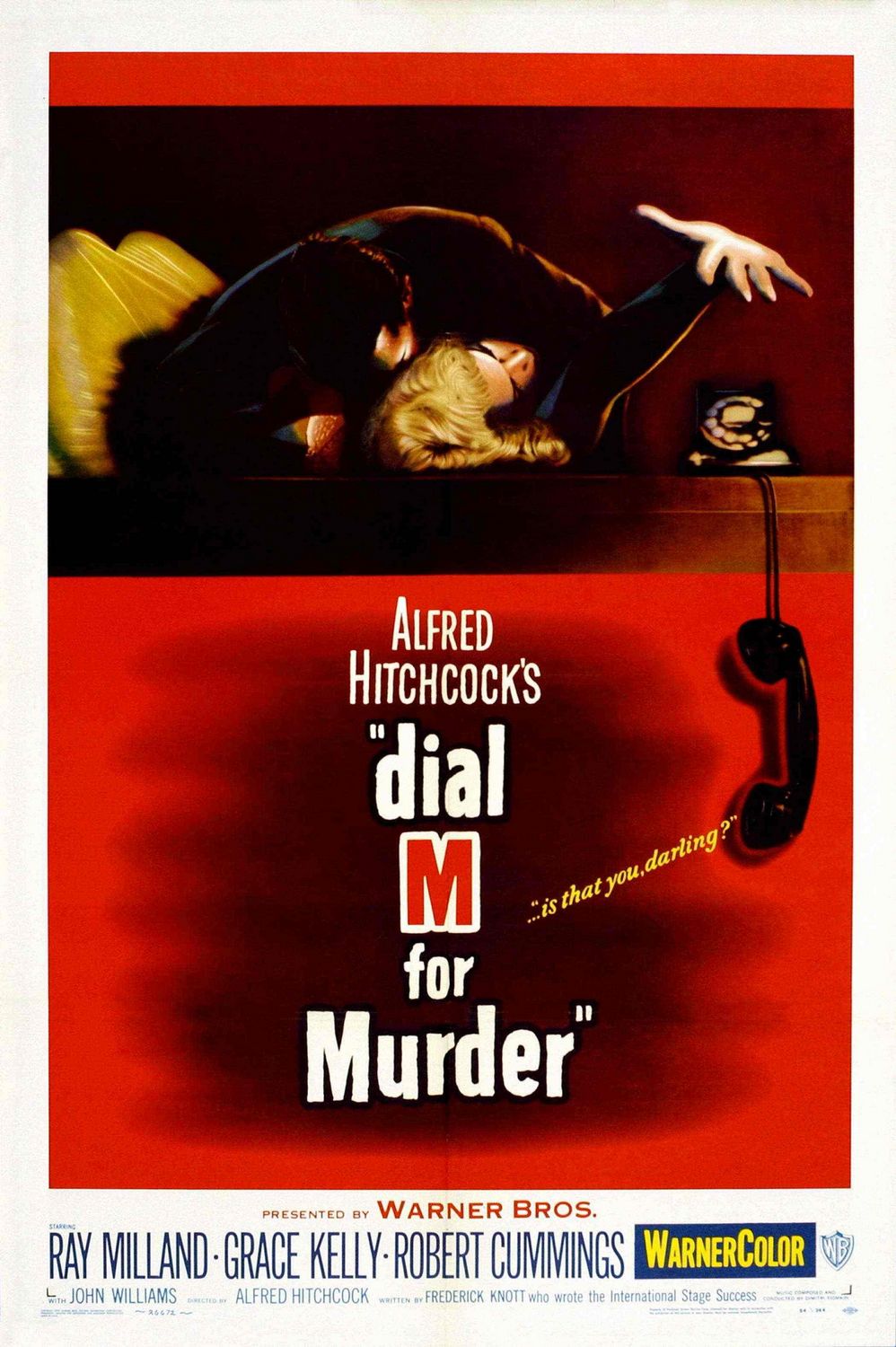
There are many distinctive signs of a great director – whether it be a strong visual style, the ability to extract strong performances from their actors, or just the general skillfulness needed to entertain an audience. My personal belief is that any talented director should be able to take a strong script that contains only two or three characters, situating them in a single location for almost the entirety of the production, and still make something meaningful. This idea isn’t always associated with Alfred Hitchcock, a director who has often been cited for his globe-trotting adventures, or sprawling works of insatiable suspense. Yet, one of his finest films is Dial M for Murder, his collaboration with playwright Frederick Knott, who adapts his own stage-play for the screen, after it had run very successfully on the London stage for quite some time. Hitchcock doesn’t make too many changes – perhaps adding a brief establishing shot in another location to add nuance, or a few directorial flourishes that aren’t possible on stage. He keeps it at the most simple level, and in the process creates one of his most unforgettable works, a tense and uncontrollably dark psychological thriller that reminds us of all the qualities we absolutely adore when it comes to the iconic Master of Suspense, who could weave together the most captivating tales from the most simple situations, and enthral an audience like absolutely no one else. Dial M for Murder may not be one of his canonical masterpieces, but it is certainly one of his most captivating films, and a firm reminder of the resourcefulness that Hitchcock demonstrated with shocking regularity.
Contrary to how his reputation has seemed to evolve into being someone who made labyrinthine mystery films, Hitchcock had the ability to take the most simple material and transform it into captivating, enthralling thrillers that kept us on the edge of our seats. Working with Knott, he puts together Dial M for Murder, one of his most simple productions – essentially a series of extended scenes that involve only a handful of characters (normally only two or three at any given point), the stage origins of this story are very clear. However, this is not a film that embodies the often disparaging term of the “filmed play”, whereby a highly successful stage production is moved into a studio, and filmed very quickly in order to capitalize on the critical and commercial acclaim, and bring this story to a wider audience. At his peak, Hitchcock was not someone who wouldn’t put in the effort to make something artistically resonant, so even when producing a film that is taken almost verbatim from pre-existing material, he did so with poise, elegance and a lot of artistic merit that we have come to expect from arguably the finest filmmaker to ever work in the medium. There are certain moments in the film that are clearly plucked directly from the stage, but they’re counteracted by some subversive choices on the part of the director, who elevates the material and make it his own, while still paying tribute to the incredible text written by Knott, who works very closely with Hitchcock to bring Dial M for Murder to the screen in a way that feels earnest and genuine, rather than just a cheap attempt to recapture the widespread popularity of the material, which is one of many reasons to absolutely admire this film.
As a story with its origins on stage, it’s only logical to have expected Dial M for Murder to be a very strong entry into the world of acting. This, taken alongside the director’s penchant for drawing out spectacular performances from his actors, turns this film into an impeccable character study that dives deep into the psychological state of its characters. The film is led by the terrific Ray Milland, who oscillates between obnoxiously charming and outright unsettling, playing the part of a former tennis champion who decides to arrange for his wife’s murder, only to realize that his plan was far from as foolproof as he imagined when it backfires and forces him to compose another series of excuses once it becomes clear someone was intended to be murdered in that cosmopolitan London apartment one evening – his job isn’t to deny there was a case of murder, but rather shift the blame, which affords him another opportunity to be rid of his wife. Grace Kelly may have had better performances under the guidance of Hitchcock (especially in this same year, with her performance in Rear Window being one of her best), but her portrayal of the innocent Margot, who is thrust into a world where she goes from mild-mannered housewife, to death-row inmate in the span of a few months, is just as interesting as anything else she did. The key to the success of Dial M for Murder is the degree of chemistry the actors have with one another – Milland and Kelly are fantastic together and individually, and their work across from the supporting cast, including Anthony Dawson as the hired killer who reluctantly agrees to take on this very challenging assignment, and John Williams as the perceptive, insatiable Detective Hubbard, makes for a thrilling film that is even more interesting considering the complex work being done by the cast.
After you’ve seen a few of Hitchcock’s films, you can easily tell where they’re heading – and with the exception of a few, there are certain patterns that can be spotted. He’s not a derivative filmmaker (all of his works are singular and produced with just as much dedication as the next – he wasn’t a director who was known to rest on his laurels). It not only gave us the concept of the Hitchcockian film, which has been promptly parodied and paid tribute over the decades, but also given us an array of interesting films that are oddly comforting, even when they centre on a subject as terrifying as marital murder. How Hitchcock could produce something as dark and sinister as Dial M for Murder, and still make it an effervescent and charming thriller that draws us in, even when it’s at its most unsettling, is a remarkable testament to his abilities as a filmmaker. In terms of subject matter, this is certainly one of his more haunting works – in a long career that travelled down many different avenues, it’s those that touches very close to home that are the most uncomfortable. Yet, Hitchcock works his way through these stark emotions, and gradually produces something insanely complex, while still oddly delightful when it needed to be. There’s a quality to these films that is impossible to both describe and replicate – a warmth that pervades the terror, and draws us closer into this world, so much that we can’t help but be thoroughly perplexed and mesmerized, in equal measure, for most of the time. His films feel rich and insightful, and considering his well-documented love for deranged humour, it’s difficult to imagine Hitchcock wasn’t deliberately turning these dark stories into enthralling thrillers with firm touches of levity scattered liberally throughout – the small amounts of humour may not evoke much laughter, but situate us in this strange and uncomfortable version of the world, in which the most grotesque category of individual is given free-reign to exist.
Despite the subject matter, Dial M for Murder manages to bea delightful experiment that works out magnificently, since the combination of a strong premise and a director who knew how to handle even the most disconcerting material results in true cinematic magic. It’s not difficult to become enraptured in this story – the premise is strong, and the acting sells every moment, even when the narrative borders on implausible (had a lesser director been at the helm, the film would not have been nearly as convincing). Hitchcock was a master, and while some have referred to this as the director working in a minor key, there’s nothing about Dial M for Murder that suggests that it is anything less than some of Hitchcock’s best work. Solid, well-acted and always incredibly captivating, the film is a masterful exploration of marital strife and murderous intentions coming into close contact – and it’s well-executed by a director who knew the genre better than absolutely anybody else, with his influence remaining just as powerful today as it did over half a century ago. It’s a wonderfully unique film, and one that proves that even the most straightforward material can result in something truly exceptional, as long as there is effort put into the creation, which is clear in every frame of this film.
 The Postmodern Pelican