
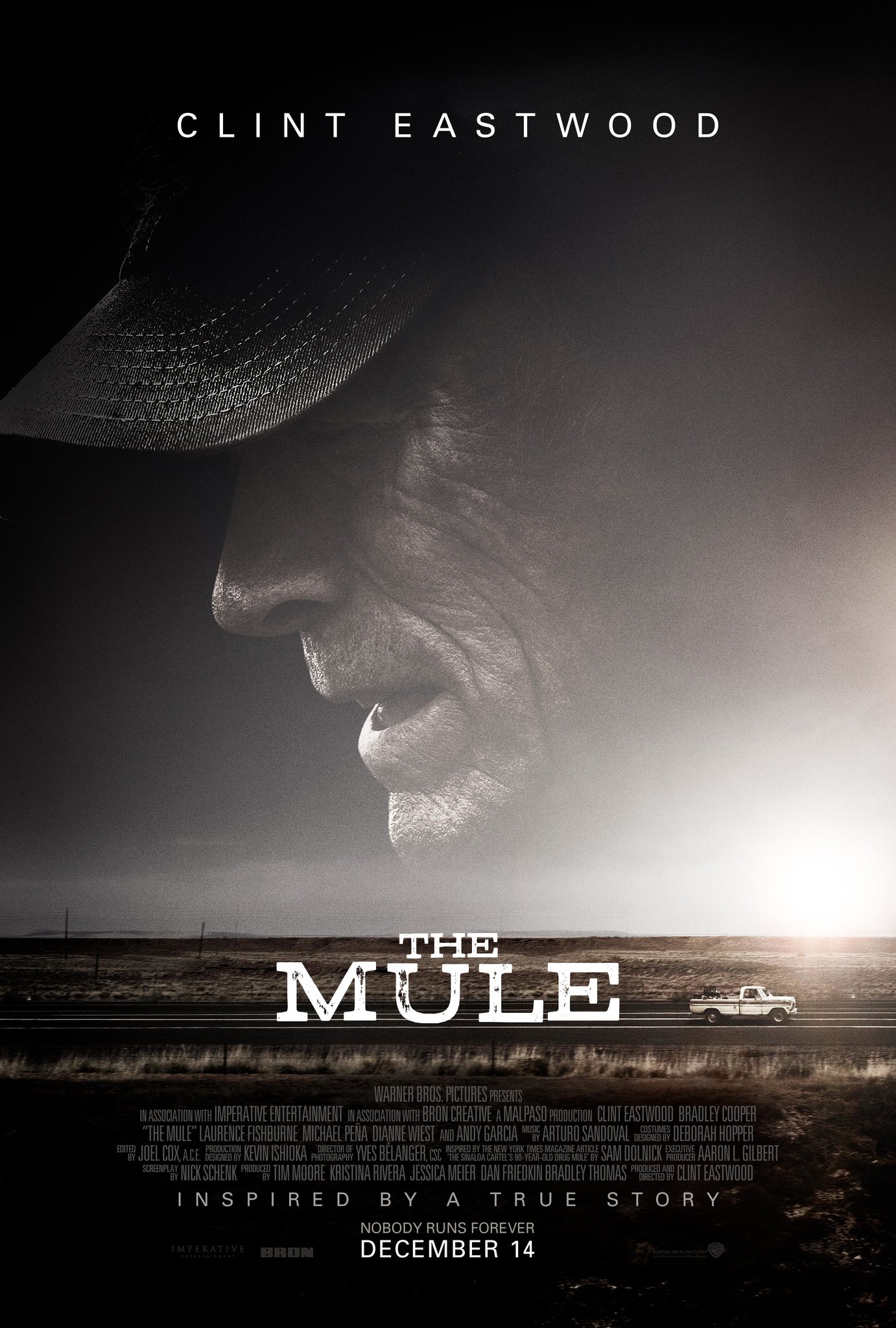
There are two ways to look at The Mule – the first is as one of the many forgettable dramas Clint Eastwood churns out every year, taking advantage of his ability to pull together a film in only a matter of months. The second is as one of the most unintentionally fascinating comedies of the last twenty years, a film that wants to pay tribute to the Greatest Generation, but fails dismally at doing anything other than being a series of bizarre set pieces, designed to showcase Eastwood’s supposed prowess, even at his advanced age. Resounding cries of “Clint has still got it!” seem to follow every time he releases something that is vaguely interesting, and The Mule was not any exception. However, as odd as it may seem (especially for someone who has been as notoriously critical about Eastwood’s output over the past quarter-century as I have), this film is actually perfectly decent, functioning as the adequate and entertaining true-life drama that represents the best the director has to offer, even if that really isn’t all that much since he has started to sacrifice quality in favour of quantity (one has to wonder whether his character’s claim that he is “making up for lost time” is in some way indicative of Eastwood trying to make as many films as he can before he steps away from filmmaking entirely). Perhaps its just the spirit of the season of being grateful, or the fact that the air is slightly thinner in these climate change-induced summer months, but I found The Mule to be rather effective, and seemingly much better than one would expect based on a cursory glance – and considering many of us are guilty of not even giving something directed by this notoriously prolific filmmaker anything close to a second look, The Mule may harbour a few interesting surprises here and there, especially for those willing to surrender to the absolute absurdity of a crime thriller done through the lens of Eastwood’s grizzled perspective.
It seems odd to instruct anyone to give an Eastwood picture a shot, but I have no doubt that this one may be surprising to those willing to take a chance, especially if they’re looking for Eastwood’s version of a crime thriller with generous helpings of off-kilter comedy. There are many moments in The Mule where one has to wonder whether or not this was intended to be something of a comedy, or if it was supposed to be played entirely straight, and the humour came about as an accident. Either way, the film is something to behold, and it sometimes feels as if the best way to view the film is through the lens of a dark comedy, which not only helps us understand some of the bizarre choices Eastwood makes, both narratively and structurally, but allows us to enjoy the film a lot more, since being invited to not take this story particularly seriously is certainly the best-case scenario for such a film, which is already quite absurd. It’s even more strange considering how The Mule is based on the true story of Leo Sharp, a two-time record holder when it comes to the world of transporting drugs, being both the most prolific drug mule on record, as well as the oldest (although it seems like a niche market already – not too many geriatrics aspire to spend their final years or months moving drugs for bloodthirsty cartels – or at least not any that I have come into contact with), charting his journey from desperation to wealth, all due to the fact that he decided to spend whatever time he had left working for criminal organizations that first saw him as expendable, before realizing how it is often the most law-abiding citizens that make the best criminals, one of the many fascinating ironies that make The Mule such an oddly effective comedy when it comes to telling a story that proves that reality is often stranger than fiction.
Perhaps its nostalgia, but there is something so transfixing by seeing one of the most notable icons of American cinema in his element – physically, Eastwood has grown older, but he has demonstrated a sharpness that is admirable for someone of his age, and regardless of whether his films are particularly good, there’s an admirable quality in how he constantly keeps working. The Mule may just be his swan song, not necessarily in terms of being his final film (since he did direct two films after this one), but rather the one that reminds us of what a tremendous actor he was. Considering he has been on the precipice of retirement for the better part of a decade, with every subsequent film he makes (particularly as an actor) being labelled as his final performance – but he keeps going like an engine powered by the steam of always wanting to get the last word in, even if it means having countless vehicles tailor-made to his interest in representing a particular generation of American males. Eastwood is actually quite good in the film – he’s a profoundly interesting actor, and he is definitely putting in more effort than usual, making a concerted attempt to develop the character of Earl Stone beyond the snarling senior citizen who falls momentarily into the midst of violent criminal activity out of sheer desperation. No one knows he is a legend quite as much as Eastwood himself does, and he is consistently showcasing how he embodies the spirit of his generation supposedly better than anyone else (regardless of the fact that Robert Redford already had another brilliant performance in a similarly themed, but much better film, this exact same year), which makes his work here quite interesting, if one can look beyond the obvious tics that he has developed as an actor over the past few years. In all honesty, he is doing good work in The Mule, a film that may have actually been able to cultivate a much stronger performance had Eastwood handed the directorial reigns to someone else, not because he was incapable of directing the film, but rather because more work should’ve gone into his performance, which likely could only have been done had Eastwood been given the chance to only focus on developing the character, rather than directing the entire film.
Forming the middle entry into an unofficial trilogy of films about octogenarian individuals who are the last remaining vestiges of a bygone era being forced into the modern world, alongside Gran Torino and Cry Macho (interestingly, all were written by Nick Schenck, who seems to be even more invested in these “good old days” of American imperialism than Eastwood himself), The Mule is a fascinating character study that is perhaps too ambitious for its own good. Inarguably, the story of Leo Sharp is one that warrants becoming a film – someone choosing to spend the last years of their life as a drug mule is inherently cinematic, and would’ve made for an interesting film, regardless of who made it. Unfortunately, as solid as a director as he has shown himself to be at times, Eastwood didn’t seem like the right person to take the helm. This is mainly because this story would be better suited for a more eccentric, audacious comedy – as heartbreaking as Sharp’s life story was, it was one that lends itself more to the more surreal aspects of our culture, and thus should have been treated as such – and it’s unlikely that even the subject himself would be entirely opposed to a more lighthearted retelling of his exploits as a world-renowned mule, someone who became respected for his ability to bring that hardworking ethic found within the Greatest Generation into the modern age, where it was effectively utilized by the more erratic cartels who weren’t quite sure what to think of someone so principled, yet so willing to engage in criminal behaviour, albeit only for survival. The Mule would’ve worked much better as a more straightforward comedy – we’ve seen many true crime stories be repurposed as zany, off-the-wall productions that retain the spirit of reality and pay tribute to the real-life individuals, but where the priority is less on the dramatic side, and more on the bizarre realities that underpin the story.
It is even more troubling when we consider how Eastwood did seem to realize the inherent comedy of this story himself – there are flashes of genuine humour in The Mule that suggest that even the director knew the comic potential of the story, but he still inevitably veers back towards the more overwrought, heavy-handed drama that doesn’t really service this film all that well, and ultimately squanders the wealth of potential lingering below the surface. It’s not particularly well-formed, and it wastes all the potential it had to be great. However, in remarking this, we have to focus on the fact that, just on a conceptual level, there was something interesting below the surface, a kind of quiet meditation on ageing and the role of the older generations in the contemporary world. Eastwood has often sought to explore these issues, particularly in recent works that place different generations across from each other, and asks them to engage in a spirited dialogue, one which may not always be as effective as it should be, but at least is the start of something promising. This isn’t to excuse the flaws embedded deeply within The Mule – after all, this is a film that trivializes the bigotry of its main character by having him deliver his biased rhetoric under the guise of being helpful and empathetic, with the idea being that he isn’t someone raised in a world rife with division, but rather someone who is a product of his time and who “has lost his filter”, as one of the characters remarks, almost as if this is a moment where the writer is suggesting that we can forgive everything this character does, as long as it is done under the veneer of being a helpful older gentleman who simply doesn’t know any better. It’s not necessarily harmful, since there are far worse works that try and follow a similar line of logic – and its heart is in the right place. It just needed a much better perspective than one that starts conversations it doesn’t really have much interest in finishing.
The important question is whether or not The Mule is a good film. Logically, the answer should be negative. It doesn’t hit all the targets that it aims for, and it consistently seems to be falling apart at the seams, one of the more troubling instances of a film trying to be interesting, but failing on both a conceptual level and in terms of the final product, which is far too melodramatic and interested in its own brand of ill-fitting American pride to be fully critical in the way that the film should’ve been. Approaching someone like Leo Sharp in a way that makes him out to be an unconventional hero seems inappropriate – after all, his story is fascinating and the sheer gumption he showed in engaging in such sordid activities at an advanced age makes for rivetting storytelling, but only to the point where it can be considered constructive, rather than celebratory. There is too much reverence being paid to the subject and his generation as a whole, which weighs this film down and prevents it from ever being as smart or insightful as it seems to believe that it is. Eastwood has resigned to making films about heroic, dashing older men who represent an era relegated to the past, representing a generation that lacked a filter or social decorum, and instead “told it like it is” – and it may work if someone is looking for an innocuous dose of meaningless patriotism – but in a story as fascinating as this one, it is really disappointing. Regardless of the dedication put in by Eastwood in terms of playing the main character, The Mule just doesn’t live up to whatever potential it had, and sometimes feels like it is gasping for air whenever it needs to discuss something more serious, which only further proves how this is a perfect example of some films having all the correct components, but lack the willpower or foresight to use them properly, resulting in a hopelessly mediocre, but still serviceable, drama that doesn’t really go anywhere groundbreaking, but offers a decent diversion, which is at least one merit of this entertaining but otherwise forgettable true-life film.
 The Postmodern Pelican