
When it comes to romance, the only concept art seems to be invested in more than people falling in love is that of people falling out of it – and while After Love may not necessarily focus entirely on a woman ceasing to have feelings for her deceased husband, it does question her motivations to retain his memory when she is confronted with the harsh truth that he did not live the ideal life she imagined and would like to keep in her memory. The film is a bitter pill, a story that looks into how someone not only mourns the loss of their lifelong partner, but also processes the fact that everyone has imperfections, and that finding the truth of one’s life after their death can provide details that could potentially entirely remove whatever joy was left in such a difficult situation. Aleem Khan tells a heartbreaking story that ventures deep into the roots of the trauma felt by a recently-widowed woman who comes to learn that her late husband lead an entirely different life across the channel, and her methods to work through these difficult emotions, all the while doing her best to keep the positive memories she holds dear to her heart intact, even when new revelations come out that force her to reconsider her reality, and question whether the happiness she felt while he was alive was actually genuine, or just a way of covering up the fact that she secretly knew there was something amiss about their idyllic marriage, proving that some moments in life truly are too good to be true, and that some degree of discernment should be practised to avoid crushing despair in moments where the truth is revealed.
Everything about After Love seems quite abstract – this is a film driven less by an overarching narrative (it has a relatively simple plot, but not one that is all that original in terms of structure or content), and more by the atmosphere evoked by the smaller details that form the basis of the story. Khan, who is making his feature-length directorial debut, proves himself to be quite a unique young talent, telling a story that clearly has roots in his own experiences as a British Muslim growing up in the county of Kent (the film is set along the white cliffs of Dover), at a time when issues relating to identity amongst the population were undergoing something of a seismic shift – and while the degree to which the director relates directly to his creation of Mary Hussain, a woman who married into this life rather than being raised in it, remains to be seen. However, there is a clear resonance between the subject matter and the director’s understanding of the details that go into the creation of such a story, and throughout After Love, we’re confronted with some unsettling facts that would otherwise be considered conventional in your garden-variety drama, but come to form the basis of this heartbreaking existential ode to one woman’s quest to find answers that she knows she is likely never going to receive. Khan is consistently pushing forward with this narrative, using his own background as a basis for this story, which may seem quite unassuming based on a quick glance, but actually proves to be a lot more complex than it would appear, especially as we venture forward and find the small narrative elements converging to form this utterly heartbreaking glimpse into the life of its protagonist, who simply wants to remember the past on her own terms, rather than redefining it through new revelations.
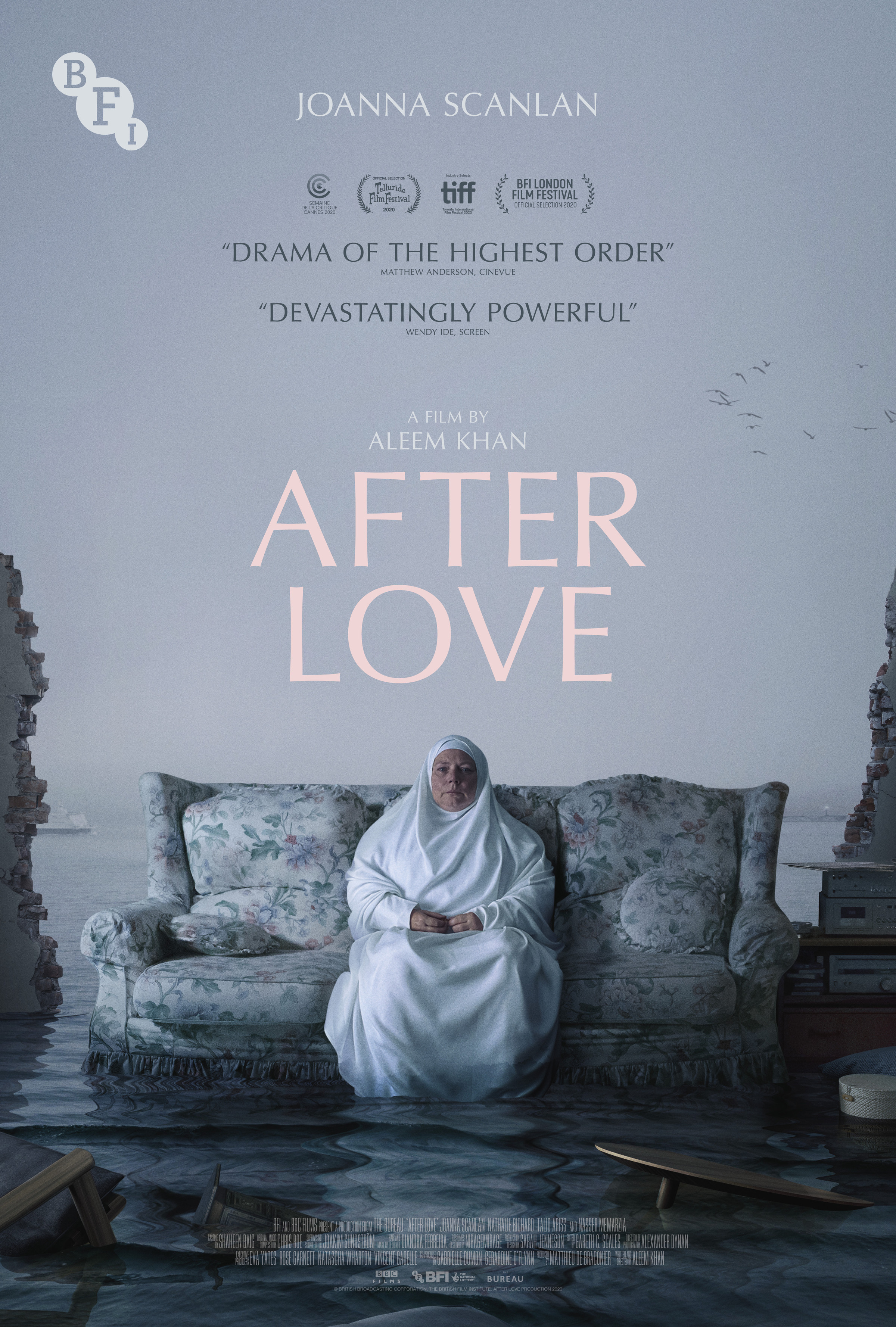
Joanna Scanlan is not an actress that many people are familiar with by name, but anyone who has been paying attention to British film and television over the past two decades will have likely have encountered her at some point. The epitome of a reliable character actress, she often appears in smaller roles in which she is always a welcome presence (even if her characters aren’t always particularly warm in a traditional sense), rather than being someone whose name sells a project. However, this is far from the case for After Love, a film built entirely on Scanlan and her undeniable talents. Mary Hussain is a complex woman who required a performer who understood how forming such a character comes from a combination of broad strokes and small details, since there isn’t one particular way to bring such a character to life, but rather a series of layers through which the performance needs to consistently oscillate, depending on the circumstance. The actress is absolutely phenomenal – it’s a deeply compelling, insightful performance that may often be quite internal and detached, but in a way that piques our curiosity and makes us want to engage further with this woman as she undergoes this metaphysical journey. In a year that has seen numerous incredible performances, Scanlan stands as one of the very best, a beautifully-calibrated work of nuanced acting that simmers with the heartbreaking melancholy that not many performers could bring to such a role. Needless to say, we’re drawn into this world purely through Scanlan’s quiet but powerful performance, so much that we are constantly pulled out of this daze as other characters weave their way into her life, presenting both obstacles and solutions to this challenging period in a life of a woman just seeking a way to work through her trauma.
It goes without saying that trauma has always been a concept that literature has been intent on exploring from all conceivable angles. For many artists, telling stories or using their grief to construct creative works is their method of processing their experience. After Love is built on the aftermath of losing someone, and while it is a fictional work, Khan is drawing from a deep legacy of similarly-themed films that dive deep into the days and weeks following the demise of a loved one, and how difficult it can be to return back to normal, if such a prospect is even possible in the first place. This is represented most prominently in the fact that the protagonist is a white English woman who converted to Islam after her marriage as part of the cultural requirements, but even after losing her husband, who was the impetus for her conversion in the first place, she shows nothing but the most fervent dedication to her faith, demonstrating how belief in some celestial being helps us in times of trauma, as a way of asking for divine intervention in what is very much a difficult period. However, this film is not necessarily faith-based as a whole (with this just being one of the most character-centric details that add nuance to the film), but rather functions as a heartbreaking story of a woman seeking resolution, structuring itself along the conventions of the kitchen-sink realism movement, where these hard-hitting social dramas were presented without any sensationalism, and where the only focus of the filmmakers was to give an authentic depiction of the trials and tribulations of their characters – and while it may not stand as the definitive work in the more modern iteration of this movement, After Love still manages to hit the same emotional beats, carrying a deep nuance that is consistently hinting at the more poignant details underpinning the story, which deftly avoids becoming heavy-handed purely by virtue of the genuine emotions that inform every decision made throughout the film.
After Love is a slow-burning, intensely emotional work of contemporary realism that can often be quite challenging to watch, but never to the point where it becomes unbearable, since everything that guides this film is extracted directly from a version of reality that should be recognizable to a lot of us, even if we may not relate to the specific cultural nuances that inform the film and give it a distinctive tone. It’s a quiet and poignant meditation on the circumstances surrounding a loss, and the challenges that emerge when someone realizes that there are still secrets lurking after death that can be profoundly impactful to how we choose to remember the deceased. Processing grief is not only coming to terms with the fact that a loved one is gone, but also learning of their imperfections, while doing everything possible to maintain the cherished memories, without allowing any new details of their life to tarnish our own experiences. It’s not an easy approach, but Khan proves his mettle as one of the brightest young talents in contemporary British cinema by consistently pressing forward and doing whatever he deemed necessary to tell this story, which has a lot of resonance with a large portion of the population, who may find their own experiences reflected in this heartbreaking but oddly uplifting story of working through loss, realizing that regardless of the exact circumstances, or the impact death has on the lives of those left behind, that there is always a way to pull through, even if it means changing the way we remember the deceased, who may not have been perfect, but are still worth celebrating, irrespective of whatever flaws we unearth in the aftermath of their departure.
 The Postmodern Pelican