
The western genre is a peculiar one – most of the time, it produces films that are mostly enjoyed by devotees to the genre, with those who may not be enamoured with it normally keeping their distance. Yet, it’s one of the few instances where every entry into the genre that is classified as a masterpiece tends to earn it in some way, very rarely not carrying some merit, whether it be in style or substance. Johnny Guitar is considered one of the finest western films ever made, which is not an over-inflation of its charms – it truly achieves every bit of acclaim that it has received in the decades since its release. However, what makes it such an interesting case is how atypical it is as a western. Produced long before the rise of the revisionist western and spaghetti westerns (which were both movements designed to take advantage of the genre and experiment with it in terms of both form and content), Nicholas Ray’s adaptation of the novel by Roy Chanslor is a fascinating excursion into the heart of the genre, taking into consideration the many aspects that have caused audiences to constantly gravitate towards western films, while still playfully deconstructing the format in a way that exposes some of its more notable vulnerabilities, which Ray subsequently fills in with his own distinct authorial voice. It could be a result of Ray not being a director known primarily for westerns (which is the reason many more traditional films tend to be slightly unapproachable, as they’re often made by filmmakers deeply engrossed in the genre), or just the fact that he managed to catch lightning in a bottle and turn in the rare kind of film that is both beloved by devotees to the genre, and enjoyed by some of the more open-minded cynics, which is all part of what makes Johnny Guitar such a wonderfully captivating work that has stood the test of time better than most entries into the genre.
If someone was to seek out a film designed primarily for people who dislike westerns, Johnny Guitar would be the best example of a classic era entry. It doesn’t go against the principles of the genre, but rather presents them in a radically different way. This is not the cheaply-made action thriller that focuses on the bravado of its rugged, masculine heroes, but rather a deep and insightful character study that refuses the clear-cut boundary between “good” and “evil” (a common conceptual foundation on which many classic westerns were based). In fact, there’s even an argument to be made that Johnny Guitar isn’t actually a western, but rather a melodrama that just so happens to be set in the Old West. This might be taking it a bit far, but it’s not impossible to see where this burst of enthusiasm comes from, since this is an oddly complex work that doesn’t always play by the rules. Ray’s filmmaking reflects the two primary purposes of a decent genre film – it manages to be both remarkably accessible, not being weighed down by expectations of the western format (which is a common problem with many western films of this era, since their main priority is to follow a certain pattern that has supposedly been earmarked for success), while still celebrating the qualities that has allowed it to persist in one form or another since the outset of cinema. The director accomplishes this through a number of methods – the writing is excellent, particularly in showcasing the intimate, character-driven moments, and the director engages with each individual scene. Even the most inconsequential piece of exposition has a clear purpose in the overall story, and Ray doesn’t waste any of the time, making for a remarkably economical film that cuts to the chase, but doesn’t neglect the more compelling moments that occur between major scenes. In many ways, Johnny Guitar has the most meaning when we least expect it, which only elevates it further into being one of the most captivating films of its kind.
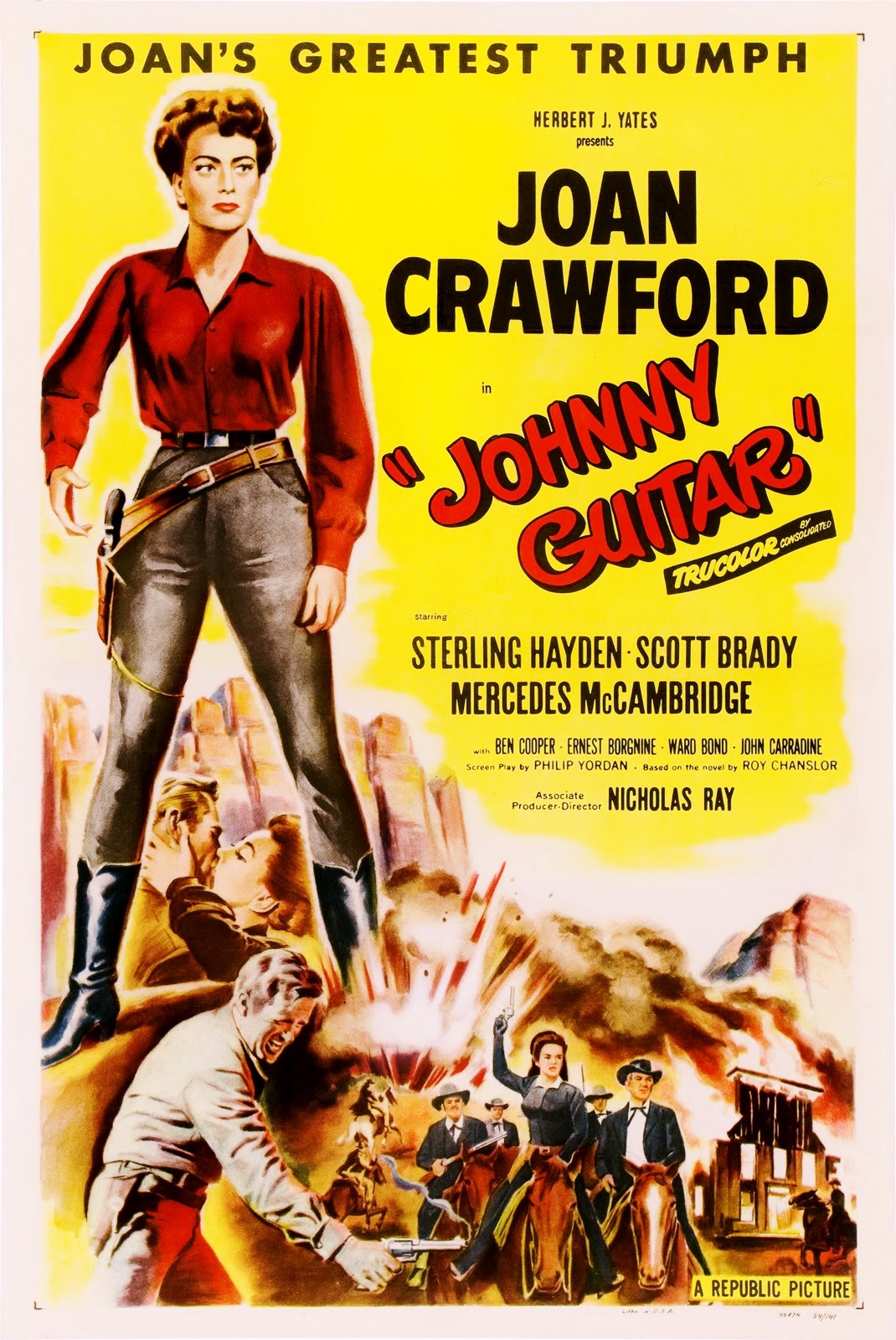
Ray may not have had much experience in the western genre, but he was a seasoned director of film noir, having made some of the most profoundly moving films under that genre, with many of them featuring very strong characters that usually elevated the plot all on their own. He brings the same sensibilities to Johnny Guitar, transposing many of his more well-known methods of extracting strong performances from his actors from the gritty streets of contemporary 20th century America, to the dust-filled landscapes of the Old West, and still manages to make it seem perfectly natural. As talented a filmmaker as he may be, there wasn’t much need to be concerned about whether this film would be in good hands in terms of stars, since the incredible Joan Crawford was at the heart of it, turning in one of her most iconic portrayals as the wilful and steadfast Vienna, a woman who grows so tired of her humdrum life as an object of desire, she decides to take matters into her own hands, becoming one of the most fearful figures in the region, purely on the basis that she dared to stand up for herself. Crawford is naturally absolutely impeccable in the role, using the platform to not only showcase her well-known talents, but proving that she was perfectly adept when it came to genre work. Crawford was one of the more diverse performers of the Golden Age of Hollywood, frequently showing that she could traverse many genres (some of them even in the same film), while still keeping with the general persona that we have grown to appreciate. She’s so good, not even the de facto lead of the film, the titular Johnny Guitar as played by Sterling Hayden, makes much of an impression, despite being very good. Mercedes McCambridge has a smaller but pivotal role as the town’s resident hysterical villain, rousing up the locals to genuinely believe that an independent woman (who she clearly has a personal vendetta against) is actually malicious. Johnny Guitar works well almost entirely as a result of a strong cast that were willing to venture into the unknown with Ray, who in turn pulled out career-best work for many of them.
Somehow, Johnny Guitar manages to be high-concept without collapsing into its own ambitions. Ray was clearly intent on making a different kind of western, but rather than deviating from tradition too much, he instead follows the general consensus of what a western was supposed to be at the time, but inserts some compelling commentary in other areas. This is obviously most prominent in Crawford’s character, with her portrayal of the headstrong Vienna showing an inverse to the traditional western – rather than the dashing cowboy being the hero, it’s instead the resourceful female saloon-owner who serves as our protagonist. This doesn’t mean that the film doesn’t focus on the titular character either, but nearly everything Johnny Guitar does is filtered through the female perspective of either his paramour Vienna, or the malicious Emma Small, who herself proves to be a very unconventional villain. Female-driven westerns may not be remarkable by modern standards, since we’ve seen many films place women in increasingly complex roles, rather than having them as mere objects of desire – but considering Johnny Guitar was made during a time where such an approach could be considered a risk, we have to give kudos to Ray and his collaborators for insisting on telling this story as it deserved to be, openly embracing the feminist leanings rather than softening their impact through drawing attention to one of the less interesting supporting characters. Structurally, Johnny Guitar may not be all that impressive, but taking into consideration the various other qualities it has, and how it deals with some tricky subject matter, it’s an absolute triumph, and Philip Yordan does exceptionally well in writing a witty, enthralling screenplay that pay sufficient tribute to the source material, as well as to the genre as a whole.
However, there is more to Johnny Guitar than just the performances and the screenplay, and a lot of credit must be directed towards Ray for taking these components and elevating them to the point of an absolutely exceptional western that is as visually captivating as it is narratively engrossing. Filmed gorgeously in Trucolor (a cheaper version of Technicolor), the design of the film contributes to the general sensation, and draws us even deeper into this world as a result of the visual splendour that played a significant part in the development of this story. The Old West has never looked quite as colourful as it did here, but through avoiding making the film appear garish and overly saturated to the point of artifice, Ray creates a lush and captivating melodrama that interweaves some stunning action sequences into the proceedings, finding the perfect balance between the two genres in a way that not many filmmakers can confidently attest towards. Ray was a skilled filmmaker, and working alongside director of photography Harry Stradling, whose cinematography is absolutely spellbinding, Ray fashions an unforgettable western that may have a lot of grandeur, but never comes across as inauthentic. It lacks a lot of the grit of many westerns at the time, but it still has a lot of nuance, and even at its most opulent, there’s depth to the film that elevates it beyond simply being an exercise in extravagance. This film outwardly avoids being purely style over substance, and carefully curates the story in such a way that it’s working alongside the images, rather than in service of it (and vice versa). It’s one of the more potent examples of symbiosis existing between form and content, and it deserves just as much credit for its artistic sensibilities as it does the subversive story at its core.
Effort went into both the narrative and visual scope of Johnny Guitar, and the result is a deeply captivating western that both pays tribute to the genre while still dismantling it in creative and often unexpectedly profound ways. It isn’t always free of shortcomings, and some of the film can be considered to be rushed – but this barely registers when the sheer splendour is enough to compensate for the smaller, more inconsequential problems. Whether it be Yordan’s impeccable translation of a pulpy western novel into a captivating screenplay, the masterful performances from its ensemble cast, led with conviction by Crawford in undeniably one of her greatest screen performances, or Ray’s ability to turn these smaller components into a powerful, engrossing western, there is something undeniably special about what he was doing with Johnny Guitar, a film built on the dual notion of both honouring the genre and taking it in new directions. Its status may be that it’s one of the most important films of its era, but this is far from an empty sentiment – there is a clear reason as to the success of this film, and while it has persisted for over half a century, especially after more seemingly captivating westerns have receded into obscurity. On one side, it’s a raw and gritty action thriller that reminds the viewer of the strengths of the western genre. On the other, it’s an insightful and enthralling drama that doesn’t dedicate itself entirely to the genre, and thus manages to alter it to fit its individual narrative needs. Johnny Guitar is a multilayered, complex film that is brimming with life and the unique energy that really only comes from the realization that sometimes the most compelling works are those that are simply the result of a story well told, which perfectly encapsulates the iconic world into which Ray immerses us.
 The Postmodern Pelican