
“If you don’t like this…we don’t care”
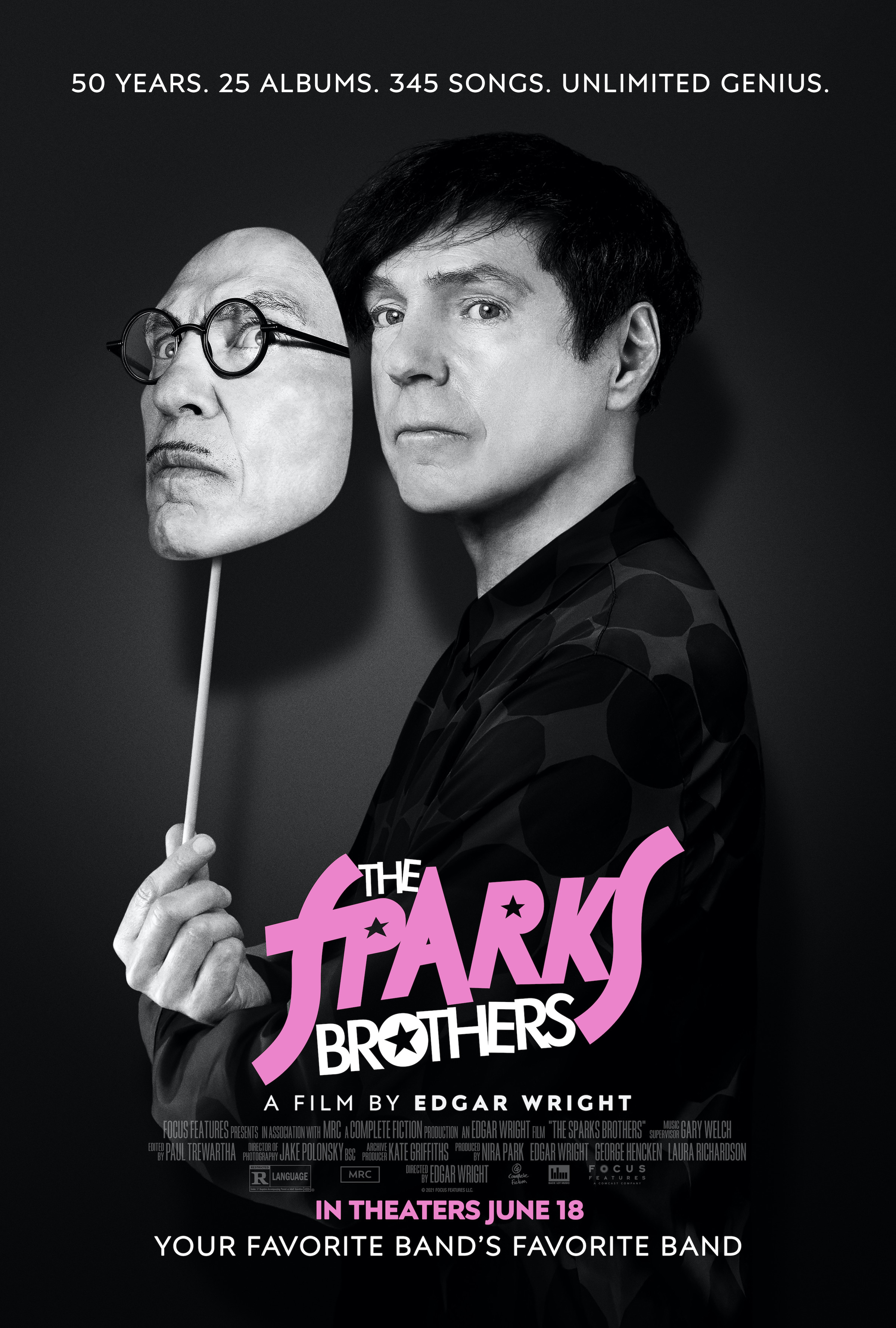
I remember the moment I became aware of Sparks – the faded, worn-out live recording where two peculiar individuals emerged onto a stage and performed a song I would soon come to learn was entitled “This Town Ain’t Big Enough for the Both of Us”. There’s a moment in The Sparks Brothers, the absolutely stunning documentary focused on the duo, where director Edgar Wright has several high-profile individuals from different industries attest to their first experience encountering the band – and without fail, they all point to this particular song. This wasn’t merely one of Sparks’ biggest hits, it was a revelatory moment in music history, the precise instant one of the most unique bands to ever work in the industry reached something very close to global stardom. Yet, how is it possible that Sparks remains so obscure, if so many of us have such vivid memories of being captivated by their music? Two dozen albums, nearly a thousand songs and fifty years in the industry should be enough to immediately qualify someone as a legend. This is where a change of thinking is necessary – Ron and Russell Mael are indeed legends, it’s just the rest of the world that hasn’t been exposed to their genius has to catch up. Wright, in what is possibly his most extensive passion project since becoming a major filmmaker, undertakes the intimidating but incredibly important task of telling the story of Sparks, undeniably one of the most influential musical artists of all time, albeit a band that has remained shrouded in mystery since their debut in the early 1970s, as a result of both their intense privacy, and the industry often never knowing quite what to do with them. The Sparks Brothers pulls back the curtain and allows us into the mind of both of the Mael Brothers, the people that constituted Sparks throughout the years, and the numerous fans, whether famous or not, that have been devoted to celebrating these incredibly strange, but unequivocally talented, artists for the past few decades – and there has never been a better time to revisit their incredible career than this year, which marks exactly fifty years since Sparks began making music.
As blasé and forthright as the opening quote may be (which is directly taken from this documentary, where it is spoken by Ron Mael), it’s a perfect way to encapsulate the entire career of Sparks, a group that has rarely given a second thought to the opinion of the dissenting voices. Never artists that had any interest in following the mainstream, or allowing the supposed advice of detractors dissuade them from following their own ambitions – and as a result, we have half a century of rich, evocative music that spans every conceivable genre, and has played as much of a part in the development of modern music as any other influential artist. Yet, despite their importance in the industry, they had a tendency to consistently (and ferociously) tearing up the very rule-book they helped in writing. It’s not a matter of refusing to rest on their laurels, but simply rejecting the entire concept of dwelling on their past successes entirely, at least in terms of never allowing it to interfere with their continuous growth. As we see consistently, there is never time for them to meditate on work that already exists – they’re progressive artists in both senses of the term, both working to push boundaries in modern music during each of their particular eras, while also looking towards the following phase, perpetually developing the next album or high-concept production that would both test their musical skills, and allow them the emotional and creative catharsis many artists strive to achieve. This makes them incredibly unique, interesting individuals, but also proves that pinning them down to a particular style or set of ideas isn’t difficult, it’s entirely impossible. If anyone was going to not only appreciate this, but actively embrace it and turn it into something special, it would be Wright, a director who has adopted a similar method of exploring his craft and trying new methods of storytelling, making the director and Sparks an unexpectedly perfect pairing.
Art influences art. This is the foundation of postmodern thinking, and how not even the most gifted artists are able to escape the fact that nothing is necessarily original, but rather sourced from a number of other works, which exist in dialogue with one another. Sparks have always been fiercely committed to representing this concept in their work, with their endless stream of productivity resulting in some of the most unique and engaging compositions, which has allowed them to have the title of “The Elder Statesmen of Pop” bestowed on them, as directly mentioned by one of the interviewees here. The creative process of any artist is fascinating, and just getting a slight glimpse into their routine and the methods they take in creating their work is an invaluable experience – so the blessing that Wright endowed on us with this detailed account of Sparks, who not only allow the director to venture deep into their past (with an array of wonderful anecdotes coming on behalf of both the subjects themselves and the many people with whom they have crossed paths in their storied careers), but also to give audiences unprecedented access into one of the most unique artists of their generations and their process of becoming this cherished duo that redefined music in their own substantial way. Considering how notoriously private Ron and Russell are, a fact that is constantly mentioned in the film and even becoming a source of humour (with Jason Schwartzmann, a devoted supporter, claiming that he has grown so accustomed to being completely unaware as to who these men are, he isn’t even sure if he wants to know anything about them), it’s an almost historical achievement that Wright was able to get such unrestrained insights into their lives – and while he does allow for the same mystique to persist by not pushing to get too many details on the brothers’ personal lives, there is content here that has never been seen or heard before, particularly when it comes to how their artistic journey.
Undeniably, The Sparks Brothers was designed mainly for those who have some knowledge of Sparks, functioning as the kind of late-career retrospective aimed at giving devoted fans the chance to engage with their artistic idols – yet, it isn’t entirely necessary to be deeply aware of the group’s career. Wright is the kind of director who actively avoids alienating his audience, with prospective viewers being eased into this world – a wonderful introduction immerses us into the world of Sparks, functioning as a reminder for those who are aware of the band, and a good entry-point for novices. It’s accessible, interesting and informative – and while my own biases prevent me from saying exactly how effective it is in being an introductory text to the band, it seems quite obvious that the director made something that provides solid, succinct reasons for Sparks’ legacy as one of the most revolutionary bands to ever record music. Whether it be in the fascinating style of interviewing, which combines anecdotes, first-hand testimonials and an abundance of passionate attestations of admiration from fans, the film easily justifies the importance of its subjects. A documentary shouldn’t necessarily strive to only be an objective work of non-fiction – when done well, it can be a good way to shape perspectives and introduce new viewers to older content, in a way that is accessible and interesting. Wright, despite having never made a documentary before The Sparks Brothers, does well in curating the definitive text on the band, or at least one that can be considered the closest we’re ever going to get to one. For fans, the film is a potent reminder of why we love Sparks in the first place, and for those who are new to the duo, it will hopefully pique their interest enough to explore the prolific and iconic career of the band. You don’t need to have an extensive knowledge to appreciate this film, since we learn very early on exactly why Sparks were such geniuses.
If there is one lesson that comes through in nearly every frame of The Sparks Brothers, it would be that reinvention is never a bad idea, and that remaining stagnant, while a logical step for many artists, doesn’t always yield the most positive results in the long run. This film is as much about showing Sparks and their creative process as musicians that have been impacting music for decades as it is a revealing portrait of the music industry, focusing on the ebb and flow of success and failure that many artists experience. While they may not be the most well-known band, there is something about filtering these ideas through the perspective of Sparks that bolsters the meaning, especially since this discussion relates to the concept of identity, and how an artist defines themselves, which is far more important than how audiences and critics classify them. A large portion of this film is dedicated to exploring the works that influences Sparks – whether musical, cinematic or drawn from the culture in general, they had a wide-ranging set of resources that helped them in shaping the band they would become. It’s peculiar to speak about Sparks in the past tense, because they remain as active as ever, and are a group that constantly evolves – the lineup has changed over the years, with only Ron and Russell remaining consistent. However, as we can see in the interviews with former band members and collaborators, there are very few hard feelings that exist between them – the nature of the group was one that was constantly changing, and everyone knew they weren’t in this for the long-haul, but rather a key component of that particular era. When an artist’s primary quality is their tendency to constantly change their image, one can’t expect anything to remain the same. Sparks, as influential as they may be, are still a band that went through the same struggles as all others, and whether in the case of their story, the bands that inspired them, or those that were subsequently influenced by their work, The Sparks Brothers asks the eternal question of how does an artist maintain their identity, when said identity is always subjected to constant change? Provocative but insightful, the film does offer some answers, albeit in Sparks’ traditionally opaque and playful way.
More than one interviewee in The Sparks Brothers, when referring to one of the many moments of success experienced by the band, claimed that this particular moment represented the idea that “Sparks is back”, which becomes a constant refrain, especially since this film doesn’t avoid discussing some of the more bleak moments of failure the brothers experienced in their long career, since one doesn’t exist as a group for so long without going through a few rough patches. However, this is a strange assertion, since how can a band be back when they never left in the first place? For the past fifty years, Sparks has been producing an exhaustingly brilliant array of songs, releasing albums regularly and consistently changing their style and image, while still remaining true to their own curiosities as artists. A funny and insightful portrait of two brothers who simply took the risk to become musicians that refuse to play by the rules, and a fascinating voyage into their long and varied careers, the film is absolutely incredible, a 140-minute long journey that somehow manages to feel like both a sweeping odyssey of their careers and the changing music industry as a whole, and an intimate, meaningful portrait of two artists so incredibly dedicated to their craft. Wright makes sure to direct this film in a way that allows us access to the lives of these fascinating figures, while still affording his subjects the chance to remain as mysterious as they have for their entire careers, giving them the opportunity to speak with candour, while never fully letting us know exactly who they are – and considering how much of what makes them brilliant is that we essentially don’t know too much about them, this seems perfectly appropriate. I personally can’t wait to see what Sparks does next, but if this detailed chronicle of their career proves anything, it would be to expect the unexpected, which audiences have been doing for half a century – let’s just hope that their next fifty years are just as incredible.
 The Postmodern Pelican