
No one did absurdity quite as well as Eugène Ionesco, one of the most fascinating playwrights to ever work in the theatre. While he isn’t massively popular outside of theatrical circles, as well as amongst literary communities, the author’s work has remained poignant and captivating, decades after his plays were first staged. His most significant works are arguably Exit the King and Rhinoceros, the latter of which was the subject of a compelling film, adapted by esteemed stage director Tom O’Horgan, who took Ionesco’s surreal story of a widespread crisis that befalls a small town somewhere in America, where the residents slowly find themselves turning into rhinoceroses for no apparent reason. Perhaps the story of a pandemic that slowly starts to infect the population is inappropriate considering the current state of the world, and what we have been forced to endure for the last two years, but there is something so electrifying about Rhinoceros, a kind of maniacal prophecy that makes light of a situation no one could predict was actually going to have resonance nearly half a century later. O’Horgan, accompanied by a dedicated cast and crew, surrender to the strange charms of Ionesco’s text, and take us on this bewildering journey into the heart of a version of America where one’s biggest concern isn’t economic growth, upward social mobility or even just plain happiness: it’s trying to avoid turning into an enormous, destructive animal, and if this isn’t enough reason to at least pique the curiosity of open-minded viewers, then very few comments about this gloriously deranged dark comedy ever will.
It seems almost lazy to look at Rhinoceros through the lens of postmodernism, since Ionesco was a prominent figure in the development of the Theatre of the Absurd, which essentially worked in tandem with the rise of pop art in the visual sphere, and the growth of metatextual literature, to create the movement that has essentially not abated for the past fifty years. To call this a postmodern text is simply a way of reiterating the extremely obvious – but when we look at it, we can easily see the reasons why it has come to be definitive of the movement. In this world, absolutely nothing makes sense – but to the characters (with the exception of perhaps the protagonist, who serves as the audience surrogate), there is nothing amiss or out of the ordinary. Life goes on as usual, even when the population is gradually metamorphizing into rhinoceroses. There isn’t any explanation for why this happens, but it’s established quite early on that this is not a film that will attempt even the slightest amount of providing any rhyme or reason to the proceedings. It’s this disorienting, darkly comedic perspective of humanity that made Ionesco such a fascinating writer, and helped his work stand the test of time, since there is nothing that can bind audiences across generations and geographical boundaries more than the outright confusion at seeing a psychological thriller centred entirely on the process of ordinary citizens turning into animals, which has delighted and bewildered viewers for as long as this play has existed.
Yet, despite the strange nature of the story, there is certainly a sense of method to the madness that comes about in this film. Postmodernism isn’t only about polarizing viewers, but also changing their perception of certain issues by filtering some deeper discussions through the guise of more peculiar stories. The more detached from reality these narratives are, the more effective they become, since the heightened sense of absurdity lends itself to some very insightful analysis. On the surface, we’d think Rhinoceros is relatively simple – a small town is terrorized by some metaphysical condition that slowly turns its residents into the titular animals. Yet, it would take a very vacant viewer to expect that this is where the intentions of the story end, since there is obviously much deeper meaning, and we’re encouraged to use our own perspective to uncover the mysteries that sit at the heart of the film. It helps that postmodern thought never proposes that there is a single definitive meaning to anything in life – it’s all a matter of perception and embracing our own interpretation, and this film does exceptionally well in tying all these components together and delivering it in the form of a wildly funny satire that always carries a sense of intrigue, when when it is at its most oblique. We’re allowed to have fun with this film, unpacking the various narrative layers and peering deeper into its very peculiar form of social satire, which only increases the impact of the underlying commentary, the specific content of which is up to the individual viewer to decide for themselves.
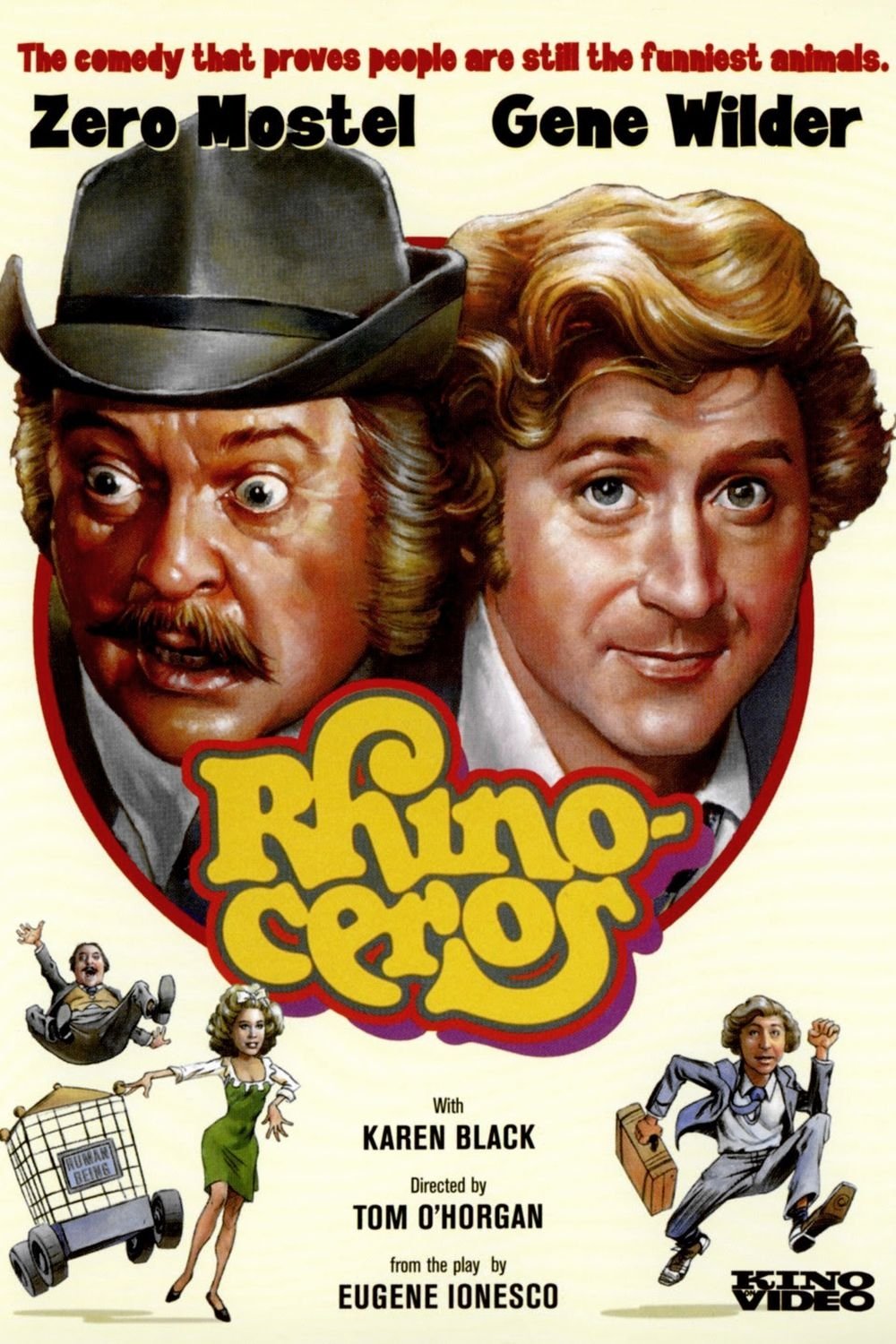
There’s a theatricality to Rhinoceros that makes it such an immersive experience. The story itself is absurd enough to pique our interest, but the only way it will be able to maintain it is if the smaller elements are pitched at the same level. The film sees the reunion of Zero Mostel and Gene Wilder, who had worked together in Mel Brooks’ revolutionary The Producers a few years before, with O’Horgan and producer Ely Landau taking the opportunity to cast them across from each other again and hopefully rekindle the magic that came from their insatiable chemistry. While it’s perhaps not nearly as compelling as their prior collaboration, Rhinoceros does play off their charms exceptionally well, with Wilder once again portraying the luckless straight-man, and Mostel the eccentric, vaguely bourgeois hedonist. They both understand the theatricality of the piece (especially Mostel, who had previously originated the role of Jean, here renamed as John, in the Broadway premiere), and manage to make sense of the madness contained in the dialogue, bringing their distinctive personas to a pair of roles that could’ve easily have been insufferable had there not been a concerted effort to develop them. It would be easy for any actor to get lost in a film like Rhinoceros, one of the few instances where a film is driven less by a particular character, and more by a premise – but emerging through the frenzied spectacle are a pair of wonderful performances, as well as an equally brilliant (but unfortunately smaller) portrayal given by the drastically underrated Karen Black, who also manages to constructively succumb to the bewildering nature of this film.
Despite the hurried madness of the premise, Rhinoceros is in absolutely no rush to tell its story. It takes its time in unveiling some very peculiar ideas, with O’Horgan managing to make sense of an undeniably strange text, taking it from a wonderfully impenetrable work of experimental theatre, and translating it to the screen in a way that the pure absurdity contained on the page is reflected just as strongly on film, where it has been committed for future generations to relish in the polarizing brilliance of a playwright as unusual as Ionesco. This is an atypical play turned into an even more unconventional film, the likes of which are very rarely found outside of experimental and underground cinema – and this is precisely where the subversive nature of this film comes into effect, since it dares to try and present the author’s exceptionally odd ideas in a form that is palatable for wider audiences, but without ever dulling the bizarre spark that made the original text so fascinating. It may not always work as well as it should, and it can occasionally be somewhat rough around the edges – but as both a piece of diverting entertainment, and a deeply disconcerting voyage into an alternative, uncanny version of a world that is barely recognizable, Rhinoceros is a worthwhile way to spend one’s time, since it dares to be different, never adhering to any known laws of logic (artistic or otherwise), and instead just being a firm, steadfast work of pure creative anarchy, facilitated by some of the most provocative and experimental artists of their era.
 The Postmodern Pelican