
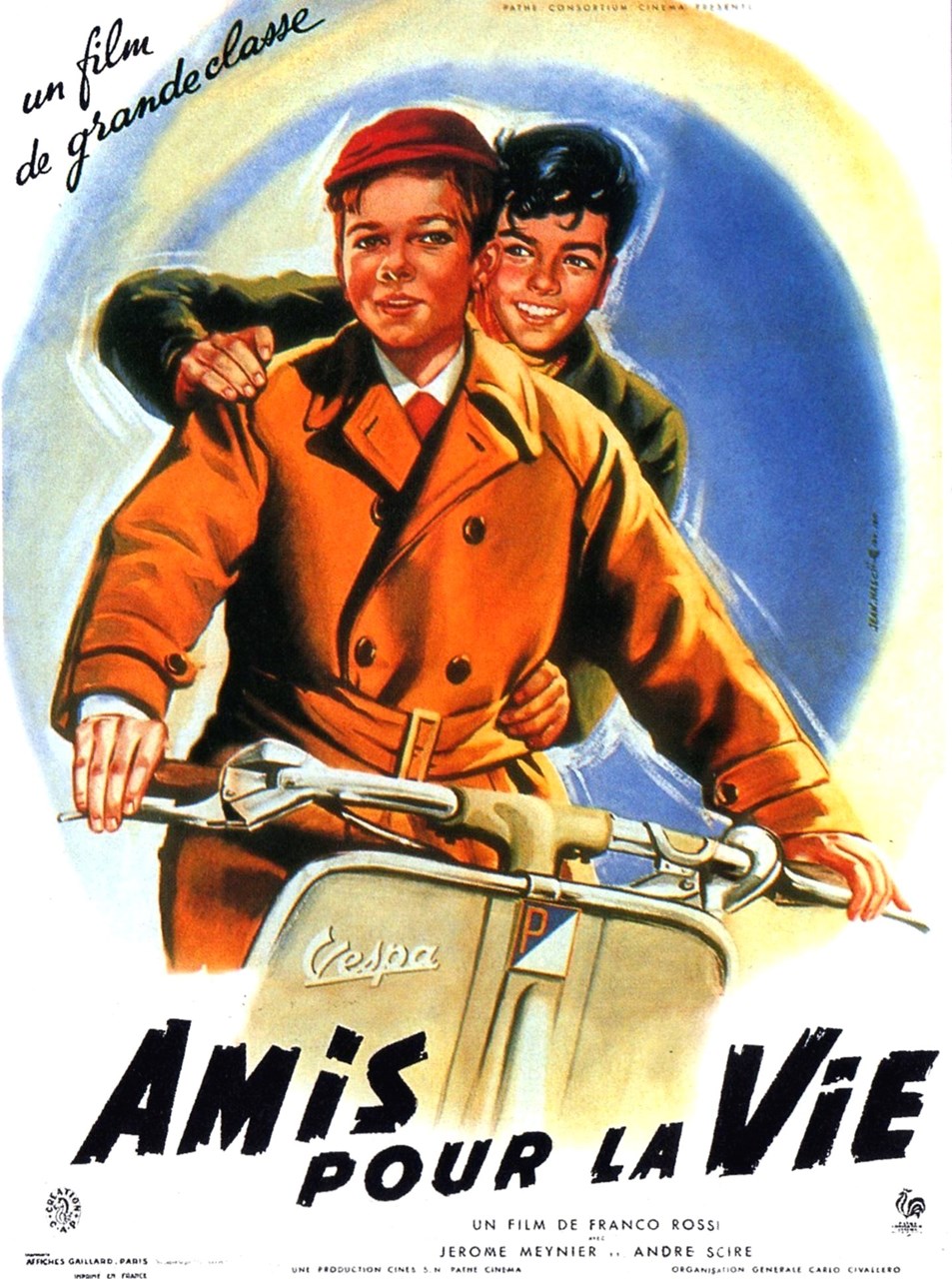
Mario (Geronimo Meynier) is a bit of a slacker – he doesn’t particularly like school very much, and he dreads going home to his working-class family, since while they do have his best intentions at heart, their approach to raising him has always been defined by stricter morals, which aren’t compatible with his more rebellious nature, as he’d prefer to have fun than work hard. Upon arriving at school late one day, he finds his regular seat occupied by Franco (Andrea Sciré), a new student who saw the open space and decided to sit there. This kickstarts a rivalry that very soon becomes a friendship, especially when the two boys learn about the other’s life. Mario comes from a poor household, while Franco is the son of an ambassador, having returned to Italy after several years abroad, which has equipped him with many skills that have put him ahead in life, something that Mario may never have the opportunity to experience. Yet, despite their differences, they become very close friends, starting with their shared interests and mischievous perspective on the world, and gradually becoming something deeper, with the pair finding that they help fill the void of loneliness that the other feels. It isn’t long before they’re “friends for life”, integrating into each other’s households in a way that suggests a firm, long-term brotherhood, rather than just a schoolyard friendship. However, their companionship goes through all the expected obstacles, being tested by their own growing challenges in their individual lives, and the fact that, once you get to know someone inside and out, you realize their flaws, which can sometimes become a problem if they don’t show much interest in resolving them. However, they ultimately come together in a way that allows them to work through these problems, and emerge stronger than ever before.
Friendship is one of art’s most beloved concepts – so many creative individuals have looked at the concept of companionship through their own unique lens, and managed to make some profoundly moving statements on the nature of finding someone with which to share the good times and bad. Whether lifelong companionships, or brief, seasonal friendships, we’ve seen these stories delivered in a variety of forms. Franco Rossi, a journeyman filmmaker who isn’t as well known as other Italian directors working at the time, made one of the most touching odes to childhood friendship of its era, the exquisite Friends for Life (Italian: Amici per la pelle), a moving, funny odyssey about two young boys finding each other by chance, and realizing how they are each other’s salvation, the friend they may not have known they needed, but wouldn’t replace for anything. It’s a simple film, a lovable little comedy about the trials and tribulations of a friendship, told through the lens of two adorable young men who serve as the protagonists of the story. Yet, there is an unexpected amount of depth lurking beneath the surface, a quality that feels very genuine, especially in how it doesn’t present the world as an idyllic place, and shows its ability to deconstruct the idealistic vision of the perfect life, demonstrating that even the happiest of individuals are plagued with internal quandaries that can drive them absolutely mad if they’re not adequately controlled. Beautifully poetic, but driven with a sense of effervescent humour, Friends for Life is an absolute delight that may be simple, but packs an emotional punch unlike many other similarly-themed films, which tend to be far more blasé about some serious issues, which here instead serve as the foundation for the story.
The coming-of-age story is one that does often yield some fascinating insights into the roots of a friendship. The vast majority of us fondly remember those companions who helped make the schooldays somewhat more bearable – some of them persist and remain our friends later in life, the others weave their way out of it, in the process of each person going their own way after a while. The adage that “some friends come in your life for a reason others, just for a season” is certainly very true, and applicable to stories that look at the roots we form when we are younger, and the connections we make with other people. Friends for Life, as the title suggests, is about a pair of children who become close, and work through their individual challenges while building their friendship, which they are hoping can last their entire lives, since all it takes to feel a sense of belonging is one good companion, which appears to be what they realize in the process of nurturing their growing relationship. Child protagonists are always interesting when it comes to telling stories, since seeing the world through their eyes is a profoundly different experience to seeing it from the perspective of adults, whose understanding of the world may be far more cynical and weary than those who have only recently become aware of their own agency. Friends for Life works with the conventions of younger narrators very well, managing to show them navigating some of life’s inevitable difficulties without being too overly twee at one extreme, or excessively heavy-handed on the other. Rossi strikes the perfect balance, and carefully curates this lovable story of friendship, filling it with good-natured humour and a much-needed dose of peculiar energy that makes it so enthralling, and allows him to touch on some slightly more complex issues in the process.
Friends for Life is such a beautifully natural film, and stands out as one of the more subtle entries into a multitude of Italian comedies that were a lot more eccentric and madcap. Rossi’s humour leans more towards the quieter, more sincere moments of human connection, where joy is derived from that magical spark that occurs between two people when they discover that they’re compatible, and which the director uses very well in setting the foundation for this loving tribute to friendship. His vision is realized through the absolutely impeccable performances provided by Geronimo Meynier, as the working-class Mario, and Andrea Sciré, as the diplomat’s son. They may come from different socio-economic backgrounds, but something these characters share is their desire to break free of the confines of their domestic life – the one wants to be free and experience the world liberated from all constraints of his working-class background (where poverty often dictates how free one actually is), while the other just wants to live an ordinary life, and be a simple young man, rather than carrying the reputation of wealth and influence, which is far more of a hindrance than he imagined it would be. Both actors are impeccable, and they bring a sense of naturalism to the roles – Friends for Life is rooted within the neo-realism movement that had been quite prominent in Italian cinema around this time, and while it may not be nearly as bleak and harrowing as most, it does borrow the sense of authenticity, reflecting life in its most genuine form, which it does through the spirited performances by its two leads, who play these roles with remarkable conviction, always looking for the truth underpinning their individual characters, and forming a strong relationship with their co-star. It’s immensely impressive that these two actors managed to achieve such complexity at such a young age, especially considering how, beneath the surface, Friends for Life is quite a complex film in terms of the emotional nuances it had embedded in its fabric, and the story it had to tell.
It doesn’t matter who you are, Friends for Life is certainly going to resonate with most viewers, particularly through its ability to reduce its fascinating story to the very basic core, focusing on the fundamental aspects of finding friends and maintaining a strong relationship with them. It isn’t a necessarily complex film – Rossi isn’t in search of some definitive statement on the trials and tribulations of a youthful companionship, which is reflected in the very simple but effective filmmaking. The humour is juvenile but still very entertaining, and it hits some remarkable emotional targets, burrowing its way into our hearts, and telling a story that we will all be able to relate to in some way. It’s a beautifully simple glimpse into a growing friendship, and carefully strips away the layers of comedy to reveal a charming, honest exploration of how any relationship, whether built on shared interests or just a general compatibility, is going to encounter some degree of challenges – the key isn’t necessarily to avoid these obstacles, but rather overcome them, and hopefully emerge on the other side with a stronger, more solid respect and mutual admiration for one another. Friends for Life is just a truly lovable excursion into the minds of two young men finding who they are through seeing it from another perspective – and in its this approach that Rossi is able to make some of the most profound statements of them all, and leave us thoroughly enthralled at the depth of his understanding of the simplest joys in life.
 The Postmodern Pelican