
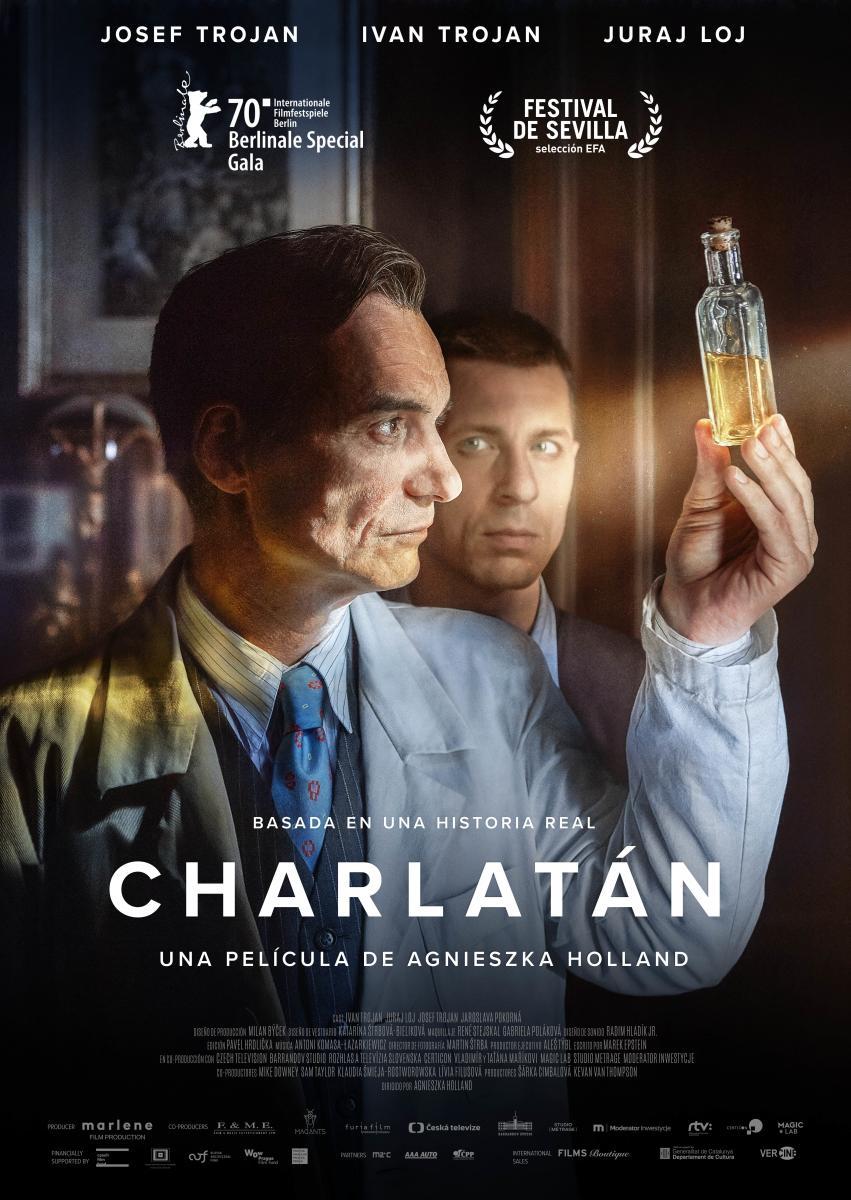
Jan Mikolášek was a fascinating figure in the history of the Czech Republic during the 20th century – a self-proclaimed healer that used his deep knowledge of herbs to create alternative medicines that he claimed saved the lives of countless people, his estimation being well over a million, which caused him to become quite a divisive figure in the world of medicine, especially at a time when there was a concerted effort to provide better healthcare through the perpetually-growing medical industry that was making major scientific advancements at the time. The exact facts are more obscure, since the amateur doctor is more known for a highly-publicized legal battle, whereby he was accused of murdering two of his patients when strychnine was found in their system, leading to their immediate death, which is traced back to the doctor, who does everything he can to prove his innocence, despite the very clear case being built against him. This story is the subject of Charlatan (Czech: Šarlatán), the conventional but effective biographical drama by journeyman filmmaker Agnieszka Holland, who continues her streak of directing films that are solid in execution, memorable in delivery. It’s an appropriate glimpse into the life of a fascinating historical figure, whose story may not be entirely revolutionary, but is still strong enough to qualify this film’s status as a worthwhile piece of biographical storytelling – and Holland has continuously proven herself a very gifted filmmaker who can turn the most conventional stories into thrilling and insightful experiences, which is easily applied to Charlatan, a film that pays attention to the smallest details and integrates them into the broader narrative, creating a multilayered story that pays homage to a very interesting individual whose life is the subject of this striking film.
Charlatan is not a film that does too much that we haven’t seen before – by all means, Holland made a by-the-numbers biographical drama which features all the common components of such a film, including shifting narratives between the present day in the life of its subject, and flashbacks into their past (where we see them develop the skills that would form the foundation of the film), as well as a lot of tension drawn from the director’s aim to tell this story in a way that is both captivating and honest to the subject. However, there are some truly interesting elements to this film, which suggest that it’s a lot more complex than a cursory glance will lead you to believe. It may stay quite close to convention, but it never feels as if it is adhering to the rules that prevent it from being interesting. Holland has had quite a varied career on both sides of the Atlantic, her career in America being one defined by more straightforward productions for film and television, while her European endeavours see her experimenting with form and content, the freedom she was afforded allowing her some additional space to explore her curiosities as an artist. Working alongside Czech screenwriter Marek Epstein, whose prolific career has seen him tackle many fascinating subjects, Holland is able to craft a meaningful biographical drama that explores the nuances in the life of a man whose work saving many lives is obscured by his unfortunate encounters with the law, which facilitates a tense but moving drama that ventures deep into his career, put together by some artists who understand that history hasn’t necessarily been kind to Mikolášek, and thus clearly are intent on presenting a more objective demonstration of his life.
In terms of telling the story of Mikolášek, Holland and Epstein had a lot of work ahead of them, since he’s not an individual that is particularly well-known even in his native Czech Republic, so making an internationally co-produced drama about his life for a global market seemed like an enormous challenge, since on one hand, it allowed the filmmakers to introduce this fascinating story to a wider audience that likely had very little familiarity with the subject, but also the burden of telling the life’s story of a man whose existence isn’t entirely as well-documented as more traditional subjects, particularly the details surrounding his earlier life, and his career before his criminal trial (which are presented differently in this film – the actual crimes Mikolášek was convicted of are not factored into this film – there isn’t any clear reasoning behind changing the nature of his crimes outside of being for the same of dramatic tension, which is understandable, if not slightly disappointing). As a result, the film seems to be struggling with the challenge of being the definitive text on Mikolášek’s life, which had many different components that would make for thrilling films entirely on their own. It often feels as if Holland was making three very different versions of the same story – the gorgeous flashback sequences set in the idyllic Czech countryside are beautiful, while the subject’s actual practice of alternative medicine is fascinating. Contrasted with the grim and bleak sequences set after his arrest, Charlatan is constantly shifting – and while it’s understandable that there would be some degree of difficulty in capturing the full scope of his story, the frequent tonal shifts can be quite jarring and pull us out of the story every time it suddenly changes. It doesn’t ruin the film, but it just makes us yearn for a more seamless execution, especially from someone as seasoned as Holland.
However, Charlatan is more of a character-driven piece, so in the same way that we should give credit to the director and screenwriter for facilitating our introduction to Mikolášek, we also have to celebrate the actor tasked with bringing him to life. Ivan Trojan is a veteran of Czech cinema, having appeared in many major productions throughout his career – and this film in particular is a worthwhile reminder of his skills as an actor. Taking on the role of a man who genuinely believed he had the ability to heal anyone through his supposed “magical” touch and intuition, Trojan had a lot of work ahead of him – and while the film that surrounded him may not be particularly perfect, his investment in the character is reflected in his stunning performance. This is a classic case of an actor doing more than was required, and in the process elevating the film beyond where it would’ve been without him. Had he not given such a spirited performance, Charlatan would’ve still been a perfectly adequate and fascinating film, but Trojan’s constant efforts to breathe life into this story through his interpretation of the character gives us unique insights into the life and times of Mikolášek, whose experiences did warrant such a beautifully-calibrated performance. No one else in the film is operating quite on his level, with perhaps the exception of Jaroslava Pokorná, another legendary Czech performer who plays the elusive traditional healer who takes a young and wayward Mikolášek under her wing and trains him in the art of non-medical healing – her time on screen is limited, but she makes the most out of all of it, which results in every moment she is on screen (accompanied by the younger depiction of Mikolášek, who is played by the lead’s own son, Josef Trojan) meaningful, and amongst the best in this sprawling drama.
Charlatan neither reinvents the genre nor does it offer anything particularly noteworthy outside of an intimate exploration into the life of its subject. However, this is precisely where it succeeds, because by adhering to conventions and relying on the elements of the filmmaking process that audiences are known to respond to, Holland and her collaborators manage to tell a thrilling and reliable story that is filled with earnest insights into the life of its main character, whose professional and personal experiences were definitely interesting enough to warrant such a project. Anchored by the wonderful performance by Trojan, who works tirelessly to bring that character of Jan Mikolášek to the screen, and complemented by deep discussions surrounding archaic perception of alternative medicine, the post-war legal system and the role of societal pressure in forcing someone to adhere to a particular identity, Charlatan manages to be quite a thrilling and fascinating character study, often leaping directly into the enthralling life of this man, whose journey reflects a lot of potent themes that remain relevant today. Conventional but gripping, and often stunningly beautiful, even when it may not entirely intend to be, this film is a solid and reliable biographical drama that makes some bold statements and leaves us absolutely enthralled, which is certainly more than we’d expect at first from a film that seemed like it was following familiar patterns, but actually turned out to be slightly more than that once we’re fully immersed in the world it evokes.
 The Postmodern Pelican