
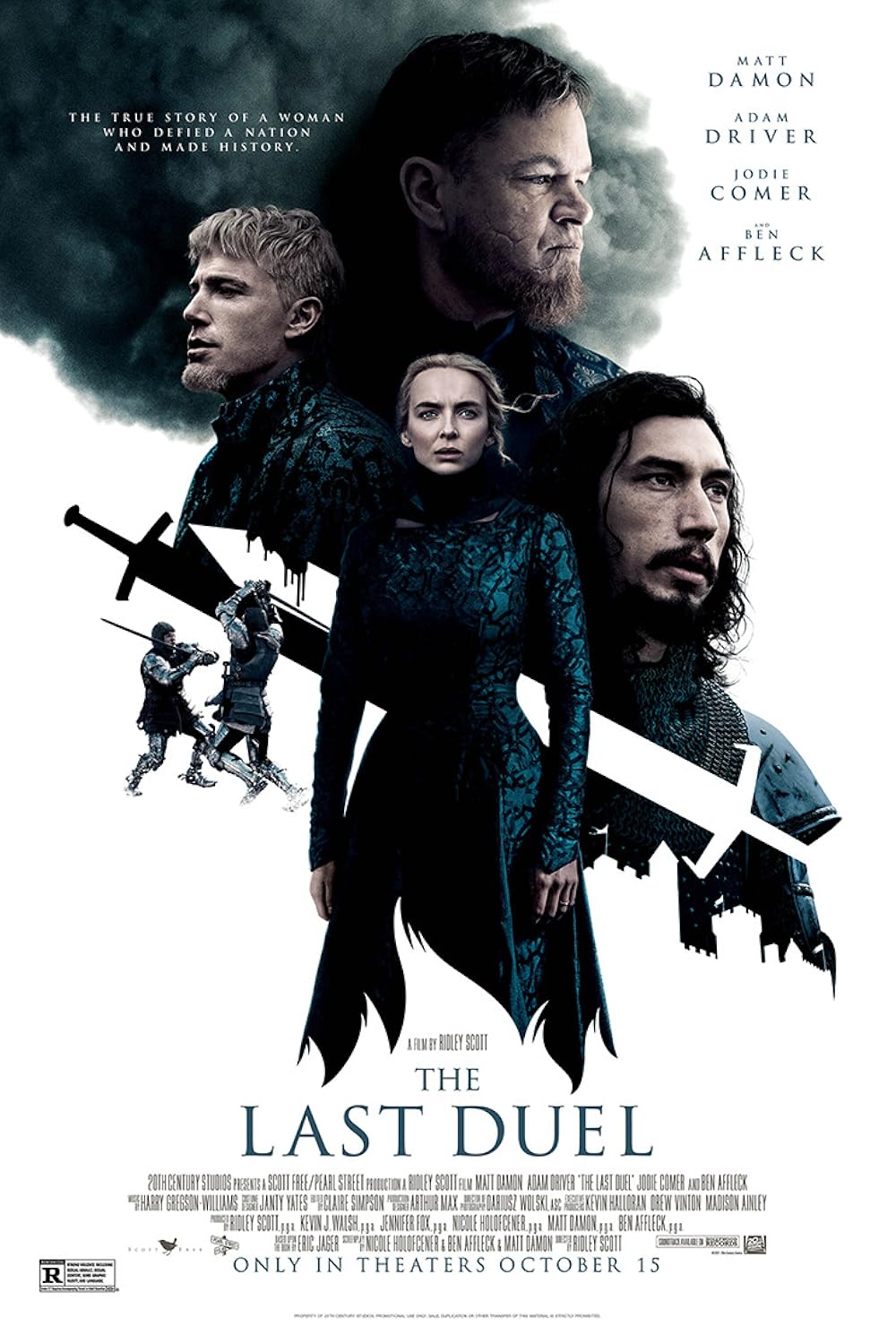
The existence of The Last Duel is both fascinating and bewildering, since it takes some time to actually realize this film was made by perhaps the most unexpected group of collaborators imaginable. This is an adaptation of the non-fiction book by Eric Jager, which tells the story of the last legal duel fought in France in the late 14th century, between Jean de Carrouges and Jacques Le Gris, written by Ben Affleck and Matt Damon (reuniting as writers for the first time since Good Will Hunting catapulted them to worldwide fame nearly a quarter of a century ago), in collaboration with Nicole Holofcener, arguably one of the most important voices in contemporary independent film, and directed by Sir Ridley Scott, who is returning to historical epics, a genre in which many of his biggest success and most significant failures are located. This motley crew of artists, in addition to the likes of Jodie Comer, Harriet Walter and Adam Driver (all of whom are part of the cast), all work together to concoct The Last Duel, one of the year’s most puzzling films – on the surface, we’d expect this to be an action-packed historical epic that prioritizes the spectacle, but almost immediately, we’re met with a more complex series of scenes that establish this as one of the more complex examples of a character-based entry into a genre that often doesn’t have much interest in the human side of these stories. If there was ever a strong example of not taking a film on face-value, based on the marketing and surface-level premise, The Last Duel is a perfect candidate – unexpectedly complex, oddly hilarious (often playing as a darkly comical fable) and structured in a way that allows us to find detail where most films in this genre wouldn’t even dare to look, it’s one of the stronger epics of recent years, and a truly entertaining film that knows how to handle its panoply of themes and shifting tones.
Every viewer will likely get something different out of this film – after all, this is a 150-minute long epic that emphasizes differing perspectives, being divided into three distinct segments, each one focusing on a different character and their involvement in the events that lead to the titular climactic duel. For some, The Last Duel is going to be an exorbitant action epic, set in the peculiar world of medieval France. For others, it’s a deeply complex character study that looks at themes relating to the social structure, and the role women played during a period where they were expected to be silent possessions. I’d expect many may enter into this film believing it to be far more populist than it actually is – and considering the narrative hinges on a rape, and the different perspectives of whether this was an act of sexual assault (from the victim’s standpoint), or a consensual encounter, it’s likely going to be divisive. The presence of Scott at the helm doesn’t necessarily help clarify this issue, since he has made his fair share of complex films, but many of his epics have been very much reliant on their surface-level premise, delivering exactly what was promised. The Last Duel is a strange film, since it’s impossible to predict anything about it. Perhaps it is the actual adaptation of the source material that made it somewhat of an outlier, since the grouping of Damon, Affleck and Holofcener isn’t one that we’d expect when thinking of writers who would necessarily flourish with an extravagant historical epic – but this is indeed where the film is the most intentionally misleading, selling us on something that we may not actually get in the end. However, this isn’t nearly as bad as it seems, since instead of a by-the-numbers action-adventure, we get a thrilling, complex medieval drama that is much deeper than we’d expect based just on the premise.
The Last Duel is very much indebted to its actors – as impressive as the production design and costuming is (as well as the gorgeous cinematography that transforms pastoral France and Ireland into the medieval era), this film relies very much on the performances. A few of the actors at the heart of this film are doing some of their strongest work, which is a peculiar development, considering how gifted many of them have proven themselves to be in the past. The leading roles are occupied by Matt Damon and Jodie Comer (as a knight and his wife), and Adam Driver, who is once again playing another maniacal villain, this time a ruthless squire who will do anything to curry favour from those superior to him on the social and political hierarchy. Damon is the kind of actor who mostly coasts on his everyman charisma, which has allowed him to be a reliable but often uninteresting action star, but who also isn’t afraid to turn in a more varied performance when it is necessary – and The Last Duel allows him a bit of room to experiment, playing the valiant but complex Jean de Carrouges with a combination of salt-of-the-earth authenticity and over-the-top dramatics (while never being too hysterical, a vital aspect of the film that makes these performances so strong). However, of the three focal characters, Damon is the least interesting, with Comer and Driver being the more prominent characters. Their segments are the strongest, and their development of these characters is quite unforgettable, each minor detail feeling genuinely interesting under their careful possession. Of course, The Last Duel will likely be most fondly remembered for the supporting performance given by Ben Affleck, who is truly unhinged in the best way – playing the maniacal Count Pierre d’Alençon, he is playing to the rafters, while still making interesting choices with the character. There are moments when Affleck seems to be actively demonstrating his prowess as a character actor, disappearing into this role with an impressive dedication of which many movie stars of his calibre should take note.
The character-based nature of the film is one of the reasons it may be slightly more divisive, since The Last Duel is heavily enamoured with the socio-cultural milieu in which it takes place, often functioning as a deep and disquieting psychological thriller in the form of a broad historical epic. It’s very likely that the target audience for this film will likely be those with an active interest in history, particularly the more intimate moments that take place in between major events. Most of this film consists of exploring the life of the medieval aristocracy, the tensions arising through the closed-door machinations that simmer between different individuals, all of whom are on a quest to not only earn as much power as they possibly can, but also maintain their reputation. Working closely with the source text, which outlines not only the duel between the two former friends and military colleagues, but also the more deep and intricate social issues that took place between them. Unfortunately, one of the negative aspects of a film that tries to take an intelligent approach to its subject is that it can sometimes feel convoluted – and the trilateral structure of The Last Duel (which many have accurately compared to Rashomon insofar as it looks at different perspectives on the same event) can be quite repetitive, especially when the differences between the varying narratives are too small and detailed to be entirely effective, especially for a film that borders on three hours in length. The film does often seem to be scrambling for content to fit in between the major events that bookend the film, and for history aficionados (especially those aligned with this era in Europe’s past), the small cultural details can be quite enthralling. For others, it can be slightly disappointing, since it seems as if the film is wasting valuable times reiterating what we already know. This is mercifully one of the only genuinely notable flaws embedded in the film, but it’s own that does warrant being mentioned, since the structure of The Last Duel is just as important as the story that is woven through it.
The Last Duel is not a perfect film, nor is it one that is projected to become all that iconic or revolutionize a genre that extends to the pioneering moments in cinema. However, it is still worth the viewer’s time, considering how it is just 150 minutes of wonderful entertainment, a thrilling and complex historical epic that hearkens back to the genre’s peak, where such intricately constructed dramas could be mounted, and paired with stunning filmmaking and memorable performances, which would in turn pay homage to whatever subject matter, whether historical or fictional, that served as the catalyst for its production. Ridley Scott has had a career that has undergone a continuous ebb and flow, his films ranging from historically resonant, to barely passable – and while The Last Duel may not be his best work, it is something of a return to form, a solid and entertaining drama with numerous touches of dark comedy that keep it afloat and help break the tension, which is evoked through the conflict between the calculating characters and their demented mind games. Composed of many impressive set-pieces (such as the climactic duel, which is beautifully staged and the epitome of what cinema is meant to do, offering thrills in both the bold strokes and awe-inspiring details), and told with the kind of precision that comes from a director who has had a considerable amount of experience with the genre. Not necessarily a massively challenging film, but still one that offers us a glimpse into the past through the lens of a solid, entertaining historical drama, The Last Duel is a true triumph, and an exceptionally well-constructed film that knows its value, and doesn’t hesitate in taking the viewer on this enthralling voyage into the past.
 The Postmodern Pelican