
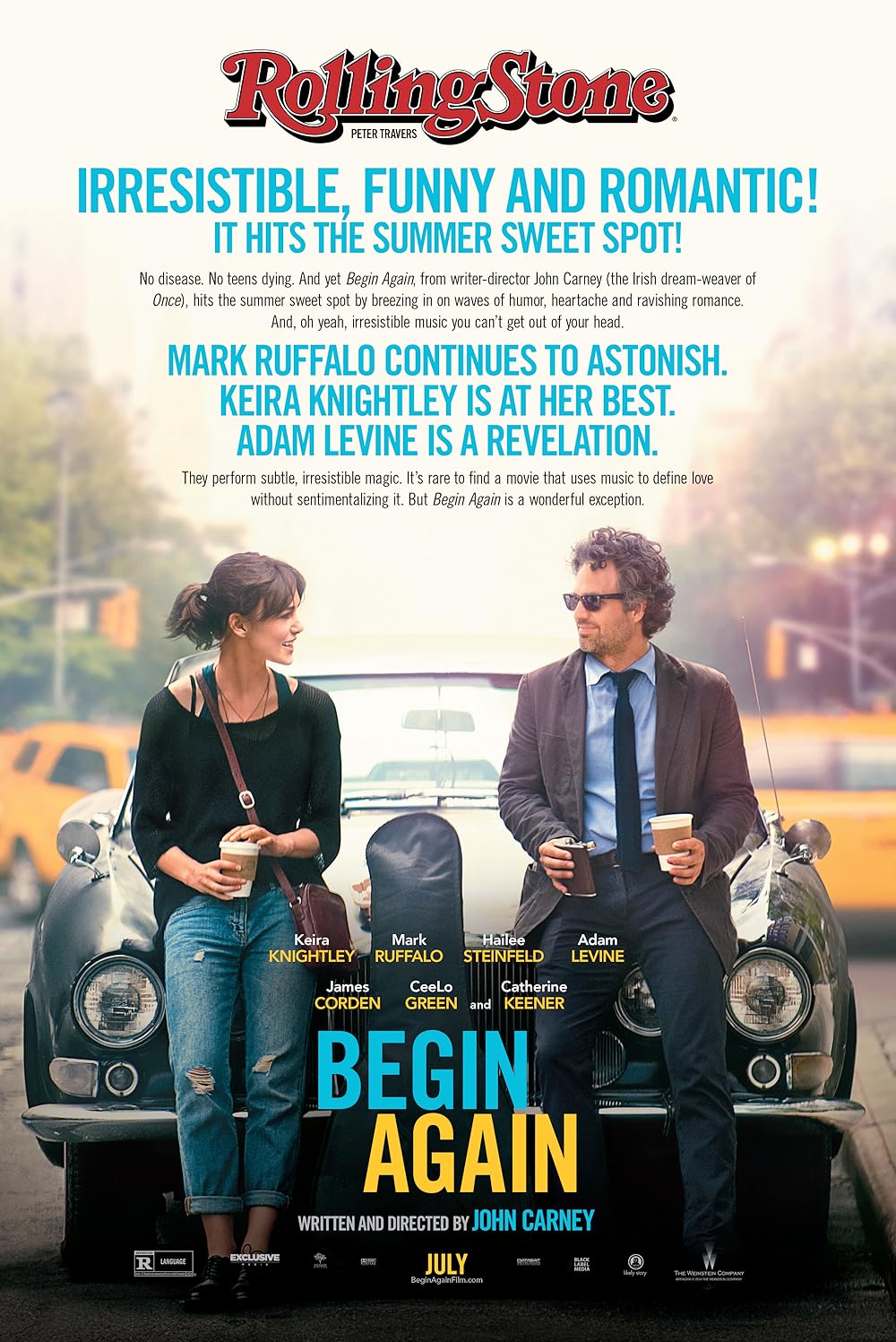
John Carney has had quite a fascinating career, having made two absolute masterpieces in the form of Once and Sing Street, intimate musical dramas set in his native Ireland, focusing on characters using the power of music to express themselves in a world that doesn’t understand them. Sandwiched between these two fantastic films is a substantially less-incredible work, in the form of Begin Again, which was Carney’s attempt at crossing over into the more mainstream market, working with a star-studded cast and a much larger budget. If there was ever a cautionary tale for someone avoiding the mainstream, this film is one of the prime candidates – perhaps not a terrible film, but rather one that epitomizes the idea of toothless mediocrity, Begin Again is an enormous chore, an oddly-made musical comedy that seems to be compressing an entire season of television into a single 100-minute running time, and in the process leaving out the aspects that would have otherwise made this a more enduring work, had there been time to allow a number of these themes to marinade and become more than just one of the many afterthoughts that plague this film. It’s difficult to criticize Begin Again, since it is quite cherished and appreciated – and while I do understand the appeal, the filmmaking is disappointing, ultimately squandering the potential for greatness that persisted throughout the film, leaving us with a promising concept but a flawed execution, while makes us wonder what an alternative version of this story would look like, had there been space for it to expand on some of these core ideas.
Once is the definition of the charming but inconsequential independent drama that seemingly arrives out of nowhere, and captures the hearts of viewers, who fall in love with these characters immediately – while it’s unfavourable (and a fool’s errand) to compare the previous film with this one, it’s difficult to not see Begin Again standing in the shadow of its predecessor, especially when it is exceedingly clear that the director was trying to capture that same spark of magic that made the previous film such a phenomenon. Lighting rarely strikes twice, so it only stands to reason that Begin Again would produce diminishing returns – the heart of the previous film (and the one that would follow, a clever choice on the part of the director insofar as he decided to go back to his roots) is almost entirely lost in the shuffle, since not only did Carney have to deal with reigniting the same passion that drove his previous work, but assimilating a number of prominent stars, both from the world of cinema and music, into the proceedings. It seemed less like a passion project, and more like shepherding a dozen disparate components together to form something that vaguely resembled a film. This isn’t to entirely dismiss Begin Again or layer criticism on a relatively harmless film – rather, we have to view this as something that aimed for impossible heights, and unfortunately faltered all the way down, struggling to find its voice, and instead just seeming to go out on a limb in terms of holding onto whatever it could feasibly pass off as deep, meaningful storytelling. It may be tender enough to earn its fans, but in contrast to other films produced around this time, it just doesn’t compare.
Of all the problems with Begin Again, it’s the lack of heart that is most striking, especially since you’d logically assume this is a film that has it in abundance. Based on the premise and happy-go-lucky disposition, you’d not be wrong for thinking this was going to be a heartwarming glimpse into the human condition by way of music, the great uniter. Compassion is essential to these stories – and based on the director’s own admission, his experience making this film could not be further from the loving, creative environment that is paramount to this film’s sense of uniting under the universal love of music. The slight trouble this film ran into during production is evident throughout the story, the sense of disconnect between the artists and their work being quite clear and entirely inescapable – the flaws are showcased just as prominently as the merits, which is never ideal for a film that wants to convey the message of unity. There are some strong moments, but they’re weighed down by an equal number of lost opportunities – perhaps there were too many characters, or the director just didn’t know what to do with the numerous plot threads he started, but Begin Again just never amounts to anything particularly noteworthy, often relying on the same heavy-handed commentary that plague similar films and cause them to be seen as contrived. Writing this entire film off for the same reasons seems inappropriate, since there is still merit underlying the shortcomings – but when we break it down, there isn’t really all that much that can be done about a film that doesn’t really care about its characters enough to make them interesting, or place them in scenarios that every viewer can recognize to some degree.
Considering how much of Begin Again depends on the feeling of community, you’d think there would be some good performances in it, at the very least. To its credit, the film does have some decent work being done by its gifted cast, who do their best to rise above the paltry material. Keira Knightley is charming as one of the film’s protagonists, playing a burgeoning young songwriting and musician with aspirations much bigger than anything of which she could feasibly conceive. She’s very good in the film, but is unfortunately the victim of the film distracting from her genuinely interesting storyline by placing it alongside the other major narrative in the form of Mark Ruffalo and his sadsack producer. Ruffalo is an actor whose degree of success in playing a role directly correlates to both the quality of the production, and the kind of character he’s playing – and as likeable as he can be most of the time, a whining former music producer who seems to be permanently under the influence of some substance is far from the kind of role that showcases the full range of the actor’s talents. Knightley and Ruffalo are perfectly serviceable in the primary roles and turn in good performances (perhaps better than the film that surrounds them), but considering the ensemble nature of the film, we have to wonder why more attention wasn’t put on the rest of the cast – Hailee Steinfeld, Catherine Keener and Adam Levine are all undeniably talented, and are important parts of the film, but yet suffer the fate of only having a small handful of impactful moments before the film recalibrates to focus on the protagonists that these supporting characters ultimately serve. Neither approach is necessarily bad on its own – it’s how Carney doesn’t manage to choose between making a quiet two-hander, or a broad ensemble effort, that causes Begin Again to fall apart at the seams, from which it struggles to recovery.
It just never becomes anything of value, other than an interesting curio that exists to showcase Carney’s interest in the world of music. Despite its grand-standing self-obsession, Begin Again isn’t a major work – it is neither complex enough to justifiably be considered a deep and insightful film, nor is it endearing enough to fully envelop the audience in the warm embrace it genuinely seems to believe it is inspiring. What it does do – and in a manner that is quite unfortunately flawed – is try and tell a story of how music is the universal language, a concept that is not new to Carney’s world, but rather something that he has continued to curate throughout his entire career, especially in his three key directorial efforts. It’s not easy to praise this film, but it feels just as inappropriate to pick apart its problems, since at its heart, Begin Again does try to be something special, it just struggles to amount to anything particularly notable outside of a few interesting moments that are enjoyable, but not enough to make up for the flaccid filmmaking that defines most of the film. As much as we keep holding out hope that this film will say something valuable, it just never does – and when we think it’s approaching an emotional crescendo, it abruptly ends, leaving us with numerous loose-ends, and not the slightest sign of resolution to be found anywhere. There’s a good film lurking somewhere beneath Begin Again – it just never rears its head, and instead just allows the final product to be a flimsy, inconsequential musical comedy that wants to inspire, but just fails to hit any of the right notes.
 The Postmodern Pelican