
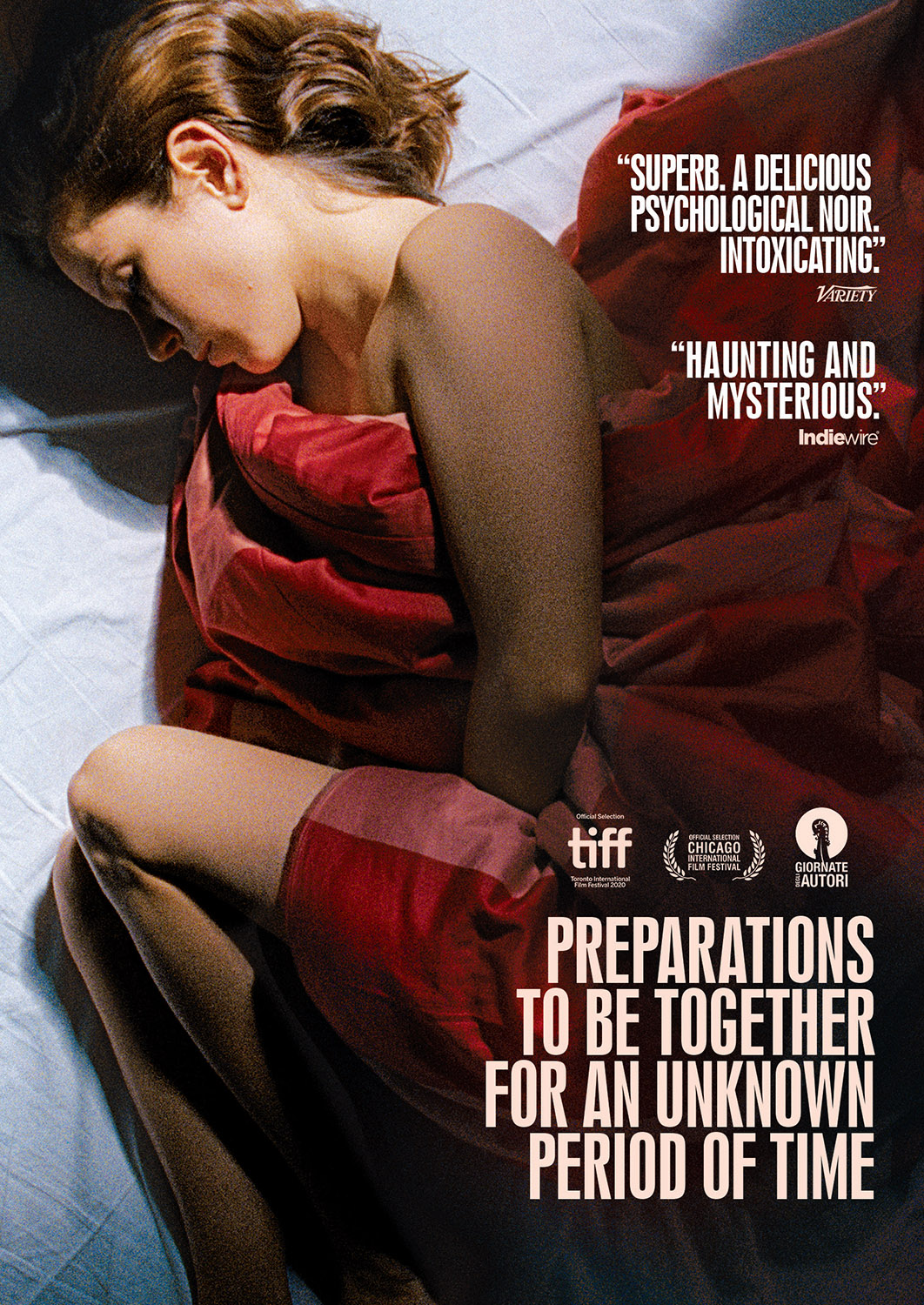
The human mind is a fascinating concept, since it is the factor that unites everyone, from doctors to philosophers, psychologists to artists, and every profession in between, provoking discourse that aims to get to the very root of what it is that drives us as a species, if such answers even exist. The precise reason isn’t all that difficult to discern, since everything related to our existence can be traced back to the mind, whether it be the physical processes of the brain, or the more abstract machinations of our consciousness. It stands to reason that it has inspired many insightful conversations – some of which are had in Preparations to Be Together for an Unknown Period of Time, the hauntingly beautiful psychological drama hailing from Lili Horvát, one of her native Hungary’s most exciting new artistic voices. Already having established herself as a director to watch with her previous feature film and a range of short subjects, she is venturing even further into some fascinating themes, crafting a disquieting metaphysical voyage that may take the form of something relatively simple in terms of its base-level premise and its execution, but carries a much deeper meaning that hints at a range of other ideas that are embedded in the fabric of this enigmatic, psychologically-complex drama that intentionally disregards revealing too much of itself, in the hopes that the eagle-eyed viewer would be able to interpret its wide-range of clues that indicate exactly what the director and her cohorts were attempting to convey with this brilliantly subversive romance that takes some fierce liberties and emerges entirely triumphant as a work of mind-bending melodrama.
At first, Preparations to Be Together for an Unknown Period of Time plays as a very traditional film – taking its cue from a range of highly compelling romance films, such as Brief Encounter and In the Mood for Love, insofar as it focuses on two individuals who find themselves falling in love despite very specific circumstances (normally inspired by temporal or geographic restrictions, as well as the occasional cultural factor), the influences behind what Horvát was hoping to achieve with this film is quite clear. This film is focused on a brilliant young neurosurgeon who returns home to Budapest to pursue a romantic pact she made with a relative stranger a year before, while gradually starting to question her own sanity, and whether she is recalling memories, or if he brain (which she values more than anything else) is simply concocting vivid delusions that cause her to act irrationally. A highly unorthodox work of romance, one where the priority is placed more on exploring the psychological side of passion rather than the carnal desire that pulsates throughout (although the climactic love scene towards the end of the film is certainly incredibly effective as a moment of catharsis after an hour of relentless tension), the film finds its voice in the most unexpected situations, where the narrative is perpetually on the verge of unravelling, but never quite loses itself in the depths of its often labyrinthine approach to exploring the human condition from a very different perspective, one not normally the subject of such beautifully poetic expressions of the more abstract quandaries many of us face quite regularly.
The concept of a brilliant professional encountering problems related to their area of expertise is a trite one – we’ve seen countless stories of doctors being diagnosed with debilitating illnesses, or a genius lawyer being put on trial for a criminal offence, which is an understandable crutch for a narrative, since it lends it an automatic point of contention from which a more serious message can be extracted. Yet, it’s not one that can occur organically and still be considered a success, since it doesn’t only take an in-depth knowledge of the field in question, but also the confidence to subvert nearly everything about it, in an effort to dismantle preconceived notions of the profession. Preparations to Be Together for an Unknown Period of Time flirts dangerously close with being convoluted – the first act of the film is truly bewildering, with a series of fragmented moments occurring alongside each other without a clear through-line from which the narrative can develop. This all changes when the director makes sure that there is eventually some context to all of it, and whether through making use of the framing device of the protagonist talking to her psychotherapist, or more interesting excursions into the past, the film is a fascinating journey that may take some time to become truly accustomed to, but gradually manages to be quite effective in how it addresses a number of fascinating themes relating to some incredibly resonant experiences that often feel like the director is speaking to us on a profoundly personal level.
The film doesn’t attempt to mask its main intentions, making it very clear from the start that this is going to be a more polarizing story that requires the viewer’s full, uninterrupted attention. If the title doesn’t captivate you, then the opening scenes certainly will – jarring images, close-up footage of the protagonist (played expertly by Natasa Stork, who gives one of the year’s most deeply compelling performances, her striking azure eyes and astonishing commitment to portraying this very challenging character making for a stunning portrayal of a broken woman) and narration that sets the subsequent hour of intricate, well-composed social commentary, which makes Preparations to Be Together for an Unknown Period of Time such a riveting film. Horvát captures the beauty of Budapest (both its visual splendour and the cultural idiosyncrasies) incredibly well, in the way that only a city’s native is able to, each movement through the streets coming across as a work of deeply-personal self-discovery, rather than simply as a way to introduce outsiders to this gorgeous city. It’s an incredibly internal film – we’re not invited into this world, but rather find our own way, sneaking through the narrative cracks that exist to give us some entry-point into this otherwise impenetrable world. It’s a stunning work that may leave some viewers with more questions than answers, but this is entirely by design, and contributes to a film that is generally more representative of a set of abstract themes than it is a direct narrative – and the moment we’re able to separate the plot from its multitude of fascinating ideas, the sooner we begin to understand exactly what it is the director is conveying through the film.
She may be relatively new to the industry, but Lili Horvát is already making a name for herself as one of the most exciting new voices in contemporary European filmmaking. Her ability to plumb some incredible emotional depths, while never deviating from a very distinct, clinical narrative, immediately makes Preparations to Be Together for an Unknown Period of Time a work that is going to interest those with any degree of investment in the contemporary arthouse, which produces some incredibly varied films that exist on the outskirts of what the mainstream is willing to do. This isn’t the easiest film, and its peculiarities can sometimes mean that it doesn’t manage to appeal to viewers who don’t have a taste for the alternative – but for those who are curious about seeing something incredibly complex, while still being taken on a metaphysical journey that will provoke and dismantle sacrosanct notions without being too self-indulgent, Preparations to Be Together for an Unknown Period of Time is an extraordinary achievement, operating as a brilliantly subversive work that takes its time getting to a specific point, and once it arrives, incites some fascinating conversations relating to human nature that will be of interest to everyone, since the message it conveys relates to life far deeper than anything else, which makes a fundamental difference and immediately proves this film to be one of the year’s most audacious and compelling exercises in humanity-driven fiction.
 The Postmodern Pelican