
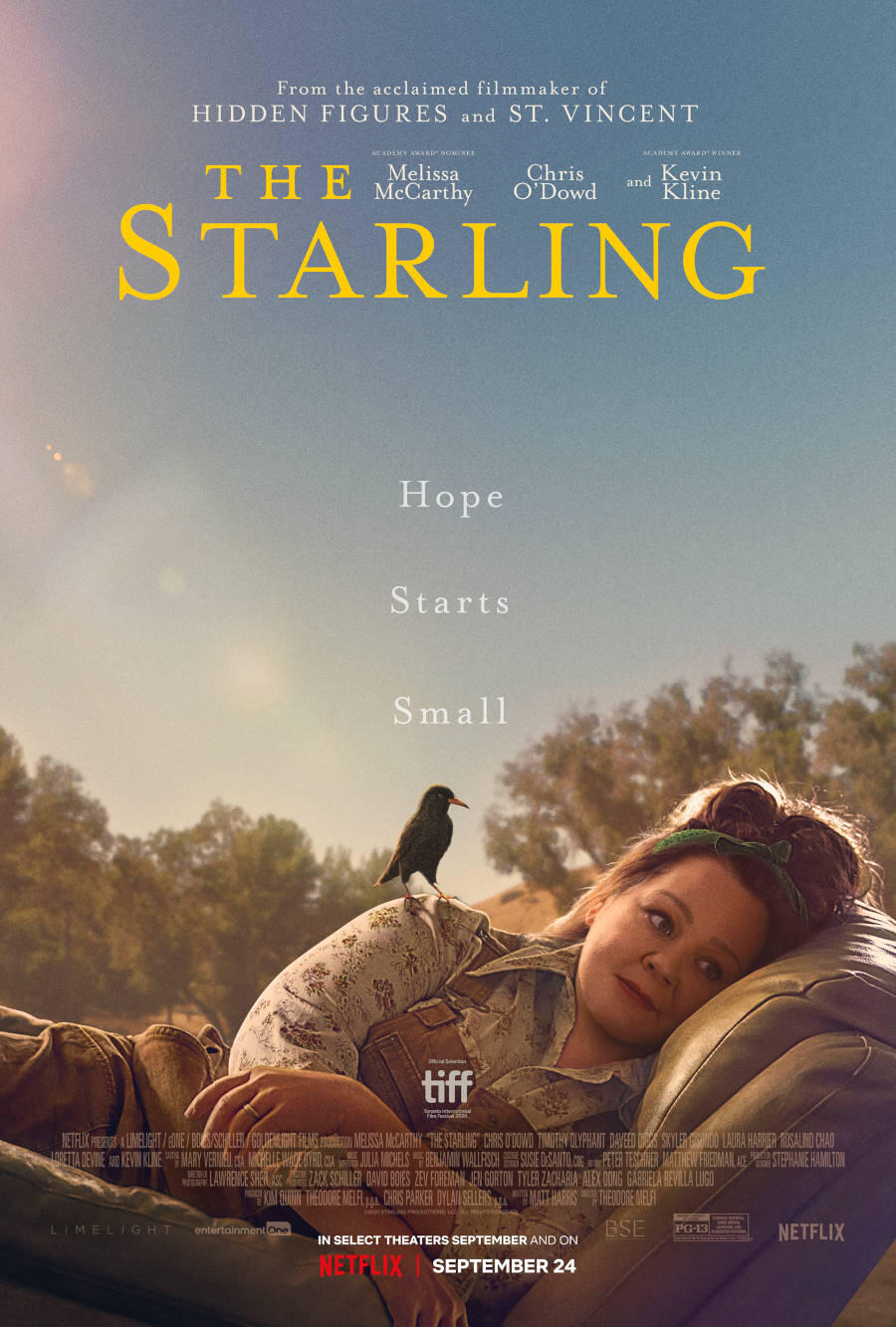
There’s a scene where Lilly (as played by Melissa McCarthy) viciously throws a rock at a bird that has been terrorizing her, only to nearly have a breakdown when she manages to have good aim, knocking the bird out of the sky and nearly killing it – and the entire third act is focused on the same character desperately nursing this bird, which I repeat she just tried to intentionally exterminate, back to health. Somehow, this is not the most absurd part of The Starling, the woefully misguided attempt at comedy written by Matt Harris and directed by Theodore Melfi, who makes several questionable decision – namely causing the viewer to question whether his two previous films, the well-received St Vincent and minor cultural sensation Hidden Figures – were actually accidents. Perhaps not enough to dismiss the talents of anyone involved, but certainly sufficient in indicating how its a low point in their collective careers, The Starling is quite an experience. Beating around the bush is never a good idea, so it’s best to say it outright: this film is absolutely dismal, a disappointing and contrived attempt at meaningful storytelling that falls apart at the seams in a way that no film that boasts such a strong cast and promising premise should have, leading us to wonder where exactly the film went wrong. In no uncertain terms, Melfi made one of the year’s most bewildering films, one is driven less by its narrative and more by the strange decisions made in its production, leading us to wonder whether the 103 minutes was actually worth any of the time and effort, both physical and emotional, that were required to make it through this absolute bore of a film.
The Starling is one of those films that aren’t bad based on a single awful element, but rather hopelessly mediocre as a result of poor decisions on every level. From conception to execution, it seems like every choice made in the creation of this film was misguided. It makes any discussion on the film almost impossible, since there isn’t any discernible place to start – this is the kind of film that inspires one to not necessarily put pen to paper, but rather scream into the void about all the flaws that underpin it. As much as we’re led to believe that this is going to be a touching, funny film, it can’t avoid the very clear flaws that exist throughout. At a purely theoretical level, the film struggles to determine what it wants to be – it exists somewhere between quirky comedy and overwrought melodrama, and while there is absolutely nothing inherently negative about a film taking a multilayered approach to its storytelling techniques, there is a degree of respectability required to help us make sense of it. The Starling is filled to the brim with the most hackneyed, heavy-handed commentary one could ever see – it feels as if Melfi and his cohorts did research on how to make the most contrived drama imaginable, and filtered it through the lens of a quaint comedy. It hits none of the very broad targets it sets out, and instead misses the point every time it tries to make a statement. It’s almost infuriating how overwrought this film is, since it often defaults into the most cliched narrative techniques imaginable. As simple as the premise may be, a film can only be emotionally resonant if it has some idea of the direction it wishes to go – and unfortunately, The Starling is far too preoccupied with trying to be a heartwarming fable, it misses every opportunity to elevate itself above inextricably mediocre.
The Starling is a film filled with surprises. For example, despite often playing the most bizarre and off-kilter characters in some truly poor films that rely on a kind of overt comedy that is rarely funny outside of context, Melissa McCarthy turns in arguably her worst performance in this film, at least in terms of how it perpetually fails to hit any real emotions. Unlike her more bawdy comedies that are often ridiculed, McCarthy seems extremely lost here, scrambling to make sense of a script that both showcases her as an actress, while not doing her any favours. It’s not a case of miscasting, since we’ve seen the actress do some terrific dramatic work (including under the direction of Melfi, who brought out a very tender version of McCarthy in the aforementioned St Vincent), but rather a storyline that never really gets anywhere in terms of character development, a bewildering fact considering the supposed intention of the film being centred around developing this character. She doesn’t know whether to play to the rafters, or do more internal work – and unfortunately, the film isn’t strong enough to facilitate both. McCarthy has the burden of carrying this film almost entirely on her own, which is unfortunate considering the quality of the cast that surrounds her – the normally gifted Chris O’Dowd struggles to play the role of the grieving, psychologically broken character (portraying him as a pathetic sad-sack, rather than someone genuinely processing their emotions), and Kevin Kline is underused, playing the archetype of the grouchy but wise older mentor figure who uses his knowledge to help the main character see the light. There are many reasons to criticize The Starling, but its clear refusal to give its undeniably gifted cast something to do is one of the most inexcusable flaws.
Perhaps the most disappointing aspect of The Starling is that, despite the flaws outlined above, this is a film that could have easily been incredible had effort been put into its creation. The problem is that it takes a good concept – albeit not one that is particularly revolutionary – after all, it’s not like this premise was bursting with potential. We’ve seen so many stories centred on trauma, where the grief felt by the characters manifests in some outward entity that enters into their lives, with the grand revelation coming towards the end. Normally, these are touching, if not harmless, stories that are endearing and entertaining enough. This is not the case of The Starling, which works our last nerve instead of striking a resonant chord. This premise is not nearly interesting enough to make up for the muddled tonal shifts and poor writing, which feel like they were composed by a complete amateur, rather than being contained in a screenplay that was supposedly highly anticipated and extremely promising, for nearly two decades. It’s not even a case of a better director or stronger cast being needed to bring out the potential – The Starling had all the resources required to be a success, and it squanders absolutely all of it in its attempts to be some deep and insightful melodrama about loss, peppered with moments of lighthearted humour to break the rigidity. If anything, these moments just heighten the tensions, contributing to the convoluted nature of a film that just never amounts to anything other than annoying us with its self-centred perspective that fails to realize how myopic its perspective is. There are few artistic liberties more insufferable than a film that emphasizes its own importance at the expense of actual meaning, but The Starling achieves it with flying colours.
It doesn’t matter how we look at it, The Starling is a poor film with a good concept at the centre – but as much as we’d like to wax poetic about how there was so much missed potential, nothing about this film seems striking enough to earn our sympathy. This is a badly-made film without any clear concept of what it wants to say, which is amongst its most significant problems, and the primary reason why it failed. It’s not even a particularly worthwhile failure – if a film is going to be bad, it can at least earn the audience’s ire through putting in some effort. The Starling is one of the most dull and meandering attempts at dramatic comedy of the past few years, being nothing but an absolute bore. It’s difficult to get through this film – the character motivations are ambigious (but in the sense of being poorly written, rather than an intentional choice), the performances are hysterical at best, gaudy at worst, and the entire film is just uncomfortable from beginning to end, never finding its voice, despite frequently reminding us of its supposed importance, as if we haven’t seen dozens of superior parables of the grieving process many times before this film. The Starling is just an enormous disappointing, an aimless and unfortunately tedious exercise in egotistical storytelling, taking itself far too seriously and not respecting the audience enough to give us the benefit of the doubt when it comes to a premise that is decent enough on its own, to the point where we didn’t need to be patronizingly guided through the story. It’s one of the year’s most unfortunate failures, and one that could’ve easily been so much better had there been some degree of work put into defining this beyond just a trite tale of trauma that never gets anywhere, and simply ends up being quite literally for the birds.
 The Postmodern Pelican