
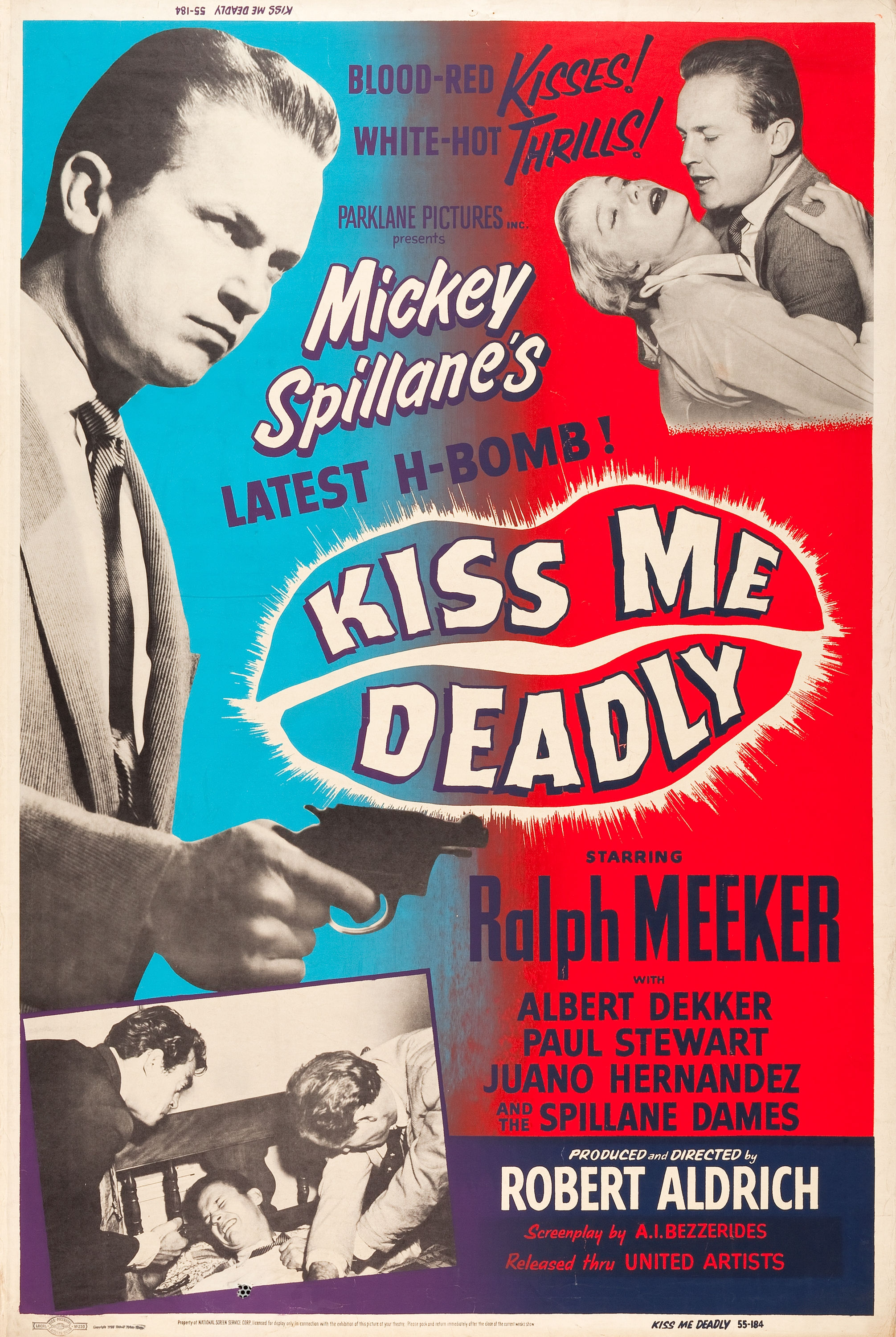
When it comes to film noir, there are a few titles that are unimpeachable classics – whether looking at the classic era where films like The Big Sleep and The Maltese Falcon were confusing audiences, or the more progressive melancholy of Farewell My Lovely and The Long Goodbye, we’ve been enticed and enthralled by stories of private detectives and their various obstacles in solving mysteries for over half a century now. However, one film in particular stands out as a work of such unique scope, it both defines the genre and outright defies it. Kiss Me Deadly, Robert Aldrich’s adaptation of the eponymous novel by Mickey Spillane, is a daring, provocative excursion into the roots of the private eye genre, told in a way that very few (if any) film noir has been able to capture. Wildly original in both form and content, and perhaps even somewhat controversial in how it becomes almost a transgressive exercise, Aldrich’s film is an astonishing achievement, a hypnotic and unforgettable tale of the dangers of curiosity, and the sometimes appropriate retribution that befalls those who start looking into affairs that have very little to do with them. One of the most influential entries into the genre, while still be wildly original in how it tackles some very peculiar subjects, Kiss Me Deadly is a strange, hypnotic voyage into the darkest recesses of one of Los Angeles, one of the most profoundly cinematic cities, and the setting for many of the greatest private detective stories. Whether it be in challenging conventions, or paying homage to the films that came before it (while not having that sheen of artifice that makes its reverence for the genre exceedingly clear – there are moments where one has to wonder whether or not Spillane and Aldrich actually adored this genre, or wanted to deconstruct it out of frustration and annoyance with its traditions), this film is a fascinating glimpse into the darker side of society, as filtered through the lens of a truly bizarre story of misplaced curiosity.
Mike Hammer has become something of a cult figure in terms of film noir and related media, since he is very different from the kind of detectives we are accustomed to – he’s not the Phillip Marlowe or Sam Spade, who are complex characters with strong moral fibres. Instead, he borders on neanderthalic, a man driven by his own aggressively masculine desire to always be the toughest person in the room – not many films are as resoundingly fervent in convincing us of the merits of minding one’s own business quite as much as Kiss Me Deadly, which essentially functions as nearly two hours of someone constantly avoiding certain demise, all because he couldn’t help himself from getting involved in the affairs of others. From the first moment, Aldrich is deconstructing the format of the private detective story – Hammer is not hired to investigate this case, since there isn’t really a case to begin with, but rather an ambigious, chance encounter with a woman whose existence fascinates him, since she harbours secrets that he simply could not avoid provoking. It sets the stage for a labyrinthine descent into the underbelly of Los Angeles, a dark and sinister comedy of errors disguised as a rivetting film noir. Aldrich knew exactly what he was doing, and in the process of adapting the novel and executing it in such a way, he wasn’t only paying tribute to one of the most original voices in the literary genre, but challenging the entire concept of what a private detective story should be, and the message it conveys. It’s wildly original, and serves as one of the rare instances of a film that is both accessible to those who are agnostic to the genre, being a terrific entry point for anyone who wants a film noir that avoids all the cliches, as well as a cherished piece of filmmaking for aficionados of private detective narratives. It’s all balanced perfectly by the director, who seems to implicitly understand the depths to which he needs to go to both pay tribute to the genre, and provide something so profoundly different, even the most seasoned viewers will be bewildered by its brilliance.
In setting up this unconventional version of Los Angeles, Aldrich employs an element of the grotesque, each moment being more disturbing and bewildering than the last. This is a film produced under the guidelines of a carnivalesque depiction of society – none of these characters act like real people necessarily would, each one of them being wonderfully eccentric and deranged in very creative ways. One of the fundamental qualities that separates Kiss Me Deadly from other film noirs is that none of these characters are direct archetypes – they’re all complex, fully-formed individuals with deep backstories and pivotal roles in the unfurling of the narrative. However, this doesn’t mean that they’re anything close to ordinary, with everyone from the protagonist, to the supporting villains, to one-scene characters, being incredibly strange and off-kilter. Aldrich isn’t interested in a realistic depiction of the world, instead going for something a lot more off-kilter, to the point where Kiss Me Deadly feels less like being immersed in a previous era, and more like being trapped in an inescapable nightmare. As a result, the film has one of the best uses of an ensemble of its era – each character is important, and contribute to the general unease we feel throughout the story. Even the most seemingly ordinary individuals come across as demented after a while, leading us to wonder whether anyone in this film can be considered normal. By the end of the film, we know that the answer is a resounding negative, as any hope of resolution is gone halfway through, when we finally realize that this isn’t a film that sets out to give us any real satisfaction. Yet, we’re never bored, with each succeeding moment of surreal despair coming across so exceptionally well, we have no choice but to submerge ourselves in this world, even if it is one that we know isn’t going to give any real resolution to our questions.
If there was ever a film that advocated for the unconditional surrender to the madness of our world, Kiss Me Deadly is a prime candidate, since all logic is dismissed in the creation of the film. Film noir is one of the only genres where absurdity isn’t only allowed, it is often actively encouraged. Ultimately, in the most traditional sense of the genre, these tend to be stories centred around aggressively masculine individuals navigating hostile surroundings and encountering similarly sinister characters – without some originality, they’d collapse into becoming a contrived, homogenous mass of the exact same ideas. There certainly isn’t a lack of films noir that don’t strive for much other than being pulpy, entertaining stories of detectives and the femmes fatale that hold them emotionally captive. Kiss Me Deadly is different in nearly every way, especially because its method of taking this story – which is relatively straightforward for the most part – and filtering it through the strangest, most deeply unsettling version of the world, only makes it more gripping. Had this film been more conventional, there’s very little doubt that it wouldn’t have had the same effect – the story itself isn’t all that remarkable, and the general direction of the story (the search for answers to the identity and secrets of a mysterious hitchhiker) almost becomes an afterthought. Kiss Me Deadly is less of a detective story, and more an atmospheric mood piece, a deconstruction of conventions and forthright descent into the maddest version of society imaginable. There are still enough components that allow the film to stay on brand and be considered a definitive entry into the genre, but it isn’t held hostage by these qualities, but rather guided. It allows Aldrich some worthwhile artistic freedom, and he doesn’t waste a single moment of this film on anything that isn’t entirely creative and compelling.
Nothing makes sense in Kiss Me Deadly, the plot twists come out of nowhere and the character motivations are vague, to say the least. Yet, we cannot help but become so invested in this story, following the main character as he traverses a world he claims to understand, but still finding himself on the precipice of danger at every turn. The ending is not only horrifying, but incredibly vague as well, leading to half a century of spirited discussion to what it means – some may claim that there is a scientific explanation related to the growing tensions of the Cold War and threat of nuclear war, others may see it as a mythological allegory, an allusion to Icarus and his demise after flying too close to the sun. The best part is that not once does Kiss Me Deadly offer any clarification – it allows these peculiarities to fester and become the basis for one of the most unconventional films of its era. Trying to rationalize what we’re seeing on screen is our natural response, and in most cases it would work – yet, in this particular context, trying to assert logic and reason onto a film like this will only serve as a hindrance, since not only will we be disappointed in the lack of clear direction in terms of the story, we’ll miss the beautifully grotesque details that make Kiss Me Deadly such a wonderfully bizarre, captivating work of genre fiction. This is undeniably the pinnacle of film noir in terms of its experimentation with plot and character development, and its status as one of the most important films of its era is reflected in the fact that the entire French New Wave was built on this film (it makes a fascinating companion piece to The Wrong Man from the following year, in how we can see where many later directors found some of their inspiration), as well as redefining the detective film, which was still at the peak of its popularity, but gradually showing signs of needing to be overhauled. Perhaps not appreciated as widely as it should’ve been at the time, but having developed a cult reputation in later years, Kiss Me Deadly is a striking, brilliant and dark film that only becomes more effective the more we immerse ourselves in this terrifying version of our world.
 The Postmodern Pelican