
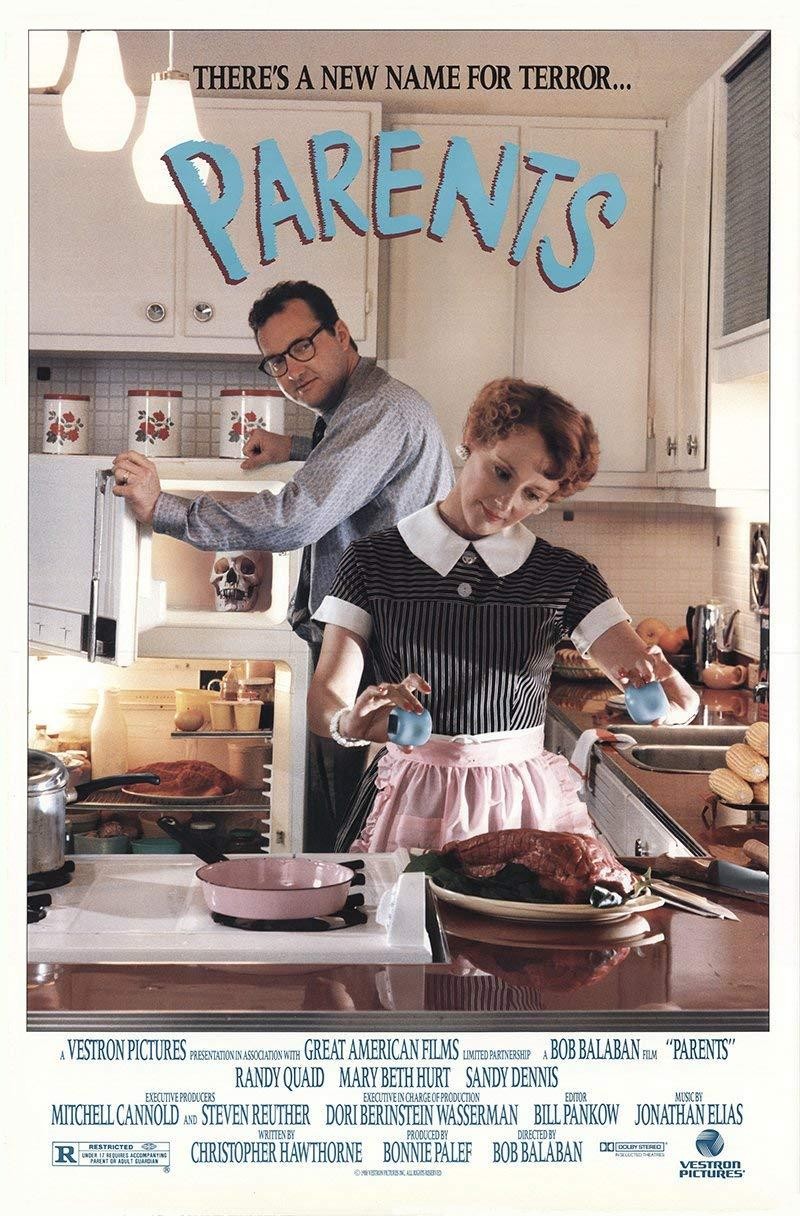
Most of us have encountered Bob Balaban at some point, whether it be through film, television or another medium. An extraordinary character actor known for playing highly intelligent but reserved nebbishes with a slight air of pretension, he has become quite a memorable performer, known for his exceptional work across a range of different projects. However, his directorial debut is the subject of today’s discussion, and it may be alarming to viewers of Parents to realize that this sick, demented and utterly twisted horror-comedy was written and directed by someone as sophisticated and reserved as Balaban, in what would be the first of a few occasional sojourns behind the camera. Very few, if any, would’ve anticipated Balaban to have such a film in him, and considering this is almost the complete antithesis of what we’ve come to expect from an actor known for a more quaint style, only makes this an even more fascinating experiment. A thoroughly insidious, but endlessly entertaining black comedy about the darker side of human nature, Parents earns its rightful place amongst some of the greatest cult films of its generation, emerging from the shadows as a terrifying but enjoyable horror that traverses many different subjects, and comes out victorious in all of them, having successfully deconstructed conventions in such a way that we can’t help but be both allured towards and repulsed away from this bewildering, disconcerting glimpse into suburban life, the kind that would make even the most combative of modern-day surrealists retreat in fear of encountering the horrors Balaban builds this strange but enticing film from, using a foundation of absolute terror for the pure sake of shock and entertainment.
The central theme of Parents is that of a child’s perspective – we’ve seen this kind of fundamental narrative before, we encounter a young protagonist, through whose eyes the world is filtered, leading to a very different portrayal of life and its many quirks. Parents uses this as a foundation, but deviates quite sharply early on, refusing to mislead us from the outset into believing that this was going to be anything other than an intentionally unpleasant experience. The character of Michael is a fascinating one – he’s neither precocious nor particularly gifted, and his existence is not motivated by anything other than the fact that he is a little boy in a precarious situation, discovering the very likely possibility that his parents are cannibals. It’s not his realization of this fact that is interesting, but rather how the film uses it, putting us in the innocent shoes of a young boy who is suddenly awoken to the true horrors that underpin our world. Naturally, everything in Parents is intentionally heightened, which it justifies through the use of Michael as the protagonist – it allows Balaban to include even the most outrageous material, as well as being as absurd as possible, since it can all be justified by the fact that our worldview as children tends to inflate the sinister nature of the world around us, and that the fears that envelope us in our younger years can be sufficient evidence for this film’s peculiar tone and approach to this story, which could’ve otherwise been entirely misguided and highly inappropriate, if there wasn’t the constant reminder that we’ll never truly know whether the events we see depicted are real, or just careful constructions in the mind of a child, the product of an over-active imagination, buttressed by very real concerns that are often chalked up to childhood naivete.
The first indication that a horror film is going to be unique is found nearly immediately, where it makes the decision as to whether it’s going to ease the viewer into the terrifying story, or rather throw us in directly. Balaban seems to be unequivocally in favour of the latter, and from the first frame of this film, we’re already filled with a sense of dread. There’s a dreamlike quality that we’re introduced to from the start, and it never quite subsides – this could be considered both a weakness and strength, depending on how you look at it. In terms of the former, it means that the film sometimes struggles to let go of these surreal underpinnings, especially when it is trying to present an image of idyllic suburbia, which it simply can’t achieve if the viewer is constantly trying to make sense of what they’re seeing (this is an area that many other suburban satires excel at, since they find the perfect balance between irreverent, off-kilter humour and darkly comical undertones). However, Parents still makes very good use of this aspect, and manages to gradually deconstruct it in a way that feels productive, rather than simply being weird for the sake of it. Dreams play a vital role in the narrative, and Balaban ensures that we’re constantly questioning whether what we’re seeing is taking place in the real world, or in the over-active imagination of a child who sometimes lets his delusions take control of his actions. Reality and constructions merge together throughout the film, and the vague manner in which the director portrays the relationship between Michael and his fantasies, which begin to influence (and perhaps even manipulate) reality, is truly captivating, and keeps us engaged, especially when the rest of the film feels misguided in both its comedy and horror at times.
The ambiguities that come out as a result of this are by far the most interesting parts of the film, and Balaban seemed to have recognized this early on as well, since the director ensures that he is constantly circling back to the young protagonist and his perspective, which lends the film a depth that helps ground the madness and gives context to what is essentially nothing more than a cannibal exploitation horror blended with a disconcerting suburban satire. This is a difficult combination to do convincingly, so it’s not surprising that Balaban’s film wasn’t an enormous critical or commercial success at first. However, it didn’t need to be, since this is the exact kind of film that flourishes in the cult sphere rather than through the mainstream. Unlike many actors-turned-directors, Balaban is not staying consistent with what he is known for – it would’ve been so much easier for him to produce something that kept with his spirit of more subdued, philosophically deep conversations on the nature of existence through comedy. One can argue that he did employ these very themes, albeit in the form of a film more focused on using it constructively and filtering it through a darkly comical lens of unhinged horror. Whether or not this was the intention doesn’t matter, since there is a wonderful depth to the film that allows us to look past these factors and instead focus on the final product, which is quite remarkable, if not polarizing from the outset. Tonally and narratively, there’s a fascinating balance that can be quite jarring at first, but gradually erodes into a smorgasbord of absolute terror and comical horror that many of us may not be prepared for based on a cursory glance at this film.
Parents is certainly not a film for the faint of heart, and those who aren’t accustomed to truly grotesque humour may be irrevocably repulsed by this strange little horror. However, this is a film that extends far deeper than just being a quaint dark comedy about nauseating matters, growing into quite a deceptive, nihilistic drama that draws us in and entangles us in a web of absolutely macabre despair. The laughter fades as the film goes on, and all that is left is a sense of discomfort and unease, which isn’t always something a film should aspire to incite in an audience, since one would normally aim to frighten, rather than traumatize. There are moments in Parents that are indelible, etched onto the viewer’s mind as they realize that there isn’t going to be a moment that yanks us out of this terror and shows us a more optimistic version of this world. The further we venture into this film, the more sinister it becomes – and even the ending, which appears to carry some hope, is punctuated by a disconcerting sense of horror that continuously grinds away at our sanity, until we’re only a few slender threads from descending into madness ourselves. The fact that Balaban managed to achieve this through what is essentially nothing more than an experimental attempt to merge body horror with suburban satire, is truly fascinating, and warrants giving Parents a wider space in the cultural conversation on both sub-genres, which benefit greatly from the devil-may-care vision of a director with a very peculiar perspective, and the willingness to go to unprecedented depths simply for the sake of terrifying his audience and showing us something unprecedented and truly demented in the best way possible.
 The Postmodern Pelican