
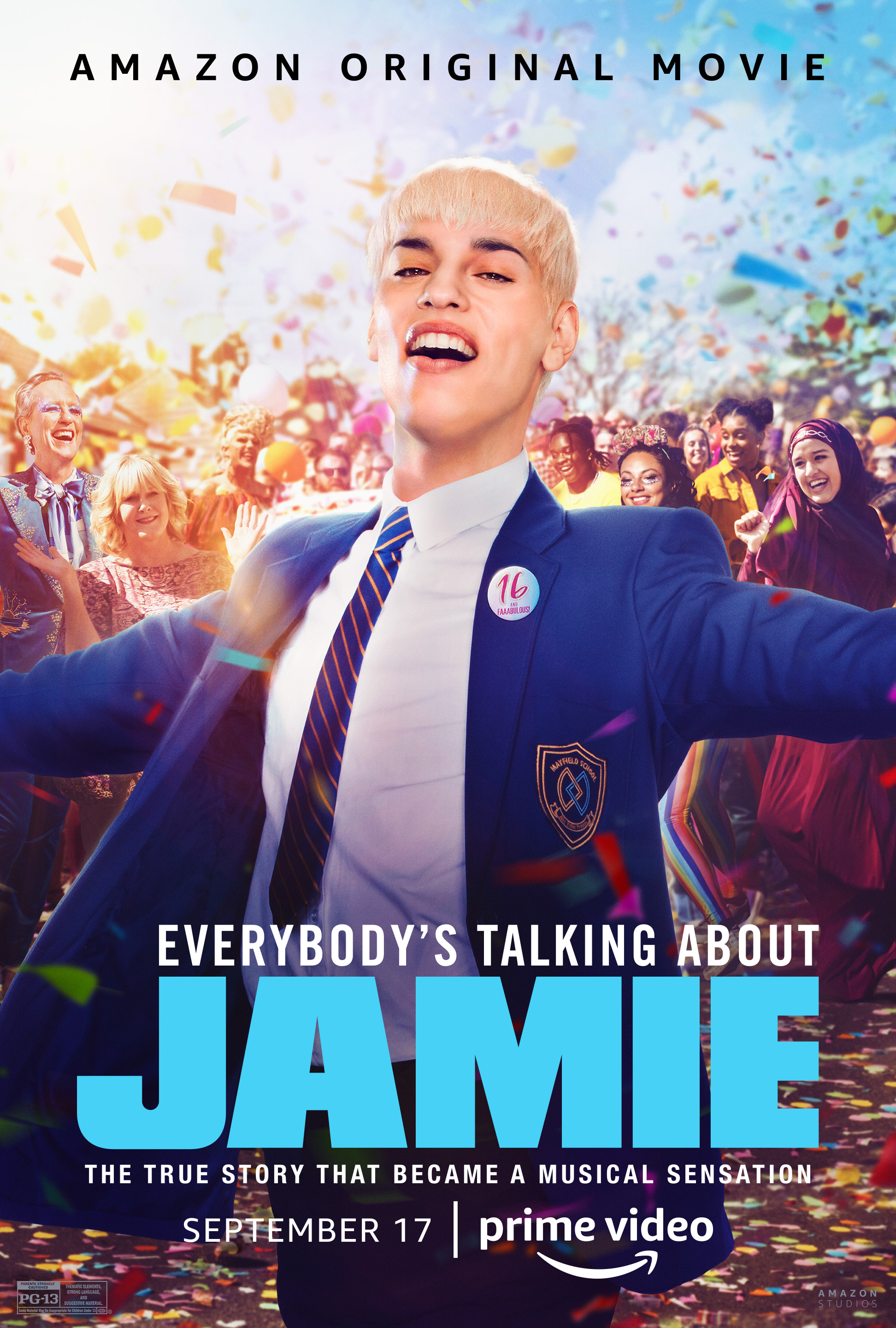
Everybody’s Talking About Jamie is not a film that is going to break any boundaries. The adaptation of the successful but relatively simple musical of the same name (in turn inspired by the real-life Jamie Campbell, whose life was covered in a well-received documentary several years ago) is a charming but minor affair, the kind of musical film that keeps the viewer enraptured for the running time, and leave us with that familiar sense of warmth and joy, but ultimately fades over time, destined to sink into the canon of lovable but unremarkable movie musicals that struggle to stand out alongside some superior productions. This certainly doesn’t imply this film isn’t worth one’s time – director Jonathan Butterell (in his directorial debut) adapts the musical with heart, poise and a good dose of well-meaning humour, and ultimately does pay tribute to the panoply of young people struggling to find their identity, or the freedom to express themselves in the way they feel they should. More than anything else, this is a film that contributes to a growing canon of queer stories, perhaps not being the most original or provocative, but still sparking some conversations that are continuously required to help normalize issues surrounding sexuality and identity. All of this, tied together with a few strong performances and strong musical numbers make for a delightful two hours of entertainment that may not hold much weight in general, but at least affords the community at the heart of the story the time and platform they deserve.
Inarguably, it’s clear that Everybody’s Talking About Jamie was not designed to be a particularly revolutionary piece of theatre – we’ve seen several musicals produced over the years that focus on the fundamental issues at the heart of this story. Whether it be classics like La Cage Aux Folles and Hedwig and the Angry Inch, or more contemporary fare such as The Adventures of Priscilla, Queen of the Desert or Kinky Boots (themselves stage adaptations of popular films), there is a steadily-growing culture of drag on stage in terms of mainstream musicals – and unfortunately, Everybody’s Talking About Jamie doesn’t quite manage to rise to their level, but not for a lack of trying. One of the most significant issues is the lack of clear stakes – from the beginning, Jamie is comfortable in his sexuality, and comes from a home in which his mother is nothing but supportive, and while he may not have many friends, he does find a connection with the few people that are willing to look beyond his eccentric demeanour. Instead of a clear conflict, the story features about half a dozen, with the same amount of supporting characters brought in to combat the protagonist’s journey of self-realization. As we’ve learned through years of musicals, too many cooks spoil the broth, which is something quite applicable to Everybody’s Talking About Jamie, a story that has far too many adversaries without any real motivation (such as the character of Jamie’s teacher, who is oddly hostile to her students and their future ambitions), and not enough actual focus on the characters that matter until the very end.
While the character development may not always be optimal, Everybody’s Talking About Jamie does make good use of many of its actors, most of whom deliver strong performances. Newcomer Max Harwood takes on the titular role of Jamie New, and while he is perhaps slightly too confident to be playing a character who is supposed to have deep insecurities, the young actor is clearly destined to be a star – he lights up the screen whenever he is in frame, and uses his natural charm and very unique physicality to define Jame as more than just an amateur female impersonator – he’s not a drag performer, he is (in his own words), a warrior queen, and someone whose ferocious drive to succeed propels him to pursue his dreams, no matter the cost. Harwood is matched beat-for-beat by a few of his co-stars, such as the criminally underrated Sarah Lancashire, who finally gets the chance to showcase her deep range of talents by playing the sympathetic mother of the main character, who does her best to give him the support he needs in order to be himself. Lancashire is the heart of the film, but the soul is undeniably the fabulous Richard E. Grant, who portrays Hugo Battersby (otherwise known as Loco Chanelle), the faded drag queen who yearns for his younger days – and being one of the most gifted, chameleonic actors of his generation, Grant is spellbinding, making the best out of a relatively small role – who else could take a relatively minor supporting character and make them into someone whose focus we crave to see? It’s a good cast, with even the younger supporting characters making an impression, and leaving us with something to think on by the end.
Considering the strength of the cast, it’s a slight shame that Everybody’s Talking About Jamie sometimes feels a bit inert, especially considering all the resources were clearly there for a much stronger film. Perhaps the problem was that the film didn’t know who its primary target audience was, so it struggled to pitch it at the appropriate level. On one hand, this is a story that would appeal mainly to younger viewers, those who come from the generation where television shows like Glee helped spark important conversations in a gentle, honest manner. On the other, the film also features deep discussions revolving around serious issues within the LGBTQIA+ community – take for example the most devastating scene of the year, the performance of “This Was Me”, where Grant duets with the legendary Holly Johnson on a tale of how the HIV/AIDS crisis in the 1980s deeply impacted the queer world, robbing many talented people of their livelihoods, tearing apart a community that was already marginalized. It’s difficult to imagine anyone watching this scene and not having a very visceral reaction to the content. Yet, these moments (as beautiful as they may be) are few and far between, and often rendered inconsequential by the more contrived subplots that clearly aim to appeal to audiences who may not be as interested in the history of the community, even if the film itself does pay reverence to those lost to this heartbreaking battle. Had the film known who it was targeting, it may have been able to find its voice with a bit more ease and consistency, rather than being a likeable but otherwise conventional musical comedy that has the foundations of important subject matter, but not the courage to see it all the way through.
Something that needs to be asked is whether a film like Everybody’s Talking About Jamie is entirely necessary – the true story that inspired it is interesting enough already (and surely more insightful in terms of exploring this young man’s identity), and there have been many fascinating accounts of young people exploring their identity, especially in environments normally more hostile to self-expression or “deviant desires”. Perhaps the trouble comes in the fact that the film was helmed by the same person who directed the stage production, and had no prior feature film experience – there is a lot of work that goes into the transition between stage and screen that Butterell seemed to have trouble grasping, meaning that a lot of this film defaulted to the stage-bound techniques, rather than always embracing the cinematic format in the way more successful adaptations have. However, it’s very easy to be cynical about a film like Everybody’s Talking About Jamie, which only invalidates the fact that this was not a film designed to revolutionize the genre, but rather to be a solid piece of entertainment, centred on the queer community that once again acquire another role-model in the form of Jamie and his journey, as facilitated by this film’s beautiful exploration of his voyage to becoming the person he has always aimed to be. It’s sweet, has a lot of heart and is willing to have some deep conversations – it just needed a bit of a boost to be a better film, one that adequately paid tribute to the subject matter, and the people who are represented by it. It isn’t going to change the landscape of movie musicals, but it’s decent enough to warrant one’s time, should they have a penchant for exuberant musicals that aim to convey a particular message in between moments of well-choreographed storytelling.
 The Postmodern Pelican
This is a thoughtful review, perhaps more intelligent than this minor effort deserves.
I want to discuss one remark that caught my eye – “comes from a home in which his mother is nothing but supportive.”
Can a parent who bald faced lies to an adolescent on the cusp of independence be described as supportive? Mrs. New creates a false relationship for Jamie with his deeply prejudiced father. She supplies birthday gifts and cards that portray a caring man, a fantasy for Jamie. She sets her son up for a devastating wake up call when the despicable man reveals his loathing for his son.
I suspect that the fantasy is less for Jamie than herself. How do we reconcile ourselves to the notion that we created a child with a reprehensible partner? How do we reconcile ourselves to the idea that we deluded ourselves to feel love that most likely never existed?
Television veteran Sarah Lancashire is coming off a successful run on the British police drama Happy Valley. The actress is obviously very strong at storytelling. The nuance required to explore the complexity of a woman who has creates illusion through overt acts of deception may be beyond the performer’s wheelhouse.
Mrs. New is a character who deserves insight. I contend her actions are far more self-serving than supportive. A stronger actress may have been able to plumb the depths and provide us clarity that would lead to empathy.