
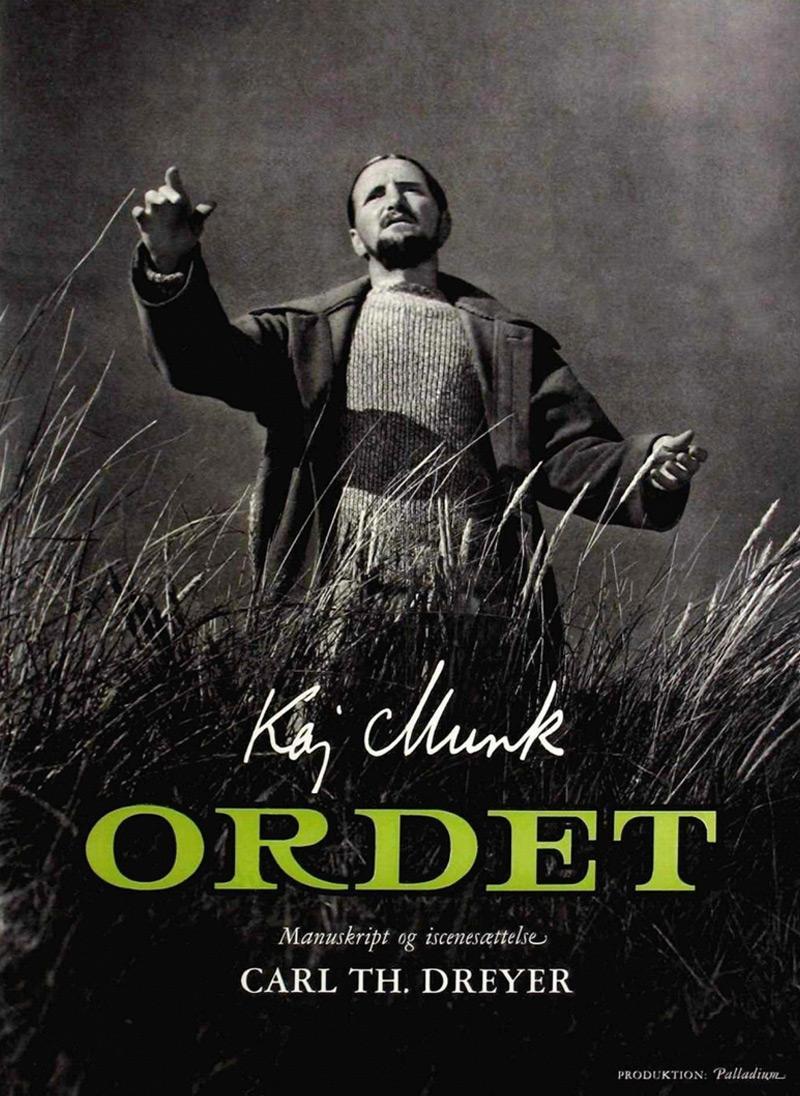
For just about as long as we have, as a collective culture, been observing the broad tenets of proper decorum, the principle of decent society being where one doesn’t dare speak on the subjects of either politics or religion has been in effect, since there are few topics that can divide a population more than these two. This has extended into the world of art to an extent, but mainly through several individuals finding creative ways to have these discussions without ruffling too many feathers (or in the case of the more provocative amongst them, have the exact opposite intentions), normally focusing on politics. However, anyone who said that religion should be avoided as a topic of cinematic storytelling clearly never saw the work of Carl Theodor Dreyer, one of the most important filmmakers to ever work in the medium, and someone who could capture an audience’s attention like few others possibly could. A director whose career spans from the earliest days of silent cinema, right up to the middle of the 1960s, Dreyer was someone who knew the industry inside and out, and was capable of telling stories no one else was both capable of or willing to explore. Ordet (“The Word”)is often considered one of his defining masterpieces, with his particular brand of socially charged storytelling continuing to captivate audiences to this very day, nearly half a century since his passing. His films are stark, bold explorations of the human condition, which take simple approaches to broad themes, and manage to create a world that is both grounded firmly within reality, and fantastical in its abundance of peculiarities, all of which combine to show that Dreyer knew how to sew together various intricate ideas into a format that feels genuine, earnest and, above everything else, deeply captivating, being able to be embraced by everyone, whether a newcomer to the director’s work, or someone who has been hopelessly devoted to Dreyer’s incredible talents for a while.
Religion is certainly a very difficult subject to put on screen, especially when a director isn’t attempting to make something explicitly focused on persuading viewers towards a particular belief (or in some instances, non-belief). Dreyer was undeniably a veteran of the film industry at the time, and some of his previous work stood as iconic exemplifications of the subject (arguably his best-known work is the famous scene in The Passion of Joan of Arc, where Renée Jeanne Falconetti’s multitudes of emotions convey the deep and unflinching suffering that comes with relentless faith). This same principle extended into Ordet, which centres on a quartet of characters, each one of them holding different values based on their individual relationship with religion – the patriarch is a very principled man who has built his existential foundation on his undying devotion to his faith, which is inherited by his younger son, who is often at odds with his older brothers, one of whom has rejected religion altogether, while the other genuinely believes he is Jesus Christ, born into the body of a simple farmer. The tensions that exist between these four characters, as well as a range of other individuals woven into the periphery, set the stage for a poignant and moving exploration of not only the power of faith in isolation, but also the importance of holding a particular belief in times of turmoil, since it’s not always easy to predict when we may need to make use of our moral grounding, and whether our strength and resilience comes from a higher power, or simply as a result in the undying commitment to genuine faith. It’s not a particularly difficult film, but nearly all of its narrative curiosities are woven together tightly, challenging in the way that only the most well-constructed existential drama can hope to be, without descending into heavy-handed territory.
Ordet is a film clearly made by someone who had his roots in the silent era. Despite being a deep and meaningful leap into the world of religious belief, to the point where it can be considered something of a small-scale epic by the sheer virtue of the conversations contained within, the vast majority of this film is centred on the expressivity of these characters. Dreyer focuses his camera on each one of these individuals, capturing every movement and wayward expression of emotion, in a way that shows the director placing the most paramount attention on the smallest, most inconsequential details, which may seem trivial in the broader sense, but add so much nuance to the film and the story it tells. We’re aware of every sensation flowing through these characters’ veins, especially through their various interactions, which Dreyer captures with such vivid detail, showing us the inner quandaries of these people without needing to become too heavy-handed in showing their suffering. Ordet is a remarkably simple film, and proof that one doesn’t need an abundance of material to create something memorable. Dreyer’s work is as impeccable as always, but there is something additional found in this film, a quality that hints towards the director acknowledging that he was at an advanced age. While clearly still capable enough to guide a film like this to completion, Dreyer was older, and thus a lot more aware of his limitations, as well as realizing that a lot of the material centring on ageing and mortality was somewhat applicable to him. This was his penultimate film as a director, which only makes it more bittersweet – Gertrud may have been made just under a decade later, but it’s Ordet that seems to serve as the director’s elegy for a life well-lived, filled with countless stories, most of which were woven into his films in some way. It’s a beautifully simple exploration of life, told by someone who was defined by his tendency to peer forward, but not afraid to look back in an act of beautiful self-reflection, as long as it contributed something to the message he was conveying.
This is reflected in all the characters, but none moreso than Morten Borgen, played beautifully by Henrik Malberg, an old man coming to terms with his own place in the world, and accepting that he can’t change anything other than his own perspective. This is where Ordet is most effective – it may want to persuade us to embrace faith without any hesitation (particularly in terms of the ending, which is possibly the only questionable aspect of the entire film, in how it adds a level of fantasy into an otherwise very simple, realistic narrative), but this is essentially a film about family, a fact that is never lost once we start to realize this is where it is heading. The religious overtones may guide most of the film, but what keeps us engaged is the achingly beautiful portrayal of an old widower and his relationships with his three sons, each one of them carrying distinct beliefs, but also being wildly different individuals, each one bringing with him a new set of challenges to the family dynamic. This is where the film is at its apex, looking at the interweaving mentalities possessed by each of these characters, with their varying faiths being used as guidelines to their decisions, rather than the sole concept that drives it forward. We’re regularly launched directly into this family’s affairs, quietly observing their varying interactions and coming to understand the individual decisions that drive each and every one of them, particularly in times of crisis. The film may be slightly imbalanced, with the first hour being a slower, more laboured exploration of this family, where we come to know each one of them individually, and the second a more frantic, harrowing portrayal of their different reactions to a crisis that sadly turns into a tragedy – but this contrast works, especially when it’s clear that the director had a clear image of the direction in which he intended to take these characters and what they represented.
When it came to representing existence as it is, Dreyer understood the intricacies of the human condition perhaps better than any other filmmaker, being able to celebrate life’s greatest joys, as well as representing the inherent suffering most of us will endure. Ordet is a powerful film that serves as not only a fascinating snapshot of religious belief at a particular moment in Danish history, but also as a beautiful ode to family, taken from the perspective of a group of men whose beliefs are wildly different, to the point of tangible tension, but still find a way to unite themselves, despite their varying approaches to faith. The film is a slow-burning, meditative experience, and has many of the same qualities of Dreyer’s earlier films, including the quiet ruminating on a number of issues, astonishing camera work (Henning Bendtsen, the director of photography, offers conclusive evidence that impressive cinematography doesn’t need to be complex, and that the most poetic images can come from more simple approaches), and performances that pay fierce tribute to the multitudes of themes that sit at the foundation of the film. The religious iconography utilized throughout the film is notable but not overwhelming, and even when it implies the virtues that come with faith, it’s rarely heavy-handed, with most of the moving material coming on behalf of the striking familial relationships at the core of the story, which Dreyer explores with dignity and precision, constructing each of these characters as vivid, complex individuals that are going through a variety of challenges, many of which could be fixed by the simple realization that we may each hold varying beliefs, but what binds us together is the fact that looking beneath these differences, we’re likely to find that we all share more in common than we initially imagined, with these binding qualities being precisely what needs to be nurtured.
 The Postmodern Pelican