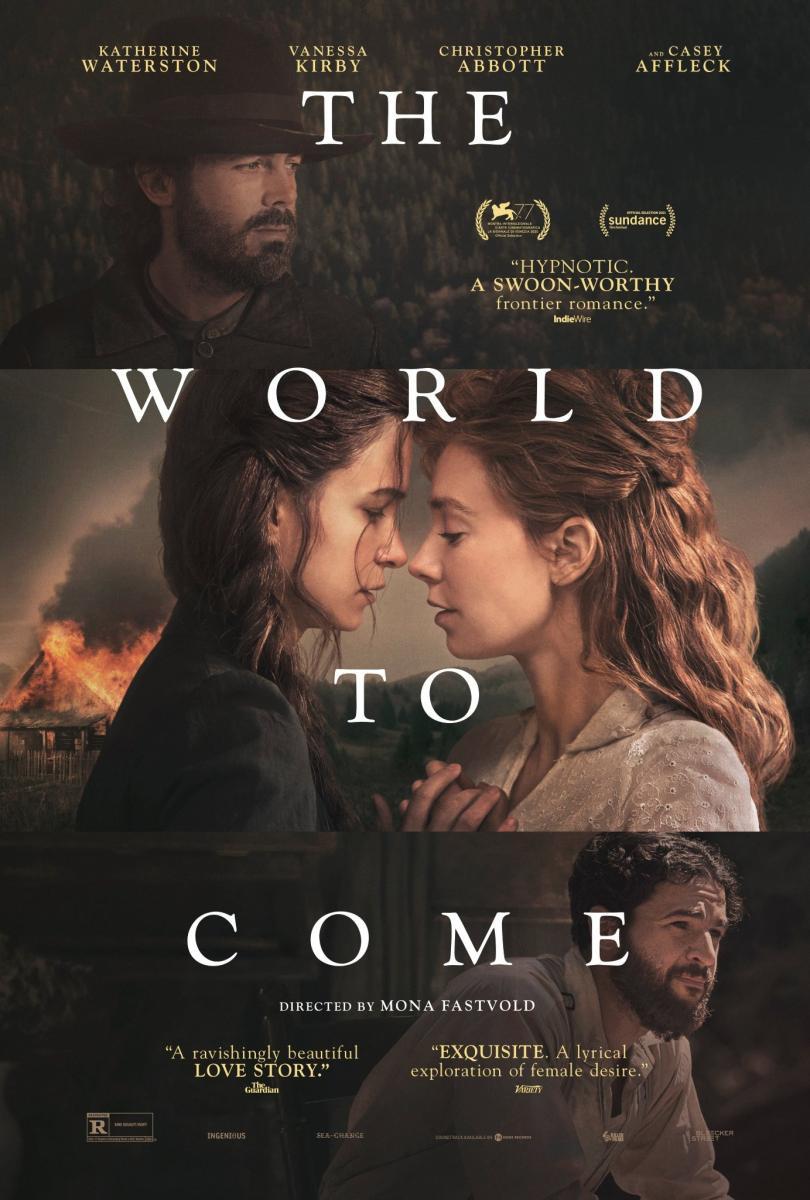
Somewhere deep in The World to Come, there is a great film, the problem is that it never manages to get to that point. Mona Fastvold, in her directorial debut, made a film that is visually astonishing, but narratively paltry, every emotion feeling empty and the structure seeming like an afterthought. Not a necessarily bad film, but rather one that required a more assured hand to adapt the short story by Jim Shepard (who wrote the screenplay alongside celebrated western novelist Ron Hansen, who has written some achingly beautiful period dramas), this film leaves the viewer yearning for a lot more than what we received, a disappointing realization that comes quite early, when we learn that there isn’t going to be some enormous emotional crescendo, nor a sudden descent into the passions that the film genuinely believes are simmering below the surface. There was so much potential harboured in this film – the genuinely insightful commentary that it could’ve conveyed is almost entirely lost in the process of trying to convey too many ideas in a relatively small space. It doesn’t do anything necessarily incorrect, but also fails to achieve the purpose it set out at the beginning. One of the more disappointing examples of a great premise failing to connect with the execution, which is instead laboured and overwrought, The World to Come had so much more to give, but simply never managed to reach a place where it was able to honour the high expectations many viewers had for this film, which initially promised to be a beautiful and sumptuous love story set to the backdrop of 19th century America.
Looking at the film as a whole, the most significant problem with The World to Come is how conventional it is. This is a by-the-numbers period romance, so for devotees of this kind of simple love story set in a bygone era, the film may be a lot more effective. However, for those who are looking for something more, it doesn’t always deliver – there is nothing that is done in this film that hadn’t been accomplished by other recent stories of love between two women, and in all the areas that it could’ve deviated and become its own unique entity, The World to Come recedes back into tradition, never amounting to much other than a very basic portrayal of romance set in the American heartland amid the modern age. Forbidden love is a theme that is still quite pertinent, and with the continued rise and consolidation of queer stories on screen, there can never be enough explorations of the deep insecurities that come about when realizing one doesn’t adhere to the status quo, their burning desires coming into conflict with their social milieu. The film covers all of this, but it never says anything particularly profound about it – and in many ways, the portrayal of this secret romance is the most heavy-handed part of the film, with the director making some peculiar choices in the characterization of her characters that removes any semblance of authenticity, and instead makes them feel like they were plucked directly out of the most hackneyed dime-store romantic novel, perhaps not the best way to construct characters, but something that this film struggles to do otherwise.
Fortunately, not everything in The World to Come is actively disappointing – the various components that constitute the film range from competent to very good, nothing being exceptionally bad. The filmmaking is solid, and the story itself is strong – instead, it’s the execution that impacts the film. None of this is the fault of the actors, all of which turn in solid performances that demanded a better film – Katherine Waterston and Vanessa Kirby, two exceptionally gifted actresses that have already made a mark on the industry with a few years of solid work, play the leads, a pair of lonely individuals that go from friendly neighbours to passionate lovers. They both turn in excellent performances (even if the choice to frame it through Waterston’s perspective seems strange, since Kirby had both the more interesting character and the better performance – but one could easily argue part of this comes in how the film frames the character of Tallie as some distant object of desire in the eyes of a more plain protagonist), and carry the film almost entirely on their own. Casey Affleck and Christopher Abbott are also quite good, but frequently fade into the background, playing the husbands of the main characters who really exist only to progress the plot – this is less of a criticism and more of an observation, since such characters don’t ever really get to have much of an individual function, which only makes sense in the context of the film around them. Whatever problems exist in The World to Come, the actors do their best to elevate the material – but unfortunately, their performances are good, but not enough to entirely distract from the broader problems that persist throughout the film.
The World to Come has its heart in the right place, but its execution is far too convoluted to ever really amount to much. The film struggles to set a clear tone – it isn’t sure if it wants to be a gritty, unfurnished portrayal of life in the heartland, or a complex, existential drama about desire. Had it chosen one of the two and focused on venturing in that direction, there’s very little doubt that it would’ve yielded much better results, rather than falling victim to the same trite conventions that the director thought would support the film, but instead ended up dragging it down. Visually, the film is gorgeous – cinematographer André Chemetoff captures the scenery well (with the wide-open landscapes of Romania standing in for pastoral New York), and the production design and costuming is impeccable – but like with many period dramas, looking gorgeous isn’t enough, since a film need to actually do something with the resources afforded to them. In the most frank terms, The World to Come is a film that veers towards becoming hopelessly boring at times – the internal lives of these characters would be fascinating had there been some substance to the material, but outside of a few striking moments where their desires can finally be met through sequences of burning passion, the film meanders along and stays far too close to the convention to make any profound statement. It seems harsh to be so critical, but the film just doesn’t have much that the viewer can actively invest in, which is why it ultimately struggles to find its voice.
It’s difficult to recommend The World to Come in any substantial way – despite being an adequate film, there is nothing that particularly stands out. All of the actors have been better elsewhere, with their performances here being serviceable but far from definitive. The filmmaking is beautiful, but there’s nothing particularly groundbreaking about these vistas or how the film portrays them. Not even the story, which would normally be the most attractive part of such a film, manages to register beyond a merely passable romance between two women fighting against puritanical Christian values. In fact, some of the dialogue feels almost inauthentic, as if the screenwriters tried to express themselves in nothing but the tritest cliches. Like any love story, The World to Come is at its best when it is genuine, and it’s in the moments of pure humanity that it works – unfortunately, these are few and far between, and don’t manage to converge into anything particularly unique, outside of some inspired sequences that hint at the fact that there was a lot more that could’ve been done to make this film into something a lot better. As a whole, it’s a fine film, one that serves a clear purpose and doesn’t leave any major impression, working as a conventional romantic drama. However, considering the high standard set by many other films with similar subject matter, and the resources available to the filmmakers, the fact that it ended up a middling, derivative film just feels disappointing, since there was so much potential lurking beneath the surface of this very promising, but unfortunately unconvincing, film.
 The Postmodern Pelican