
Looking at the genesis of any director’s career is always a fascinating endeavour, particularly when dealing with those that you admire – seeing their roots presented in the form of their early work helps us critically judge their evolution as artists, and show their journey to becoming compelling storytellers. Jim Jarmusch is one of the most inspiring filmmakers of his generation, a stalwart of American independent cinema that essentially took the reigns from John Cassavetes to become one of the foremost auteurs in the American arthouse when it comes to smaller, character-driven stories that focus on the lives of ordinary people. Permanent Vacation is his first film, and one that both hints at the gifts the director would employ numerous times later in his career, and deviates wildly from the more polished, nuanced stories that Jarmusch would craft later in his career. A highly experimental film with a caustic sense of humour and the same brand of effortlessly cool nihilism that has come to be definitive of the director’s style, this is quite an interesting journey, one that may not be as entertaining as those that would come later (by virtue of the fact that Permanent Vacation is playful but lacks much coherency, which can sometimes be a problem for feature-length films), but still has a degree of sophistication that proves that we can’t discount this at all, rather working around the flaws in such a way that they become unnoticeable in some instances, and even yet another fascinating detail in this otherwise vivid, complex exploration of a very different kind of New York City, filtered through the sunglass-covered eyes of a filmmaker whose ease behind the camera was present at the very first moment in his incredible career.
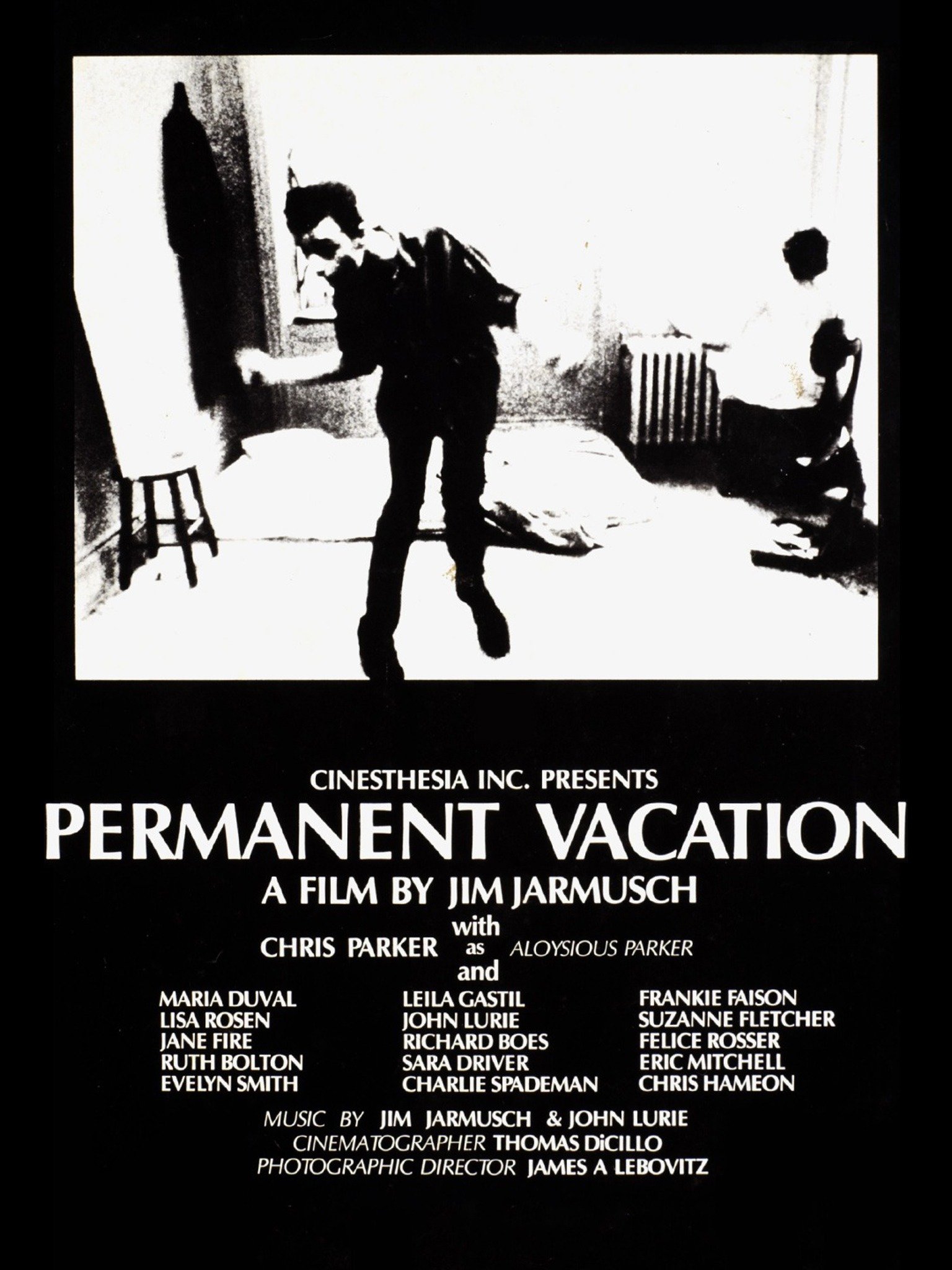
Permanent Vacation is a film that is certainly rough around the edges, imperfect in the ways that we have come to expect from debut features, especially those produced at a time when independent cinema was defined by shoestring budgets and renegade filmmaking techniques – yet, this is perhaps its most impactful merit, since it contributes to the uneasy message of the film. Jarmusch was a scrappy young director who had just dropped out of film school, and set off to pursue filmmaking in his own way. Assembling a motley crew of friends and amateurs, he threw together a brief, 71-minute long film that turned out to be an insightful metropolitan odyssey that, whether intentionally or by accident, managed to be a profound account of the angst that comes from living in a big city, isolated and alienated, despite the multitudes of souls that exist around us. Jarmusch has always had an inherent fascination with human stories, which he presents in often very unorthodox ways – and the character of Aloysious Parker, a wayward young man without any real direction, is certainly something that fits in the director’s brand, since most of his protagonists take the form of these self-assured, cocksure younger people who don’t think they’re better than the people around them, but rather know it for sure, even if their behaviour suggests otherwise. Permanent Vacation focuses exclusively on the physical meanderings of this young man across the city over a number of days, giving us a glimpse into his everyday life, as he visits his girlfriend, discusses philosophy with any stranger who catches his eye, or interacts with any of the many fascinating figures who haunt some of his favourite locations, all the while seeking some deeper meaning to an existence he isn’t quite sure is real at all.
There are questions that young Parker asks that he doesn’t find the answers to – in fact, it’s not even clear if he expects to find any solutions – but it doesn’t matter much, since he is so much more compelled by the experience of seeking them out, which extends to the audience as well. We’re caught up in this hypnotic journey that enrobes us in a bizarre sense of nihilistic absurdism, which has evolved into being Jarmusch’s signature concept, and has been well-deployed in the vast majority of his films, which seem to follow in the strange tendencies of this one. It isn’t quite clear what Jarmusch was trying to do with Permanent Vacation, other than showing New York City through his perspective (which has always been defined by an off-kilter sarcasm that can often be excessively dry and inaccessible for those not acclimated to his peculiar deadpan humour), but whatever it was, there was something so enthralling about how he presents this story, always aiming high, but not quite meeting the target, instead hitting a range of other fascinating ideas that wouldn’t be present in more conventional projects. Jarmusch is self-assured enough to execute this strange film without it becoming too polarizing, since everything makes sense when filtered through his strangely mesmerizing perspective, which is far more compelling than the work being done by some of his more conventional contemporaries.
Not many directors can make something as non-coherent as Permanent Vacation and still have it feel like a genuine excursion into the mind of real characters – but through the well-written screenplay and obscure directorial flourishes, we believe every moment. There is a looseness to the filmthat works incredibly well, an elastic approach to the narrative that compensates for the lacklustre consistency, which actually becomes less of a problem the more we are willing to surrender to the inherent peculiarities of the story. Nothing is supposed to make sense in Permanent Vacation, which takes the form of a series of disjointed vignettes, taking place in a familiar version of our world, albeit one that feels slightly disconcerting, everything being shifted gradually to the left, creating a sense of unease that keeps us engaged, but never complacent. Permanent Vacation is not an easy film to put into words, since so much of what Jarmusch does here is visual, playing on something deeper than mere storytelling, and putting the viewer through a more polarizing experience that has made this a rightfully divisive film, albeit one that does manage to add in some interesting commentary between the jarring scenes, which converge in an oddly touching ode to a city seeing the change of time between the generations. Jarmusch is very skilled, and while his debut may not be the best representation of his talents, it is an essential glimpse into his early work, and a vital stepping-stone towards the rest of his career, which was built from the foundation he set with this film. Simple but effective, Permanent Vacation is a terrific film, but one that takes some getting used to – but once we are on Jarmusch’s bizarre wavelength, it becomes an absolute abundance of absurdist, nihilistic delight, with a healthy dose of deadpan humour thrown in for good measure.
 The Postmodern Pelican