
If you ask someone the simple question: “If you could live anywhere in the world, where would it be”, some may answer that they’d like to live in some tropical paradise, while others a bustling metropolis. Personally, I would like to live in the mind of Leos Carax, purely because there are few artists throughout history who have shown such steadfast dedication to bewildering audiences more than him. In a career spanning a few decades, but only producing a small but important handful of films, Carax has been at the forefront of a movement committed to embracing the absolutely strange, rather than fitting into a mainstream none of them aspires to be a part of anyway. His most recent effort may be one of his most extraordinary achievements, with Annette, his frightfully ambitious musical epic, being the precise reason cinema has been so readily embraced as arguably the most important artistic medium of the last century. Created in collaboration with Sparks, one of the greatest bands to ever step foot behind a microphone (who in turn finally managed to realize their decades-long ambition of writing a film musical), and put together with the steadfast dedication of a filmmaker who had nothing but undying faith in his own artistic vision, enough to take us on this strange journey into the lives of two complex individuals without worrying about whether or not we are going to understand what is presented to us, Annette is a staggering piece of purely unhinged filmmaking, plucked directly from the mind of a director who simply doesn’t give a second thought to logic, reason or ration, and a band that has spent the last half century challenging the conventions of the entire music industry – and for that alone, we have to celebrate them as some of the most essential artists of their generation, so much that even something as offbeat as this film can easily be proclaimed a masterpiece from the very first moments, without even an iota of hestitation, simply because the people behind its creation prove once again how willing they are to push boundaries further than anyone before them.
There are several terms that can be used to describe Annette, but oddly enough the most inappropriate would be to call it simply a film. Carax doesn’t deal in simple cinematic excursions – he crafts beguiling, confusing narratives that combine film with existential philosophy, anthropological theory and even some touches of grand opera, which all converge into this wildly entertaining, but deeply unsettling, voyages into the heart of the human condition, a subject that Carax always manages to weave into his stories, which has also been found in much of Sparks’ musical output. This film in particular is a work of truly unconventional art – it is 140 minutes of pure carnivalesque madness, anarchy condensed into a love story that is in turn filtered through the lens of a bold and audacious musical production, constructed in tandem between Carax and Sparks, who share credit as the authors of this entire project. When you have artists as wildly unique and idiosyncratic as Carax and Sparks working in tandem, you would be foolish to think this would be anything close to conventional. The creators of this film don’t so much break the rules as they actively dismantle them, taking the audience on a journey that may be difficult to process at times, but will always end up being worth our time, because the destination is one that we may not be able to entirely envision while in transit, or fully-comprehend once we’ve arrived, but we do understand that it is reflecting something much deeper about our world. You can always tell when you are watching a Carax film, or listening to a Sparks album, by a few key qualities – offbeat narrative qualities that don’t always make much sense, a feeling of disharmony that is both terrifying and alluring, and a sensation of foreboding danger that is only eased by the realization that we are in good hands, and that even if our questions are not answered by the end of the piece, we’d still gain something from the experience. The two artists working together could’ve either been an enormous collision of styles, or a deeply moving leap into the unknown – and Annette can truly be described as embodying both of these ideas, which only further contributes to the madness residing solidly at the film’s core.
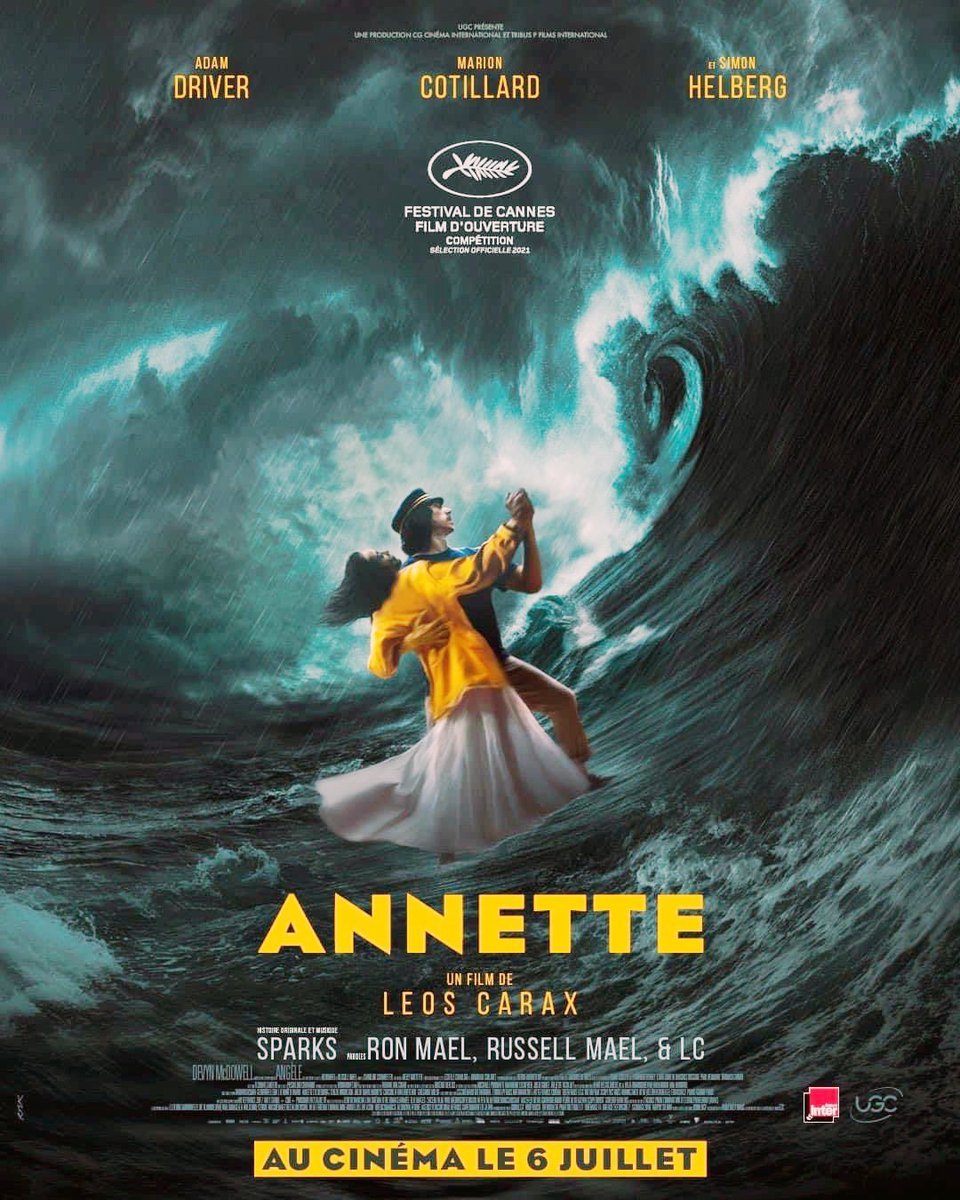
It seems with every passing year, Adam Driver continues to consolidate himself as one of the defining actors of his generation. His precise style of acting and unique combination of hulking physicality and introspective vulnerability making him a very interesting performer to watch on screen in any project, and his constant pursuit of collaborations with a variety of auteurs, both local and international (all of which readily embrace Driver’s talents), has made him quite a formidable presence in contemporary cinema. Annette is certainly amongst his greatest work to date, as he fits perfectly into Carax’s world, playing an intense but complex anti-hero that anchors the film. His performance is a work of absolute splendour – his ability to plumb every scene for deeper meaning, while always coming across as natural as possible (a rare feat for an epic musical drama) proves his skills. Annette was certainly a film that challenged the actor to broaden his horizons and embrace a set of skills he had yet to demonstrate – but consistently and seemingly without much difficulty, Driver rises above the obstacles and comes through with one of the year’s greatest performances. Despite playing a more subdued, quiet character, Marion Cotillard is not to be discounted either – while Driver is the over-active brain of Annette, Cotillard is the beating heart, the tragic heroine to her co-stars deeply disturbed anti-hero. It’s a collision of two very different actors who find the symbiosis through the gorgeous music written by Sparks, and the deeply complex nuances facilitated by Carax’s direction. Watching Annette isn’t only about appreciating the artistic audacity shown by the writers and director, but also the incredible work being done by the two leads, who single-handedly carry this intimating project to fruition on the strength of their wonderful performances. It’s difficult to imagine a pair of actors better suited to play these characters than Driver and Cotillard, who truly embody the spirit of Annette with a candour and intensity that we don’t often get a chance to see in contemporary cinema.
Carax has always thrived through residing in the ambigious spaces between films – he has never been one to adhere to standards, and has made an entire career out of the vague grey areas that most other films refuse to even acknowledge. Carax goes where no one else is willing to travel, which has made him a director who frequently stands on the margins of the mainstream, but has never been compelled to actually make any effort to break through, even though his wide breadth of talents means that he can do absolutely anything, even if it means putting together a film that hinges almost entirely on the realization that, regardless of our incessant need to rationalize everything, this is a world often driven by delusion and insanity, especially when it comes to matters as deeply troubling and exceptionally common as the search for widespread recognition. Annette finds the director at his peak – he is handcrafting a fascinating story drawn from a number of his own artistic and psychological quandaries, the premise extracted from his own attempts to work through a variety of questions he has about the world that has fascinated him for his entire artistic career. Taking the story conceived by Sparks, and adding his own quintessential components into what would become the film’s screenplay, written in collaboration with Ron and Russell Mael (who prove they are just as gifted when writing dialogue as they are composing music), Carax forms a fascinating drama that doesn’t have any qualms with making the audience wait a considerable amount of time before even attempting to lay out its intentions – but rather than remain vague for the entirety of the production (which is all too common a tendency for these more ambigious, experimental projects), Carax and his cohorts gradually work through the panoply of themes that inspired the creation of this disquieting adventure into the mind of a deranged comedian and the woman he loved and lost, all as a result of his own hedonistic search for fame and fortune, and the obstacles he encounters in the process.
Focusing on the purely straightforward components is a disadvantage for a film like Annette, since its the kind of work of art that doesn’t require us to have a large working knowledge of any of the philosophical ideas that sit at its core, but rather just the willingness to enter into this film with an open mind, and perhaps a slight sense of humour, since there are moments of unrestrained absurdity that require us to suspend disbelief almost entirely, which is almost expected from a Carax film. Once we can overcome the initial shock of not knowing what this film stands for, or where it is headed, it doesn’t take too much effort to realize what it is actually attempting to say. There’s a slightly more obscure quote by Friedrich Nietzche, which has been roughly translated to “one must face chaos to give birth to a star” – and while the extent to which the esteemed German existentialist was an inspiration for this film remains to be seen, this is a perfectly appropriate way to look at Annette, both in terms of the surface-level premise (if we can put aside the innumerable sequences of surrealist ramblings to find some semblance of a story centring on fatherhood), and the underlying social commentary, which is about as opaque as all the other intentions Carax and Sparks had when going into this film. It is primarily a film about love – not to be mistaken for a love story, which is often a genre that the film is actively trying to avoid – and the various forms it takes. The recurring refrain of “We Love Each Other So Much” has a much deeper meaning with every appearance, this seemingly romantic ballad evolving into a disconcerting admission of guilt by the time the film reaches the final use of the song, in which focus has shifted from the romantic love felt between two individuals finding their way through a hostile world, to the unconditional love that exists between a father and his child, which sharply contrasts with the darker message that comes through in these sequences. It’s challenging to talk about Annette without giving too much away – not only because the element of surprise is so integral to the success of the film, but everything is so abstract, describing it in coherent terms is quite difficult, since so much relies on the unspoken meta-language that comes through in each interaction.
Some may describe Annette as a religious experience – and considering both the feeling of grandiosity that we encounter in nearly every frame, or the more intimate allusions to religion (various poses emulating iconic images from the past few millennia across a range of faiths, the constant image of an apple being eaten by the alluring Ann, who becomes something of an Eve figure to her husband’s more envious and maniacal Adam analogue), it’s easy to see how some would have a very strong visceral reaction to the content at the heart of the film. Fame is both a shimmering goal and a vicious punishment for many people, and as we see throughout the film, the lustre of seeing one’s name in lights is not always as satisfying as it would appear. Carax combines various concepts, drawn from numerous sources across a variety of disciplines, to construct this film and its central ideas. Fame is conveyed as the ultimate reward for talent, to the point where someone is worshipped in the same way one would dedicate their life to a god – and Carax explores this extensively, especially in a series of spectacularly bleak moments where the central characters are subjected to nothing but fawning and admiration by their devoted fans, who see them as the epitome of celestial elegance, and are worthy recipients of their adulation. The boundary between admiration and near-religious devotion is razor-thin, and working as one of the supplementary themes of Annette (which is mostly a film about parenthood and grief), fame is a fascinating discussion that Carax has often been focused on exploring, most notably in his enigmatic masterpiece Holy Motors, and ties together a variety of other concepts in the director’s pursuit of pulling together a wildly unsettling portrait of the search for worldwide recognition, and the remorse that comes about as a result of realizing there are more obstacles ahead of those in the public eye than most initially imagined when starting this journey.
There aren’t many ways to easily encapsulate the true scope of this film in terms of the thematic content that underpins it. It’s a revelatory experience, a feeling of rebirth – it challenges us and invites us to look behind the veneer, not only of fame, but of life in general. This is a truly exceptional voyage into the deepest, most disconcerting recesses of the mind of a character we should not be this fascinated by, since everything about the central protagonist should be repulsive. Yet, Carax has always had a tendency to centre his films around strange, offbeat individuals that may not be the most endearing, but have a quality that piques our curiosity. The film around him is just as complicated, with the entire story being a ferocious elegy to a nightmarish version of our world that has been overtaken by hedonism and a herd mentality surrounding anyone even vaguely famous – and what makes Annette all the most disconcerting is how it is a cautionary tale, a warning against the cult-like admiration of individuals, where ordinary people are repurposed as celestial beings based solely on their status in their chosen industry. Naturally, a film of this length and scope doesn’t only have a single line of inquiry, and throughout the story, we’re witness to a variety of deeply captivating ideas, whether its the central romance between the two main characters that occupy the first half, the deeply unsettling but oddly beautiful dynamic between the main character and his daughter (who should be noted is played almost entirely by a puppet, a strange but intentional choice that adds to the peculiar nature of the film), or the exploration of the inner workings of someone slowly descending into madness. In as clear terms as possible, it’s easy to proclaim Annette a modern masterpiece, a deep and introspective musical drama that weaves together so many different ideas, and emerges triumphant at alarmingly regular intervals. Carax is a director who warrants every bit of acclaim he receives, and earns the title of one of the most inspiring mad-men of contemporary French cinema, which has never been better encapsulated than in this film, a story of individuality, the pursuit of fame and the unhinged descent into a darker version of society, from which there is very little escape – not that we want to ever leave this terrifying but hypnotic version of the world anyway.
 The Postmodern Pelican