
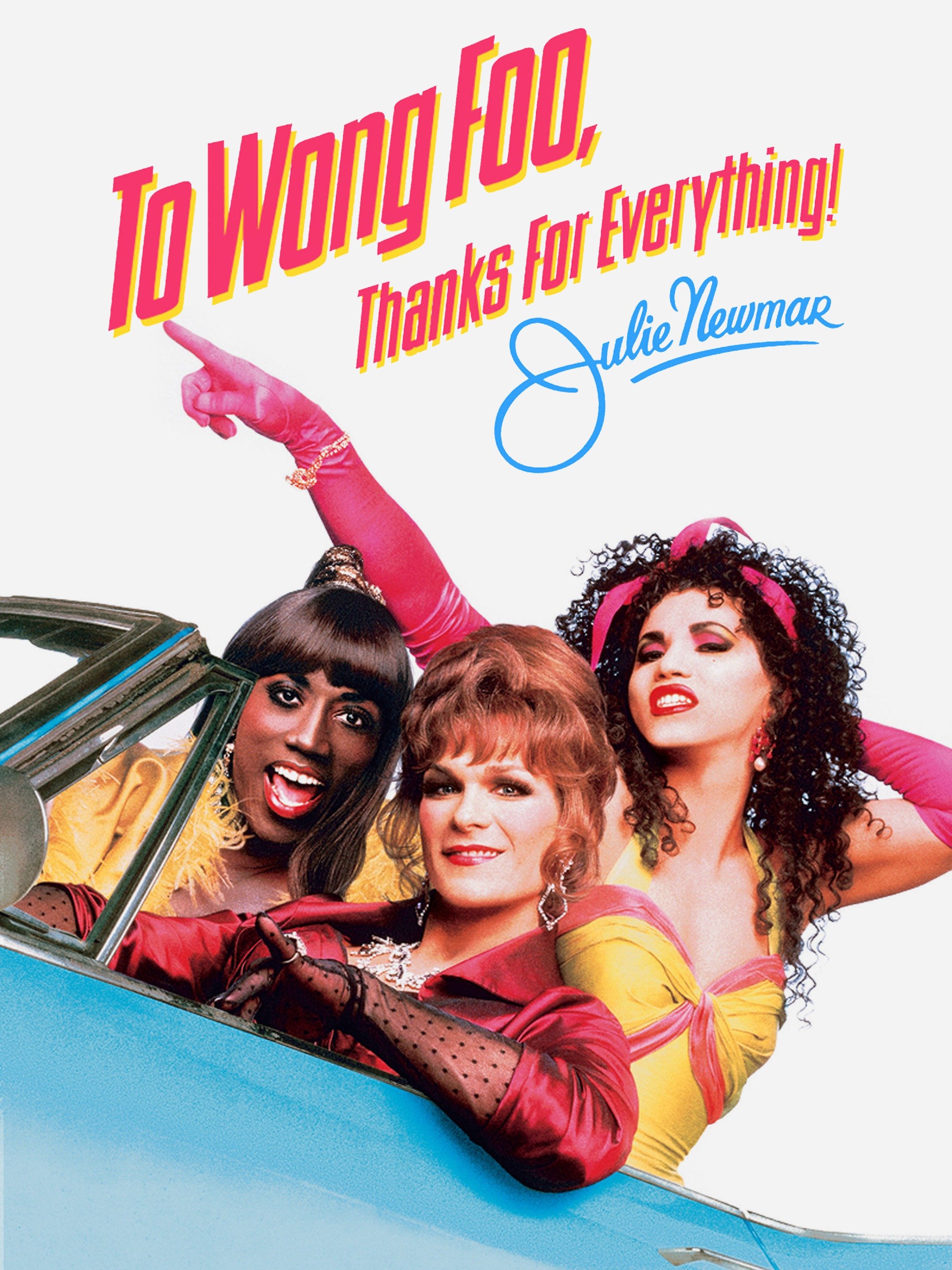
The 1990s were a watershed moment for queer representation on screen, especially in telling stories of the LGBTQIA+ community on a more mainstream scale, often filtered through the lens of drag, which has often served as the most accessible gateway for many into understanding queer culture. There were three consecutive years where some of the most impactful comedies relating to queer issues – at one end is The Adventures of Priscilla, Queen of the Desert, the revolutionary Australian comedy that went from a small independent production to one of the most celebrated films of the era, and on the other is The Birdcage, the beloved comedy helmed by Mike Nichols that not only contains one of Robin Williams’ funniest performances, but introduced most of the world to Nathan Lane, who has grown into one of our finest performances across every conceivable medium. Sandwiched between them is a film that has just as much of a cult following, and perhaps even more so, considering the message at the core. To Wong Foo, Thanks for Everything! Julie Newmar is the second in this unconventional drag trilogy, and like the other two, it only gets better upon rewatch. Daring, provocative and wildly funny, director Beeban Kidron managed to essentially deconstruct the core values of the American way of life by venturing deep into the nation’s heartland, and portraying a diverse range of individuals and their reactions to encountering a trio of the most bodacious drag queens one could ever hope to encounter. Filled with the kind of heart that is almost always reserved for only the most charming comedies, and progressive in a way that may shock many viewers expecting just an entertaining romp, To Wong Foo, Thanks for Everything! Julie Newmar is just as good today as it was a quarter of a century ago.
To Wong Foo, Thanks for Everything! Julie Newmar is certainly a product of its time, and watching it from a contemporary perspective is definitely an interesting experience, since our perception of what drag represents has evolved, going from something that is almost entirely confined to the underground (and when it does make its way into the mainstream, it’s often as a punchline), to a global phenomenon. Obviously, this doesn’t suggest that it’s an art-form that has been universally embraced, especially in corners of the world where queer issues are still very prominent – but it does show that there are ways to get these stories out. It may be slightly dated in its style, especially considering how drag has evolved into something much deeper than the “boy in a dress” archetype that serves as the film’s starting point, but it is still radical, both for the time it was made, and how it exists today as some hilarious and offbeat comedy about a trio of drag queens making their way through the United States, encountering a variety of characters and leaving their mark wherever they go. A film motivated less by a deep social message (which is still there, but not nearly as prominently as more overwrought explorations of the subject), and more by the willingness to take these characters and place them in unexpected situations, which they doubtlessly manage to work their way out of without much difficulty, To Wong Foo, Thanks for Everything! Julie Newmar is the definition of a good time at the movies, with its peculiar sensibilities and enormous heartfulness making for quite a remarkable piece of filmmaking.
While it’s most common to remember a few specific details of the film – whether it be a quotable one-liner, a particularly funny moment or one of the many stunning costumes (designed by Marlene Stewart, who does exceptionally well in bringing out the personality in all these characters), To Wong Foo, Thanks for Everything! Julie Newmar is a film driven by a particular narrative, as evident in the fact that this is essentially a story about conflicting lifestyles – the kind of road movie that has a prolonged pit-stop in an area that is foreign to the main characters. The film gravitates towards the fish-out-of-water narrative, as well as showing the conflict that occurs across the aisle, when the residents themselves start to venture out in an effort to learn as much as they can from their visitors. Acceptance is a process that takes many different forms, and this film uses its culture clash qualities to create a vivid and endearing story about two different lifestyles coming into contact, and the wonderful realization of those on both sides, who realize that they have much more in common than they initially expected. Throughout the film, we encounter several characters that aren’t used to the presence of individuals that live such starkly different lives – it initially launches a very tense, awkward series of moments, but gradually dovetails into one of the most charming and endearing representations of unconventional friendships being formed. Once someone gets to know another person’s life, and realize the way they go about their day is just as valid as what is considered “normal” from their perspective, the sooner they can move past their own myopic worldview, and realize the value of embracing a wide range of individuals. We’re different, but not separate – and if there is a lesson at the heart of To Wong Foo, Thanks for Everything! Julie Newmar, beyond the built-in message of tolerance and acceptance, it’s the importance of expanding one’s horizons, regardless of your background.
While it’s worthwhile to find nuances in the film’s execution and how it conveys a particular message, To Wong Foo, Thanks for Everything! Julie Newmar would not be nearly as successful had it not been for the performances given by the cast, in particular the core trio. Wesley Snipes and John Leguizamo, both of the two most promising actors working at the time, take on the roles of Noxeema Jackson and Chi Chi Rodriguez, a pair of lovable drag queens that find themselves hopelessly out of their depths when their car breaks down in the middle of nowhere. They’re accompanying Vida Boheme, played magnificently by the incredible Patrick Swayze, who steals the entire film, to the point where the large cast of very gifted actors pales in comparison to his performance. This isn’t the first time an actor mostly known for his simmering bravado put aside his masculinity to play a more feminine role – but unlike many other instances, this doesn’t feel like a popular actor wearing a dress, but rather a full transformation into the character, so much that Swayze disappears into the character. His commitment is beyond admirable – he proves why he was one of the most interesting actors to ever work in the medium, far more than the overly macho hero he often played. It’s a shame he didn’t pursue more character-based work later in his career, since not only is he very gifted at it, it opened up a world of possibilities for an actor who was often weighed down by his own reputation, based on a few roles that pigeon-holed him into constantly playing the same typical characters. His performance as Vida isn’t just the actor stepping out of his comfort zone – it’s a fierce rebellion, the kind that redefines an actor’s career. This may be Swayze’s peak as a performer, and while a relatively inconsequential comedy might not be the best place to use such an assertion, when an actor gives as spirited a performance as Swayze did here, it’s perfectly appropriate.
To Wong Foo, Thanks for Everything! Julie Newmar is a lot of fun, working as one of the quintessential comfort films that many of us gravitate towards, whether it be for the first time, or a regular rewatch. It is anchored by a very distinct sense of humour that is a defining trait of many 1990s comedies, as well as a very sentimental heartfulness that makes for a truly captivating few hours of cinema, where we’re invited into this world, accompanying these eccentric characters on their journey, both the literal one and the emotional one that they discover along the way. It may be conventional, and you can easily predict the direction the film is going after a while – but there’s a depth and gravitas to it that keeps us engaged and enthralled, perpetually indicating that there is depth to the frivolity if you look deep enough. It may not be the defining text on queer issues, and there were many films produced around this time that had a more authentic viewpoint (but sadly didn’t receive even a fraction of the attention this did). Yet, a film like To Wong Foo, Thanks for Everything! Julie Newmar still serves the vital purpose of starting the conversation, which is already half the battle accomplished, especially in a time when such issues were still quite unexpected for mainstream media. Entertaining, heartfelt and beautifully made (not to mention populated by an endless array of unforgettable characters), this film is an absolute triumph, and remains as charming today as it did at the time of its release, a difficult task for a film occurring in a genre that has a tendency to age faster than most, which only further proves what a special film this is, and how it deserves all the acclaim and adoration it has received over the years.
 The Postmodern Pelican