
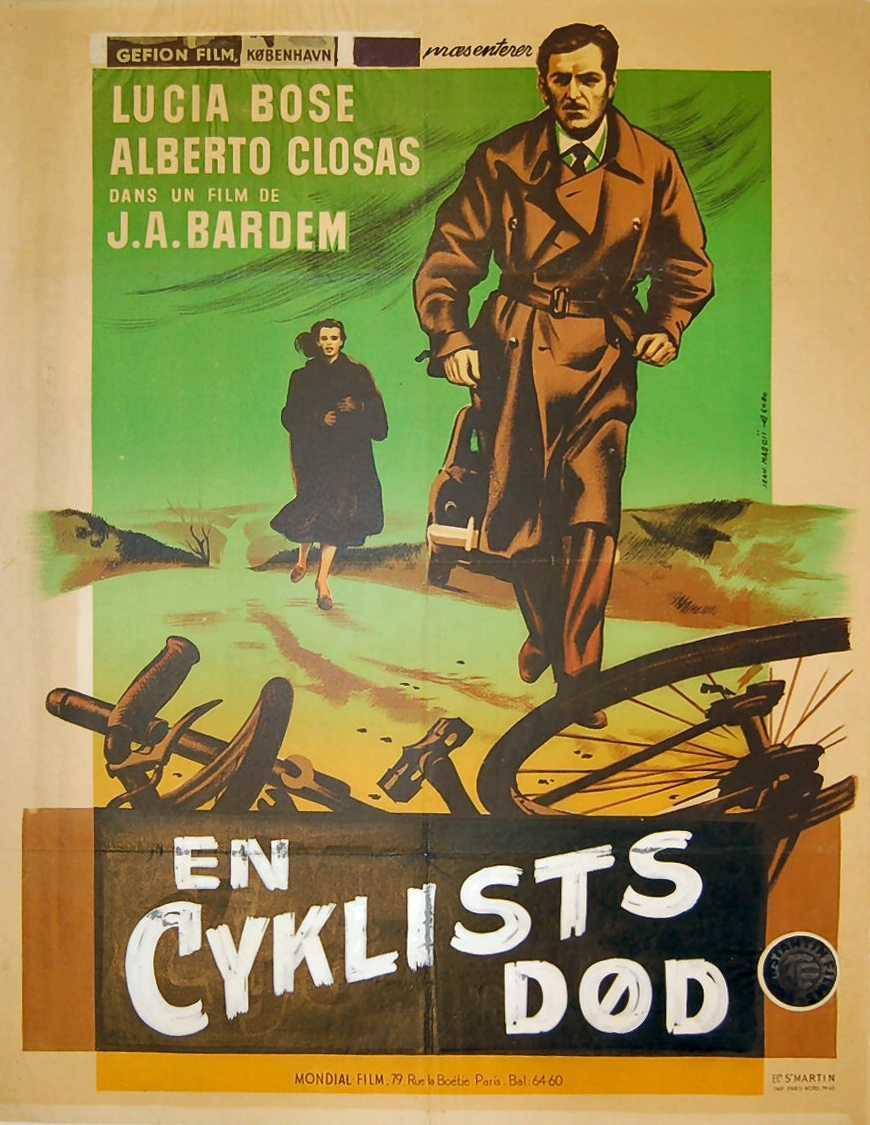
A secluded patch of road somewhere in the idyllic countryside is suddenly the site of a major collision between a car and a cyclist, with the former striking the latter, causing an enormous accident. The occupants of the car are concerned about having possibly killed the cyclist, but decide they can’t stick around to find out, since being seen together will confirm that they have been having an affair, which would wreak havoc on their lives, as they’re both members of Spain’s high society, and they don’t particularly crave being at the centre of a major scandal. This is the basic foundation for Death of a Cyclist (Spanish: Muerte de un ciclista), the ambitious psychological thriller written and directed by one of Spain’s most important filmmakers, Juan Antonio Bardem. The film, which functions as a disquieting odyssey into the lives of a small group of characters peppered throughout the upper-echelons of society, is a harrowing exploration of grief and alienation, with Bardem carefully curating a number of scenes that demonstrate the depths to which one can descend if they are not careful to restrain themselves from falling victim to their vices. One of the pivotal texts of Spanish cinema, and a defining work in the career of its revolutionary creator, Death of a Cyclist is a fascinating experiment, a powerful and multilayered account of the human condition, as siphoned through a horrifyingly grotesque demonstration of duplicity and manipulation of reality. Both of these themes serve as the basis for this haunting look into the fragile egos that dominate high society, and the advantages offered to those who are able to make use of their affluence to get their way. It focuses on the arrogance found in these people can backfire when it isn’t supporting by any moral grounding, proving that influence and power do not necessarily make one a decent member of society.
Death of a Cyclist is generally referred to as a social realist film, which is certainly one major component of how Bardem crafted this film. Any work of literature produced in Spain during the middle of the 20th century is going to have some degree of socially charged element, since they’re all made under the shadow of the Francoist dictatorship, which irrevocably changed the nation and its perspective on not only the outside world, but on their own existence. Very often, these works are divided into those that look at the working-class or high society, with this particular film focusing on the latter. Bardem had a firm fascination with the social and political machinations of his country at the time, as reflected in every frame of Death of a Cyclist. Each moment is brimming with the quiet fury of a director who understands the platform he has been given, but also possesses the wisdom to know exactly what to do with it. Not directly focused on the political milieu, but rather on the cultural impact of living under a dictatorship that brought about such clearly defined delineation between social classes, the film is a fascinating portrait of Spain under this dictatorship, filtering some broad themes through the guise of a potent psychological thriller that addresses both sides of the social gap. The contrast between the two classes – the one defined by the two protagonists and their colleagues (who represented the hedonistic bourgeois) and that of their now-deceased victim (who we soon learn was a blue-collar worker struggling to raise his family above the poverty line) – is stark and unforgettable, with Bardem’s ability to oscillate between the two being all the more impressive considering how consistent the film looks at both sides. Never heavy-handed in the way many social dramas tend to be, while still bursting with genuine emotion, Death of a Cyclist provides the casual viewer with a fascinating introduction to the social divide, in a way that seems strikingly authentic, which isn’t always easy to accomplish when working under such strict political conditions.
What stands out the most about Death of a Cyclist, at least on a purely narrative level, is its simplicity. This isn’t a film that needs to waste too much time on exposition, instead thrusting us directly into this world, and allowing us to observe the machinations of the class divide from afar, while still exuding the kind of stark detail associated with intimate, character-driven dramas. This film is a masterwork of psychological manipulation – we may not particularly like the main characters (each one of them is rather despicable, filled with hedonistic arrogance and self-centred vitriol for anyone outside of their social stratum), but we do become invested in their attempts to hide their misdeeds. The story uses the actual death of an ordinary person, who remains relatively anonymous throughout the film, as the starting point for a deep and harrowing exploration of the treachery of the elite. For the main characters, it isn’t so much that they fear revealing the truth because of the victim they accidentally killed, but rather that the revelation will serve to uncover the truth of their elicit affair. In their mind, being considered murderers pales in comparison to their peers discovering their infidelity, since an affair indicates in-group betrayal, while the murder of a nameless, working-class man is just a mere accident. It’s a twisted and perverted way of looking at the class divide, and it can sometimes verge on spiralling out of control, which would’ve likely happened had Bardem not been so thoroughly committed to showing the intricate details of such a story, using the titular event as the centrepiece of a dark social fable that showcases the more sinister side of society, and how easy it is to get away with murder if one is afforded the right resources and ability to have the benefit of the doubt, which is shown to be inherited when making one’s way up the social ladder.
However, even with as captivating a story as this, Bardem isn’t content to rest on his laurels. Midway through the film, Death of a Cyclist begins to change gears, going from a very simple social realist drama, into something far more sinister, becoming an enigmatic, experimental attempt at penetrating the minds of its characters. The story itself is very simple, and while there are some absolutely stunning shots, the visual scope of the film is relatively humble in the way most realist films at the time would be. Instead, Bardem uses tone and mood to set a particular atmosphere, especially in the later parts of the film, where the growing paranoia within the characters reaches an unbearable crescendo, and their well-maintained lives slowly start to collapse around them. This is a purely psychological film, as it ventures beneath the social veneer and demonstrates the unravelling mental states of the two main characters. Their increasing fear of being caught causes them to act out, asserting more extreme measures that will prevent them from being found out – and in the process, they begin to lose their minds, their sanity holding on by a slender thread. By the end of the film, the only resolution for these characters is to surrender to the contrition, and to agree to a form of self-imposed penance, since nothing else has been able to put their minds at rest. It results in a bewildering climax that is simultaneously hypnotic and utterly terrifying, where the two find themselves succumbing to the guilt, as there is no other choice but to place themselves at the same level as their victim. It’s a fascinating way of concluding this labyrinthine story – these characters would prefer to die with their reputations intact, rather than face the consequences of their actions, which may seem like a peculiar sentiment, but it’s all too common in our world, with Bardem only serving as the guiding artistic force that brings it to life.
Throughout Death of a Cyclist, Bardem immerses us in a very dark version of the world. The upper-class are portrayed as grotesque, maniacal villains whose every action only serves to assist their specific agenda, while the working-class are ignorant and foolish to the problems that surround them, mere pawns for the manipulative games of power and influence that are enjoyed by the elites. However, rather than presenting this duality in the form of a carnivalesque satire (which would’ve been more conventional for such a story), the director instead chooses to go about doing so through a tightly-wound, fascinating psychological thriller, anchoring it within reality. He does take some artistic liberties – there are several moments in the film of stunning beauty, and the ending scenes are a combination of gorgeous and terrifying, which can only be the product of a director firmly in control of his craft. Death of a Cyclist is a poignant film, a rousing call to arms for rational individuals to look beyond the socially-constructed veneer, and while it may not be much of a commentary, functioning more as a series of keen observations of the trials and tribulations of various people living under a dictatorship, it presents us with a nightmarish version of the world, which only becomes more troubling as we further venture inwards. This is a vitally important work of Spanish cinema, a simple but effective psychological drama that knows how to target the audience in a productive way, and leaves us thoroughly enthralled, even if we only become more disturbed by the horrifying image of the world Bardem is painting for us.
 The Postmodern Pelican