
While his name may not be known to many people outside of aficionados of early Hollywood history (and even then, it may not be as obvious as it would seem), William A. Wellman will always be considered part of film history for directing arguably one of the defining works of silent era cinema, the incredible Wings, which was not only the first film to win the Academy Award for Best Picture, but has often been considered amongst the gold-standard for silent films, with its aerial footage, gorgeous camerawork and incredible performances consolidating it as an unimpeachable classic. Wellman had a fruitful career on both sides of this film (particularly afterwards, where he wasn’t one of the silent-era directors who refused to transition to sound), as evident in another one of his most prominent productions, the dashing adventure Beau Geste, which saw Wellman (and quite a formidable cast) venturing into Africa to tell the story of a trio of brothers that enlist as soldiers in the French Resistance, and their experiences being commanded by a particularly malicious officer who would just as easily lead his men to battle as he would execute them in cold blood. Beau Geste is a fascinating film – it’s not the most interesting attempt at telling such a story (nor is it the only adaptation of the famed novel by Percival Christopher Wren, which has inspired a number of other works in this medium, as well as others), but as a work that comes about during an era when the adventure genre was going in unexpected directions, it served a very particular and meaningful purpose that makes it such a delightfully entertaining, and often unexpectedly complex, journey into the arid deserts of the past.
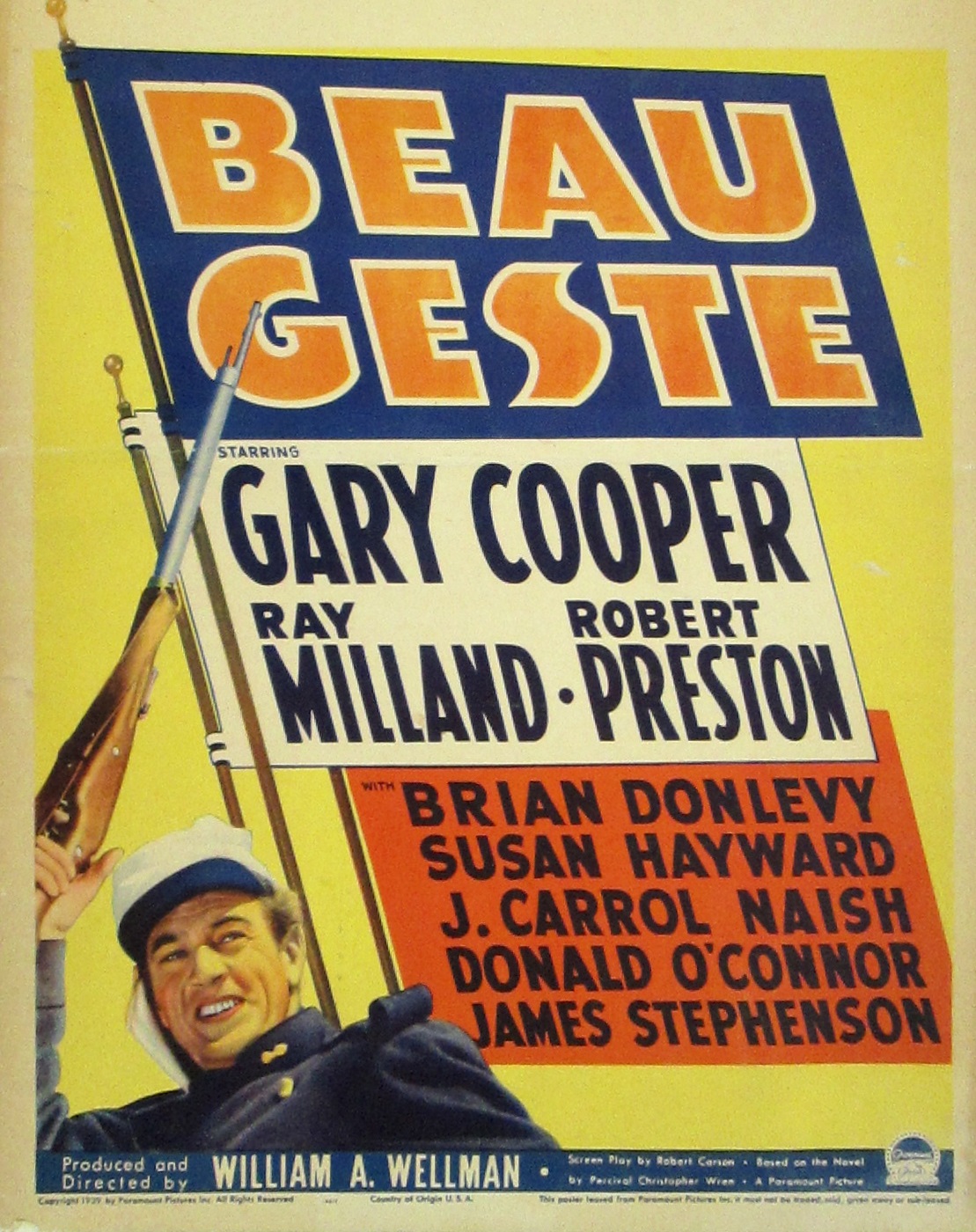
Beau Geste is mostly remembered as an early starring vehicle for both Gary Cooper and Ray Milland, two promising young actors that had already established themselves as reliable performers, but were still finding their way through the industry, looking for their place, which was essential at a time when every actor was supposed to fit into one of only a few key categories. Cooper is the de facto lead, playing the titular character (whose name is a wordplay on the French term for “good gesture”, which is certainly an apt descriptor for his character), while Milland follows very closely behind. Both actors are tremendous, bringing charm and nuance to a pair of roles that could’ve been forgettable had they not been so dedicated to the role. The film also features one of the first major performances by Robert Preston, one of both stage and screen’s most beloved entertainers, who (even at the young age of only 21) showed considerable maturity and control of his craft, fitting in perfectly as the third brother in the Geste trio. The film also benefits massively, perhaps most of all, from the performance being given by legendary character actor Brian Donlevy, who plays the film’s villain, the sadistic and maniacal Sergeant Markoff, whose malicious deeds are only surpassed by his genuine and earnest belief that what he is doing is moral, and for the good of king and country. A film like Beau Geste doesn’t need to have strong performances, since the story itself is strong enough to provoke interest – but it helps massively that there are some committed actors at the core, since it only improves the overall experience of working our way through this mysterious version of the world.
Wellman had many skills as a filmmaker, but something that he was exceptionally gifted at was creating a spectacle. Beau Geste may not be the technical marvel that Wings was in terms of being a pioneering piece of filmmaking that dared to go where no other film would dare – but this doesn’t mean it is any less impressive, with the director’s particular style for large-scale filmmaking being absolutely groundbreaking. Reports vary on whether it was filmed in Arizona or California, but the desert vistas stand in perfectly for the Sahara Desert, with small but key directorial decisions in the production design and cinematography creating an impressive illusion. It’s easy to get lost in a world as exciting as this – despite being adapted from a popular text (albeit one that would probably be considered pulp fiction by modern standards), the film never feels overly literary or dour, being built on a foundation of giving audiences an entertaining experience, rather than one layered with an unnecessary discourse that is neither relevant nor interesting. The transition from the silent to the sound era was not without its challenges, but mercifully Wellman seemed willing to not only accept the new technology, but embrace it – and as evident throughout Beau Geste, he makes good use of the resources afforded to him, with details embedded in dialogue and the sound design creating an eerie, captivating aural landscape, one almost as beautiful as the vistas in which the film was photographed.
Beau Geste isan interesting combination of style and substance, which is likely the result of a director who had an assured vision, a clear set of skills and (most importantly) the dedication to both the source material, and the audiences that he knew he’d be drawing in, turning a conventional adventure story into one of the most enthralling entries into the genre, which is already one that could be considered to be over-saturated with content. Beau Geste is a thrilling film – it moves at a remarkable pace, blends dramatic material with some light touches of comedy (mainly plumbed through the lighthearted but endearing relationship between the brothers, their repartee being a considerable part of the film’s storyline), and never overstays its welcome, being a well-paced but quite economical 113 minutes, a rapid running time for an epic that spans as much time as this film. As a whole, the film deserves a better reputation outside of being an early example of the cross-continental adventure drama – it has some impressive performances, an abundance of unique filmmaking techniques, and an extremely captivating sense of self-awareness that prevents it from ever collapsing into its own absurdities. Wellman was a gifted director who knew how to work a camera in such a way that he could spin pure magic from the most simple of premises – and while it may not be his greatest work, nor the definitive entry into this genre, it still means something considerable, which only makes it an even more worthwhile endeavour to seek this film out, because what it lacks in originality in terms of the premise, it more than makes up for on the sheer audacity of the execution alone.
 The Postmodern Pelican
A lovely review that is prompting a rewatch!