
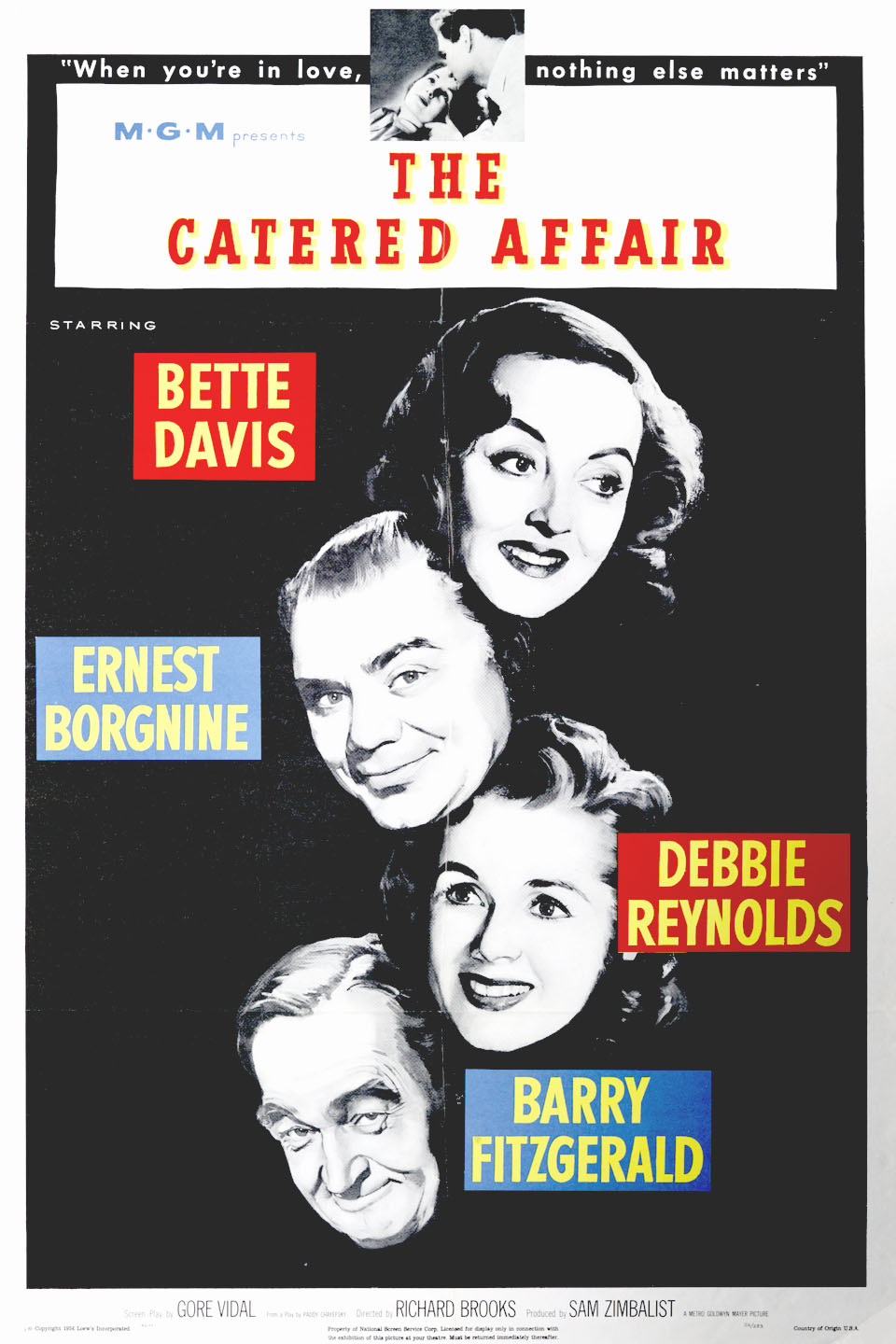
Watching the opening credits roll by at the start of The Catered Affair is quite an experience, since the pedigree of talent involved in the creation of this film is staggering – Richard Brooks (one of the more reliable genre directors working in this era of Hollywood) was directing a screenplay by Gore Vidal, who was adapting Paddy Chayefsky’s teleplay of the same name, and which features a quartet of leads consisting of the divine Bette Davis, the incredible Ernest Borgnine, iconic starlet Debbie Reynolds and the most reliable of character actors, Barry Fitzgerald. Yet, what is even more puzzling than the fact that all of these remarkably creative artists assembled to work on this film is that somehow, The Catered Affair is somewhat obscure, having received considerable attention at the time, but gradually having faded into the background as the years went on. The reasons are not too difficult to understand once we start to unpack them – a film that grapples the line between comedy and melodrama, it wasn’t always a story that could meet all audience expectations. The subject matter is tricky, and the performances, while given by recognizable actors, are a lot more raw than we’d normally expect. The film has a grit to it that may have been the reason it never quite stood the test of time, since its lack of polish, while something that would be celebrated in the modern perspective, doesn’t age well when the audience isn’t all that receptive to what is being shown – and in the shuffle of the decades, and the continuing success of nearly everyone involved, meant that The Catered Affair become slightly forgotten. However, it’s never too late for another critical re-analysis, and now seems like the perfect time to remind ourselves of what an absolute delight this kind of film could be when done properly and with the right amount of heart.
The premise of The Catered Affair is extremely simple – a young woman (Debbie Reynolds) and her fiance (Rod Taylor) decide to get married on a whim, after a turn of events necessitates their quick nuptials. The girl’s parents (Bette Davis and Ernest Borgnine) have to now take on the responsibility of giving her a wedding. The bride desires a small, intimate ceremony with only family present. Her mother, knowing how she was never able to have a big wedding, instead insists on bankrolling a large affair, with many guests and every conceivable luxury, which only serves to bother her husband, who keeps reminding them that they are poor people, and simply can’t afford such extravagances, even if it is for a once-in-a-lifetime event. We’ve seen stories that tread similar narrative territory, and very often bring a unique sense of intimacy to their proceedings, adding an abundance of insights into the trials and tribulations of a family trying to find a way forward while being held back by constraints mostly out of their control. However, where The Catered Affair differs is that, while on the conceptual level it is quite straightforward, the final product is an elegant but very challenging affair, an unsettling portrait of a family trying to work their way out of poverty, by doing what many delusional people would in their situation – creating an image of wealth that they know doesn’t exist, but hopefully will manifest if they genuinely believe it to be true. It’s a story that has aged better than a lot of more modern social dramas, and adding in some of Vidal’s distinctive wit only serves to further exemplify the dark underpinnings of a film that intends to draw awareness, rather than outright unsettle.
Bette Davis is the kind of actress whose presence in a film immediately makes it essential. One of the few rare screen sirens who rarely (if ever) turned in anything even vaguely subpar (despite starring in some films that may not match her talents throughout her career), Davis could hold our attention like very few others. In The Catered Affair, she is at her most motherly, playing the matronly Aggie, who only wants to give her daughter the day she has longed to see for decades, ever since her own failure to get the dream wedding she had always hoped to experience. Davis is obviously impeccable, delivering a masterful portrayal of a woman trying her best to make the most out of a challenging situation, playing all the subtle notes with only occasional sojourns into carefully curated hysteria, which is still emotionally resonant, even at its most broad. She’s matched beat-for-beat by the delightful Ernest Borgnine, who is himself turning in a terrific performance as the working-class cab driver who tries to remain optimistic about the future, but has his plans eroded with each new development. They’re joined by Debbie Reynolds as the effervescent daughter caught in between parents with wildly different interpretations of what a wedding should be, and the wonderful Barry Fitzgerald, who steals absolutely every scene he is in, without becoming a distracting presence. The cast of The Catered Affair logically defines the film, since it is a performance-based narrative – and they each deliver unforgettable performances that speak to their inherent soulfulness, and help guide the film along beautifully.
By looking at this film, you can tell its origins were on the stage (or at least the televisual playhouse, which is where Chayefsky got his start as a playwright), since there isn’t much in terms of visual flair embedded into this story – it takes place in mostly one location, and has a limited ensemble of actors woven into the story, with four central characters being the main focus. However, what is quite evident is how the film trades in the spectacle for something more profound, a kind of human intimacy that allows us to get to know these characters and implicitly understand them. There’s a degree of empathy that propels this film forward – the story might not be particularly notable, really only focusing on the inner machinations of a family trying to plan a wedding and being conflicted as to whether they are going too far, or not going far enough on what is supposed to be the most special of days. By the time we’re immersed in this film, we don’t even pay attention to how simple the conceit is – we’re instead invested in these growing relationships between the characters, and profoundly moved by the way each one of them is developed beyond mere archetype. Vidal does well to capture the spirit of Chayefsky’s work, and narrowly avoids becoming too cynical, stepping back whenever the story was under threat of becoming too overly convoluted, which would’ve been extremely easy considering how The Catered Affair traverses commentary on issues such as poverty and marital strife. There is always a sense of hope underpinning this film, which helps it from ever surrendering to the more depressing message that resides at its core. This is ultimately a film that portrays the vital need for optimism, even in the most challenging of situations, which is a wonderful message in itself.
The Catered Affair is a simple but effective film – grappling the line between comedy and drama perfectly, and constructed with a genuine tenderness for the subject matter, and an endless admiration for the cast hired to bring the story to life (particularly the incredible Bette Davis, who commands the screen in a way that proves why she was perhaps the finest actress to ever work in the medium). It’s not a necessarily original film, nor is it one that offers us more than a straightforward exploration of a family going through the motions while trying to find some meaning in their lives, helped along by an impending wedding that will give them purpose, even if they have wildly different opinions on what this entails. Brooks would go on to do more ambitious projects in subsequent years, with The Catered Affair being perhaps the last remnant of this very simple time in his career – and it’s certainly one of his finest achievements since he acted as less of a director with an authorial vision, and more of a facilitator for the achingly beautiful story constructed by two of the finest writers in their respective artistic fields, which helped usher the film along and gave it the depth and nuance it needed to succeed. Filled with an equal balance of heartbreaking melancholy and warm-hearted humour, and executed with an incredible amount of sensitivity, The Catered Affair is an absolute triumph and just a delightfully sweet drama with a lot of joy embedded in its fabric.
 The Postmodern Pelican