
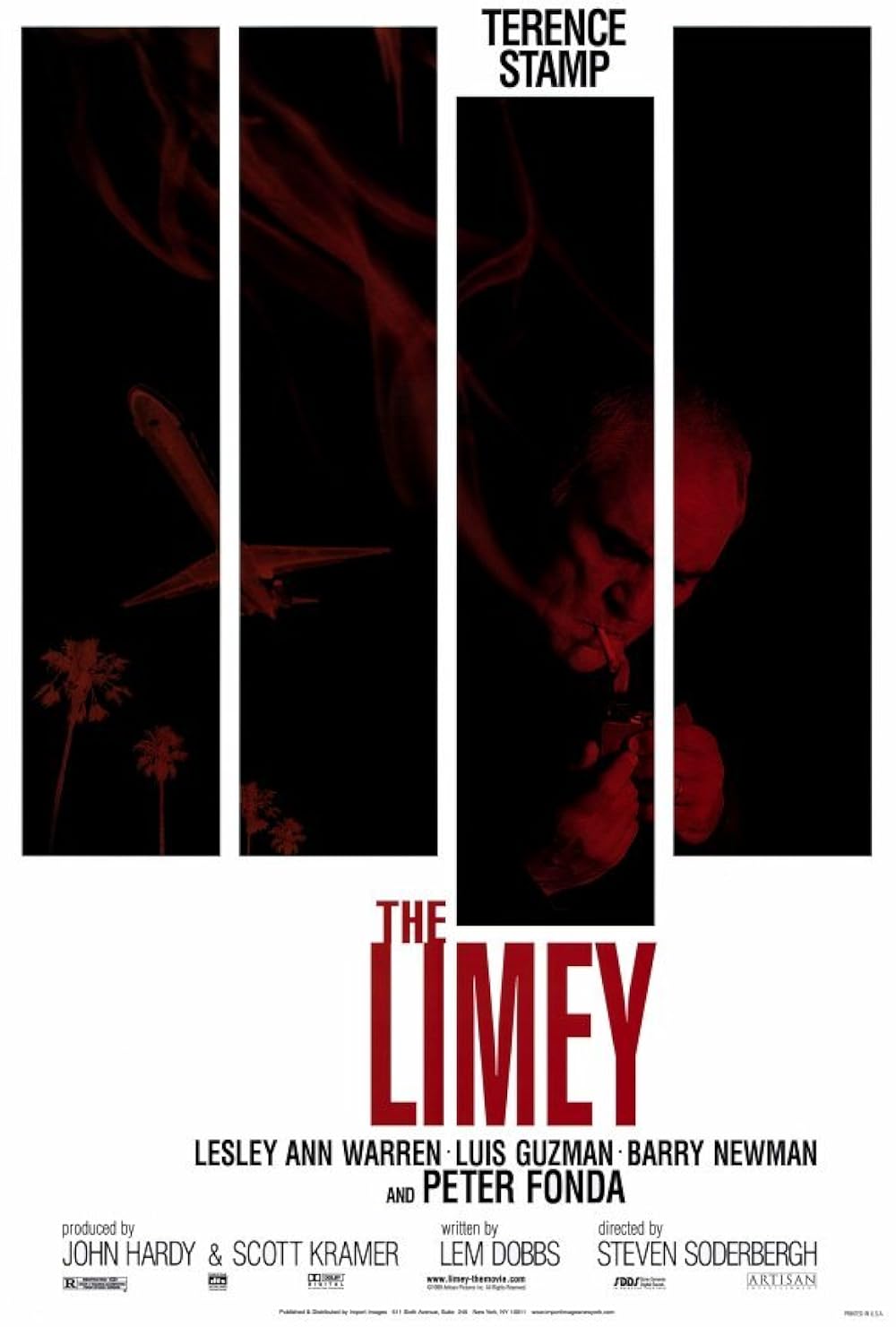
When it comes to reinventing his career, there are few filmmakers that stand out as much as Steven Soderbergh. However, his style changes so regularly (very often annually), it’s less a case of redefining his approach to filmmaking, and more indicative of his intentional refusal to stick to a particular niche, which has made him one of the most unpredictable filmmakers of his generation. He does work within a few genres quite regularly, at least in terms of similarly-themed films, with one of them being the crime genre, which has manifested in a few memorable experiments over his prolific career. One of his more underpraised films is The Limey, his darkly comical version of a contemporary film noir, set to the backdrops of the Hollywood Hills, and featuring a career-best performance by a cinematic icon. Like many very prolific filmmakers, its impossible to pin down a particular film as Soderbergh’s best, and while I am more partial to his straightforward genre efforts, his experimental work is just as impressive, of which The Limey is one of his most coherent, and at the very least valuable in how it handles some very tricky subject matter that many lesser filmmakers may have either mishandled (since it is one that lends itself to more complex ruminations on the nature of existence), or squandered entirely, neither of which are definitive of Soderbergh’s films – his work may not always been great, but its certainly rarely ever uninteresting, with even his most monumental failures being worth the discerning viewer’s time. Mercifully, The Limey is one of his most interesting films, and one that continues to grow in esteem as time marches on.
There is a legitimate argument to be made that The Limey is Soderbergh’s finest film, at least in terms of featuring some of the more notable elements as someone with a penchant for experimentation. Many of his skills are put to the test here, especially his tendency to employ a multimodal approach to his filmmaking process. The most obvious exemplification of this is the use of footage from Ken Loach’s Poor Cow, which has been repurposed into flashbacks for the younger version of Terence Stamp’s character, a risky but ultimately inspired choice that adds a degree of nuance to an already multilayered film. There is a sense of intricacy that goes far beyond the confines of a regular film noir – The Limey is less inspired by these classic genre films as it is a firm celebration of their underlying qualities, which Soderbergh and screenwriter Lem Dobbs do particularly well in repurposing as the basis for this otherwise very unconventional film. Using fragments of other works, and combining them through the director’s trademark editing, where repetition is less of a flaw and more of a merit, a creative choice that heightens the suspense and causes us to question reality. Soderbergh’s experiments may not always be particularly effective, but they’re at the very least memorable, and while it could be jarring for viewers going into the film expecting something more traditional, it ultimately becomes a defining quality of this film, which uses its peculiarities to great effect, making for a deeply compelling, and incredibly thriller, a riff on the film noir genre that is more sincere in its appraisal of the nuances of the genre than it is overly dismissive of the cliches, which do come into play throughout the film.
On the subject of finest work, there are days when I consider The Limey to be the finest screen performance given by Terence Stamp. This isn’t as easy a statement to make, considering he is one of the greatest actors to ever work in the medium, as well as someone whose career has stretched across over half a century, and been the embodiment of both prestige and mainstream fare. Much like another film that contains one of his best performances (the absolutely iconic The Adventures of Priscilla, Queen of the Desert), this one does everything a little differently, harnessing the raw energy that Stamp exudes in a way that he can develop a distinct character without being a caricature, which is normally what lesser films ask of him, and what led him to consider retirement before the Stephan Elliot film kickstarted the second stage of his career. If that was the start, The Limey is the film the defined this era of revitalizing his talents and bringing him to a new generation of viewers, who are unlikely to be anything other than enthralled by his peculiar skills and very distinct way of developing his characters. This film plays off his distinct Cockney accent, rough-and-tough working-class personality and the blasé, deadpan sense of humour that makes him such a fascinating actor, because we truly never know where we stand with his characters – and in the midst of all of this, his Wilson actually becomes one of his most oddly personable characters, with his unconventional charms making this a definitive entry into Stamp’s incredible career. He hits some notable heights with this performance, which is far more elegant than the edgy subject matter would have you believe.
The Limey is a film that is firmly rooted in a tradition of crime thrillers with both a satirical edge and a tendency towards concentrating on more complex themes. On the surface, the film looks like a very traditional revenge story with a conventional main character, a tough-as-nails criminal with a good heart trying to put all his misdeeds behind him and use his skills and knowledge for good. It’s a common story, and one that Soderbergh uses well, but not without subverting every common trope and making it out to be far more intricate than a simple revenge story would tend to be. The best part of this is that Soderbergh understands that one can be extremely experimental and touch on some bold issues without coming across as convoluted. Keeping within the confines of this story without too many deviations, while still having some sub-plots occurring concurrently, and still managing to make something gripping and thoroughly enthralling, takes quite a bit of talent, and even when it is at its most jarring in terms of the editing (as well as being yet another instance of the director experimenting with the form, a while before digital filmmaking was aesthetically pleasing), we are never at a loss for something to ruminate on from the moment this film makes its intentions clear, thrust into this gritty and harrowing story of surviving the mean streets of a crime-ridden city, where the beautiful, idyllic hills hide something incredibly sinister, which we’d all be lucky not to encounter for ourselves.
Soderbergh is such a gifted filmmaker, he managed to turn something relatively simple into a tour de force of narrative and structural excellence. The Limey isn’t a film that will appeal to everyone – not even those who are accustomed to this kind of revenge crime drama are instinctively going to like this, since it adheres to the quirks of the genre just as much as it actively subverts them. It takes a certain kind of viewer, those with an open mind and a certain level of patience, to fully embrace what is being done throughout The Limey, which is about as far from conventional as something like this can be without being entirely derailed but its own audacity. If there was ever anyone who made a career from going against the rules in ways that threaten to challenge his entire artistic output, it’s Soderbergh, who proves, time and again, that he is capable of weaving something special from the most paltry material. This film is a haunting account of the lengths to which we will go to defend our loved ones – and the combination of carefully calibrated humour, graphic but tasteful representations of violence, and a deep psychological understanding of the characters and what drives them to act in the way they do, all go towards proving this film as something quite special, and a wonderful achievement from one of the more original directorial voices working today.
 The Postmodern Pelican