
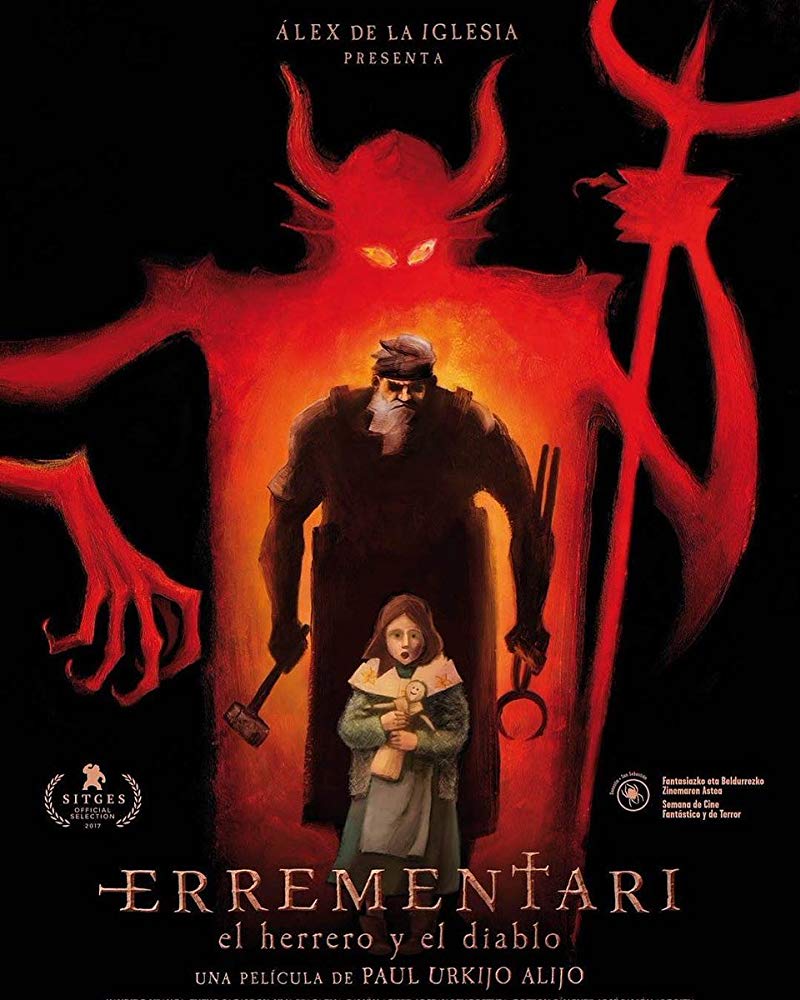
Mere words are not nearly enough to describe Errementari: The Blacksmith and the Devil – but that doesn’t mean we can’t at least try. Deranged, bizarre and entirely absurd, the feature-length directorial debut of Paul Urkijo Alijo is certainly something that should be witnessed more than it can be described. The film, which is based on the legend of The Smith and the Devil, a traditional folkloric tale, is single-handedly one of the darkest, most incredibly strange glimpses into Spain’s past produced in the last few decades. To its credit, we’re given exactly what we’re promised – it’s the additional quirks that make this such a profoundly odd experience, but one that an open-minded viewer might find absolutely delightful, granted they have a sense of humour as bleak and harrowing as the comedy that underpins this film. Somehow, Urkijo Alijo takes the cherished roots of his Basque culture and its long tradition of folklore, and turns it into Errementari, a film with the style of a young Guillermo del Toro, but the sensibilities of the most demented heavy metal musician, weaving them together to form a truly disconcerting portrait of a time and place, which only exacerbates the feelings of isolation that we come to encounter throughout this film. One of the most difficult films to describe – not only because every word one speaks in relation to Errementari gives away some detail (it’s entirely impossible to describe this film without mentioning some crucial aspect of the plot that may be better suited for someone to encounter on their own), it’s also such an off-kilter, bewildering piece of storytelling, any attempt to put its many fascinating qualities into words will somehow leave something out, a pivotal piece of information that will entice some viewers, and repulse others. Ultimately, this is less of a film, and more of an experience – but in both cases, it’s beautifully made, well-acted and just a generally entertaining piece of storytelling that continues to prove the merits of giving young, ambitious filmmakers the space and platform to explore their creative quandaries.
Venturing into this film is like walking into a mysterious forest – we may not know what lies ahead of us, or where the path will take us, but we certainly are well aware that it’ll be an adventure, and even if we don’t quite make it out alive, there will be some degree of exhilaration along the road. Errementari is a fascinating piece of Spanish history, sewn together in this dark period horror that makes exceptional use of its nation’s culture and traditions. Made in the Basque language (quite an anomaly for bigger Spanish productions), and drawn from centuries of oral traditions, the film takes the form of a dark fairytale, filled with intrigue and mystery, as well as an odd amount of humour, which may take the viewer by surprise, especially since we’re never sure whether or not to laugh at what we’re seeing on screen. Combining traditional folk tales with religious beliefs (which are almost consistently the same in terms of the traditional stories of a country like Spain, where religion plays a pivotal role in the culture and history), the film looks into the relationship between three individuals – a charming young girl whose biggest flaw is her insatiable curiosity and tenacity to always get her way, a mysterious blacksmith who is feared by the local community, and a malicious villain held captive, and tortured for his existential misdemeanours. This sets the stage for a fascinating fable that is as insightful as it is deeply unsettling, with the director making sure every frame of Errementari is unforgettable. Terrifying beyond belief, but also hypnotic in the way any great fantasy film should be (since this is essentially a work of fantasy that veers more towards frightening the viewer, rather than enticing them with mystical tales of foreign worlds), the film has a lot of peculiarities, but none of them seems out of place, especially since everything surrounding it is so incredibly captivating, we can easily forget how unstable and nonsensical it becomes after a while.
Getting lost in the world of Errementari is not difficult, because this is a truly beautiful film, and while the story itself may be entirely polarizing, Urkijo Alijo shows remarkable prowess as a visual stylist, building a world that seems both detached from reality and rooted in the past in a way that will be a delight to anyone who has an interest in seeing how our ancestors lived. On a purely artistic level, the director showcases a real skillfulness that almost makes up for the strange turns the film takes – the detail put into bringing an 18th-century Spanish village to life is staggering, and the special effects are just as impressive, perhaps even more so, considering the smaller budget with which Urkijo Alijo was working. The premise may be disturbing and challenging to get through (at least in terms of trying to keep a straight face – I am still not entirely sure if the director designed this film as an intentional dark comedy, or if it was just a happy accident that so much of this film consists of the most deranged, surreal humour imaginable), but just marvelling at the effort put into taking us to the past is incredible. Ultimately, we aren’t here to learn anything, or feel much other than the delight of a dark and demented story that combines religion with sinister folkloric beliefs – so at the very least, the director makes sure that we do take away something meaningful from the experience, even if it is just a bemused sense of bewilderment at what we just witnessed. There’s a charm in this approach that any viewer with a sense of humour and willingness to surrender to the madness will certainly appreciate, the kind of peculiar, earnest quality that could either be indicative of a tongue-in-cheek sarcasm, or the genuine conviction that this is a story that deserved to be told. Either way, it’s visually striking in a way that many films often struggle to come close to achieving, which is one of the most interesting aspects of what the director does with this material.
Regardless, this film is just as gripping as any major production, and it points towards Urkijo Alijo growing into one of the most fascinating young voices in contemporary European cinema. Errementari is pure absurdism, condensed into 100 minutes of unhinged, beautifully composed madness, and an incredible showcase for the director’s visual flair, and ability to draw out the intricacies from an otherwise very strange story. Having an open mind is absolutely paramount when venturing into this film, since there is something about it that is inherently repulsive, and will possibly repel the cynics who see it as self-indulgent, and disturb those who aren’t prepared for the cavalcade of unmitigated surrealism that is about to overtake them for the next 100 minutes. It’s all part of the joy of sitting through this dementedly brilliant work of unconventional art – we never know where it is going to take us, but what is certain is that it’ll be unforgettable at the very least, which is more than can be said about many recent horrors, which struggle to find the balance between style and substance. Errementari may lean more towards the former, but to disregard the compelling story that gives a thrilling account of Spain’s past through the lens of a bewildering story of a mysterious blacksmith and his pet demon (which is essentially the most accurate description of this film one can get before giving too much away), serves to go against the main intentions of this story, which is to be a memorable excursion into the past, by way of the deepest, most terrifying demonstrations of religious belief. Beautifully made, well-acted (kudos to the entire cast for crafting believable characters, with Kandido Uranga in particular being a standout), and just compelling from the first moment, Errementari is a terrific film, and one well worth the time of anyone with the curiosity to experience something very different, but still incredibly entertaining.
 The Postmodern Pelican