
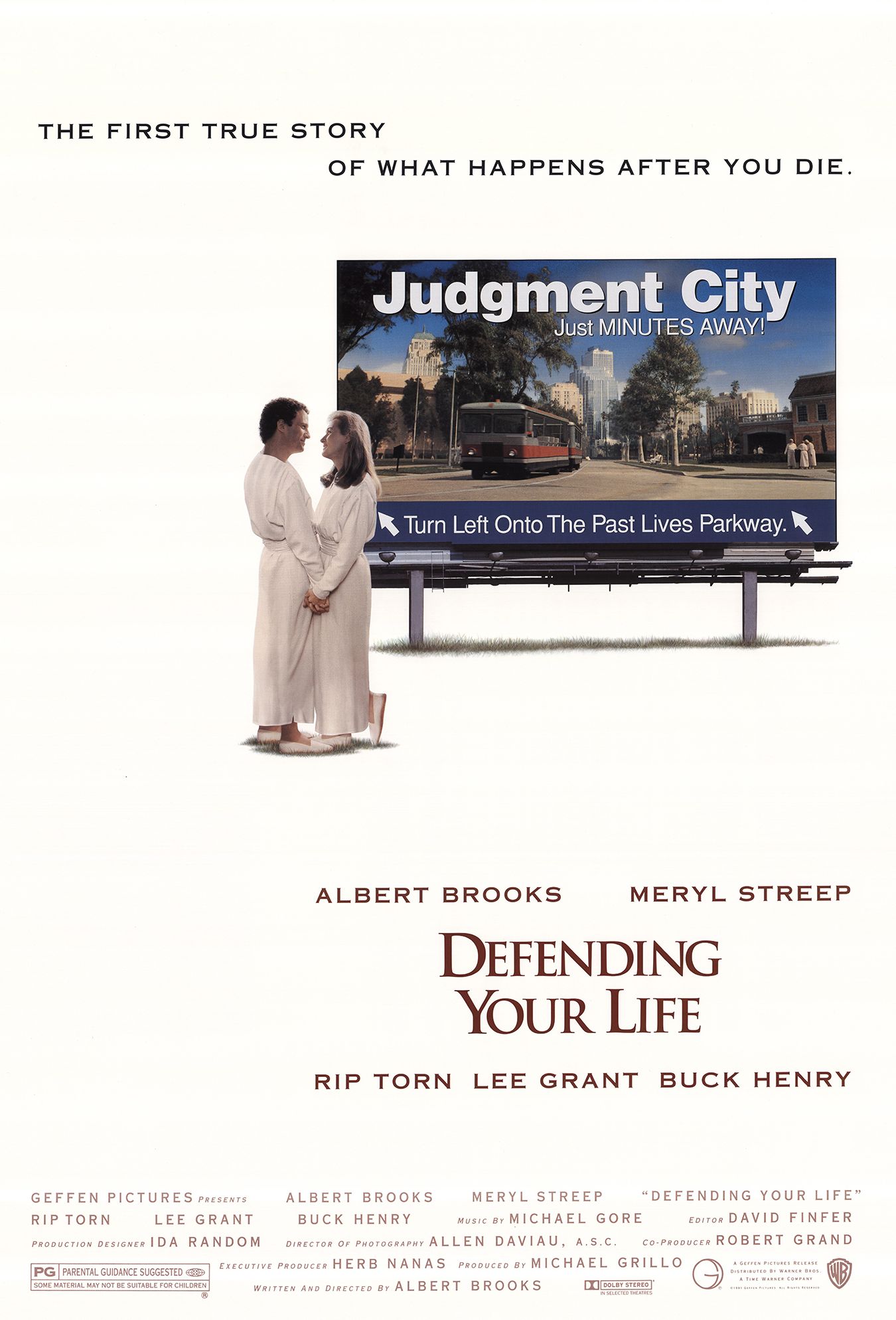
What if, after we die, instead of going to whatever afterlife supposedly awaits us on the other side, we are put on trial, and forced to defend the choices we may throughout our lives. Should we succeed, we’ll be able to move onto the next plane of existence. If we fail, we’re sent straight back to Earth to start all over again. This premise forms the basis of the aptly titled Defending Your Life, one of the several masterful comedies written and directed by the tremendously talented Albert Brooks, an artist who has never failed to showcase his incredible comedic mind. The plot isn’t entirely original – as long as films have been made, there have been examples of people, mostly those who die prematurely, making their way into some celestial space, where they’re forced to look back on their life and reflect on their various successes and failures. What makes Defending Your Life different is found solely in how Brooks executes a relatively common story, merging romance, comedy and hard-hitting drama in one of the most impressive examples of humanist filmmaking, and a masterpiece that dives deep into the roots of our existence, and offers us an unflinchingly honest glimpse at life through the perspective of a hypothetical “other side”. It’s a beautiful and heartwarming comedy that may be incredibly funny, but doesn’t neglect to find the emotion in the midst of the eccentric humour, balancing tone and structure with a remarkable ability that proves that Brooks is more than just a terrific actor, but a skilled director who is capable of far more than just off-beat comedies, and can also work in the realm of something profoundly cinematic. Humane, honest and undeniably hilarious, Defending Your Life is a triumph on nearly every level, especially those in which its undying devotion to the story, and its abundance of heartfulness, are paramount to weaving an unforgettable tale of life and death, and everything in between.
The more one watches his films, the clearer it becomes that Brooks is an insanely gifted artist on both sides of the camera. Nearly every one of his films that I’ve encountered so far sets a very clear foundation from the start that lets the audience know that we’re in supremely good hands. He’s a very practical director, and he doesn’t waste any time or energy on overly convoluted explanations, or trying to make certain concepts more obvious than they need to be. This has lead to some remarkably entertaining comedies that benefit from his hands-on style of simple filmmaking, but also allowed something like Defending Your Life, which is positively teeming with ambition, all the more effective, since there isn’t an emphasis on exposition – like the main character, we’re thrown into the new world, and forced to figure everything out ourselves, which is a risky directorial choice, but it’s one that Brooks knew exactly how to employ, giving the viewer the credit we often deserve when it comes to such stories. One of his more admirable qualities, whether as a director, writer or simply an actor, is that Brooks tends to gravitate towards stories and situations that would entertain and enthral him – he’s an artist who usually focuses on spending his time telling the stories that would interest him. His films may vary in premise (and perhaps even quality), but it’s undeniable to look at any of them and not see a clear foundation built on artistic curiosity inspiring them. The sign of a great artist isn’t one that sets out to express their own interests, but also allow their audience into their mind, giving them access to their own individual quandaries and questions surrounding a number of issues – and this has never been better exemplified than by Brooks in this film, where he took a bold concept, and transformed it into a simply unforgettable work of humane storytelling.
Defending Your Life may be focused on the concept of life after death, asking inarguably the most intimidating and perpetual question that has been the subject of thousands of years of philosophical ponderings. This is a story extracted from common conversations centring on whether there is an afterlife, or rather the specific circumstances surrounding where we go after having shuffled off this mortal coil. Yet, even at its most deep and profound, this is a deeply human work, one that is divorced from any faith or creed, but instead focused solely on the human aspect. There are an endless amount of works, at least from a western perspective, across every conceivable medium that uses the Judeo-Christian model of judgement coming from balancing the amount of good we did in our lives with the bad, and making a decision based on whether we’ll spend the rest of eternity in bliss or undergoing torture. None of this is present here (and Brooks makes it very clear early on that this is not going to be a film focused on trying to get to one place or another), and the focus is instead on the more abstract. We’re judged less by our deeds, and more by our character – the extent of how we treat one another, how we embrace the world and, most importantly, our ability to face our fears, whatever they may be. It’s a film that seems to be putting in a concerted effort to not align itself with one particular school or faith, and instead wants to be a uniting piece, leaving out the specific details that would go against the principles many may believe (while still expecting us to know that this isn’t trying to be a definitive word on anything – it’s a simple fantasy film), and instead seeking out that common ground many films on the subject tend to forget about when it comes to the details.
A benefit of working in the industry for decades is that one tends to make connections, which has resulted in Brooks being able to collaborate with a number of prominent industry figures on both sides of the camera. Naturally, he knew his own worth as a performer, so he cast himself in the central role of the recently deceased advertising executive (but unlike many actors who direct themselves in their films, this never feels self-indulgent or arrogant, mainly considering how Brooks isn’t afraid to play someone extremely flawed), and he’s terrific. However, the best performances come from those in the periphery, such as acting icons Rip Torn and Lee Grant, both of whom are doing some of their best work in their long careers as duelling afterlife attorneys who go head-to-head to defend and dismiss Brooks’ character’s right to move onto the next stage of existence respectively. It also features one of the least-discussed performances from the woefully underrated Meryl Streep, who proves her skills as an actress by playing the romantic interest to the protagonist (in all seriousness, Streep is as charming and lovable as ever, with this undeniably being mid-tier work, but still certainly worth every moment she is on screen). These performances are all good, and each one is certainly very funny, but there is an immense amount of depth to them, which comes through in how the director ensures that they’re not just archetypes, nor are they guiding the narrative. Defending Your Life has a very strong storyline, one that didn’t really depend on the development of these characters. Rather, they contribute towards, rather than define, the story, which becomes all the more captivating in its unique portrayal of humanity as a result, and where every minor detail embedded in these characters adds to the emotional nuances that underpin the film and make it so unexpectedly moving.
The film may be making some daring remarks on the nature of the process of life after death, but by looking less at a particular religious faith, and focusing more on the intricate nature of our existence, and how we perceive the world, the director made something that speaks to us on a profoundly personal level, to the point where it may not necessarily lead us to believe that what we’re seeing is true (after all, this is very clearly a work of fantasy filmmaking), but opens our mind to reconsider what’s actually around us. It’s a bold approach, and some may argue Brooks demonstrated too much audacity in this regard. However, the proof is in the pudding, and Defending Your Life is a masterful achievement. It is certainly a film made by someone with a background in comedy – Brooks doesn’t waste an opportunity to throw in a laugh, or comment on some obscure foible of the human condition, but it’s all well-intentioned, as is often the case with even the director’s most caustic moments of satire. Whatever drove Brooks to choose this particular concept as the basis for arguably his most ambitious film to date, isn’t entirely clear, other than the possibility that the idea just fascinated him, which is as good a reason as any, especially in how he pays attention to developing it beyond a simple anecdotal premise, and instead carefully reconfigures an entertaining but trivial idea into a multidimensional manifesto on the many peculiarities of the human condition. It sometimes feels as if it is biting off a bit more than it can possibly chew (especially in the more conceptual moments, where it is provoking some deep existential questions), but Brooks knows exactly what will work, and using both his skills as a writer to set a strong basis for the story, as well as his gifts as a director to manifest these ideas into something meaningful, he succeeds wholeheartedly.
The term “masterpiece” has lost a lot of its lustre as a result of overuse, so when we eventually do encounter a work that exemplifies it in its most true and sincere definition, it seems intimidating to find a better descriptor. Defending Your Life is possibly Brooks’ finest work, since it has all the components that has made him such a terrific artist. The writing is razor-sharp and frequently laugh-out-loud hilarious (there are some pieces of dialogue peppered throughout this film that are so funny, they require the viewer to actually pause to take a breath), as well as being contrasted with a genuine sense of compassion. Brooks never goes for the low-hanging fruit with Defending Your Life. Everything in it is sincere and meaningful, and comes from a very clear place of respect and curiosity, with the director ensuring every frame is filled with a kind of endearing honesty that makes for a really captivating experience. The seamless combination of comedy, romance, existential drama and fantasy all converge into a wildly original piece of filmmaking that takes us on a wonderfully profound journey into the human condition, giving insights into some deep philosophical issues, while never neglecting to entertain the audience. This film may not have received much attention at its original release, and it remains relatively underrated – but as we’ve seen in recent years, the rediscovery of this comic masterwork has resulted in it becoming embraced by a wider audience, and all signs point towards it ageing incredibly well. Life isn’t always easy to understand – in fact, it’s outright confusing. Brooks used this as the foundation for this heartfelt, delightfully irreverent ode to humanity and its innumerable idiosyncrasies – and in the process, he created something unquestionably unique and moving, which only confirms what an absolutely essential piece of cinema Defending Your Life is, and how it will stand the test of time better than most films that tread similar narrative territory.
 The Postmodern Pelican