
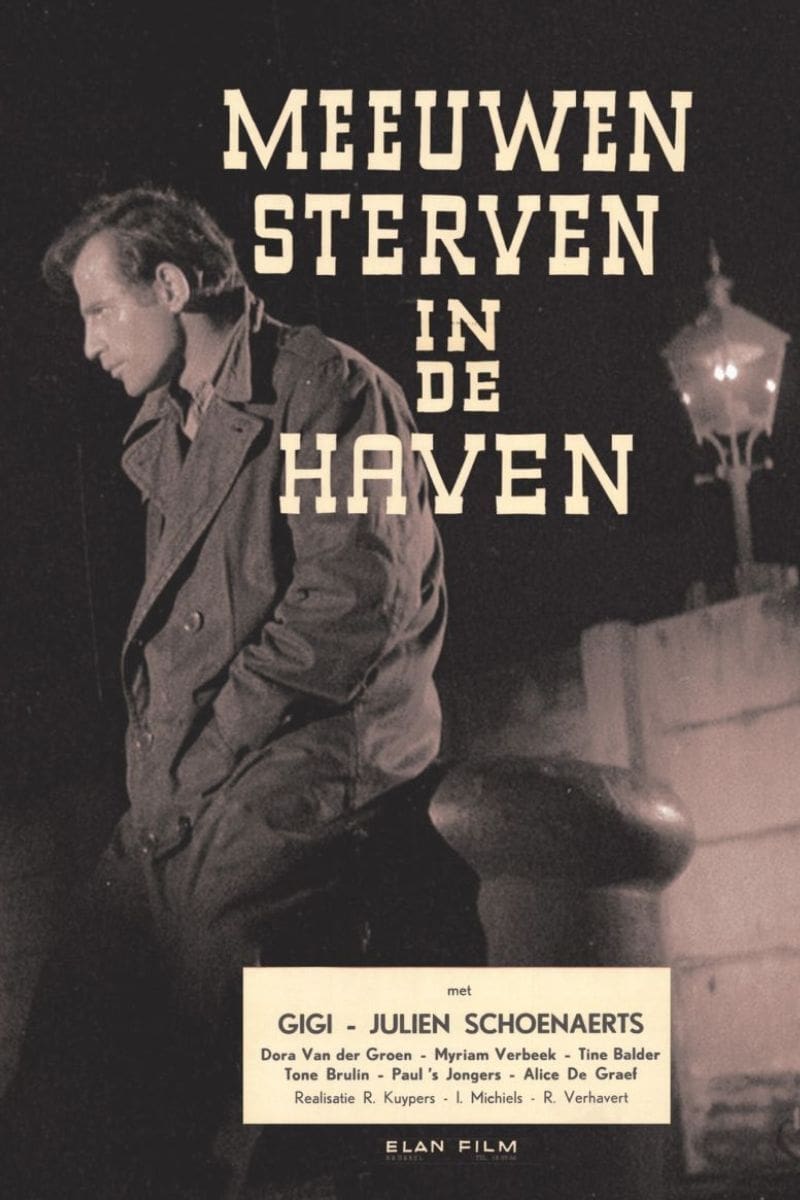
Somewhere in working-class Belgium, in the middle of a barren harbour, an unknown man stumbles through the evening – no one knows who he is, or where he is from. All they do know is that he carries many secrets, so over the course of the evening, a variety of characters try and penetrate the mind of this mysterious figure who has walked into their lives, and hear his stories, which may just change their perspective on reality. This is the foundation for Seagulls Die in the Harbour (Dutch: Meeuwen sterven in de haven), the ambitious psychological drama by Rik Kuypers, Ivo Michiels and Roland Verhavert, who wrote and directed a powerful elegy to the burden of memory, and the constraints of the human spirit in times of turmoil. Not in any way a simple film, and one that is more akin to the artistic movements that would come about in later decades (of which many might have been inspired by this very film), its an enigmatic drama with a jagged, subversive edge which gives invaluable insights into the darker recesses of the human condition, especially in matters relating to the inner machinations of the minds of the many outcasts that tend to make their way through life. The trio of directors take on a difficult story, and set voyage for a psychodramatic destination that many artists have attempted to reach, but struggle to do all that well, since there is something so bleak about breaking down existence to the bare minimum and realizing that there may just not be a purpose to it in the end. A film intended to explore the world we have come to be so familiar with, in the hopes of finding the meaning of life, Seagulls Die in the Harbour is audacious enough to not only refuse to resolve these quandaries, but outright state that there is, quite possibly, no purpose to the madness that surrounds us.
By the very nature of its narrative structure, Seagulls Die in the Harbour is an inherently challenging film, and throughout its running time (which is mercifully short – at only 80 minutes, it is a breeze to get through, and had it been any longer, I’m not sure of the kinds of existential crises that would occur as a result), it is constantly provoking a number of complex ideas that lay dormant in the collective consciousness, but rarely find their way to the surface when it comes to even the most profound dramas. Kuypers, Michiels and Verhavert are pursuing a set of questions that aren’t easily answerable, and using the story of a man aimlessly looking to the past as the foundation for their existential ponderings. An incredibly intelligent film, but one that certainly requires the viewer to acclimate to the material and understand that not everything contained within is going to make perfect sense, Seagulls Die in the Harbour is a thoroughly evocative glimpse into the ties that bind us, and the social and cultural structures that are supposed to keep us in line and adherent to some metaphysical set of conventions, but which can just as easily be derailed once we realize that our existence is built on a set of falsehoods, rather than some omnipotent series of guidelines – and if this sounds confusing or overly verbose, the film itself takes these ideas to an entirely unprecedented level, showing us a version of our lives that is simultaneously thought-provoking and deeply unsettling, which is certainly one way of constructing what is essentially just a bleak manifesto on life’s many broken promises.
Seagulls Die in the Harbour doesn’t have a premise or plot so much as it features a series of interconnected vignettes, with a variety of characters woven into the narrative, and having their stories overlap with one another. The central role of “The Stranger” is the closest the film comes to a main character, but rather than being the focus, he works as the impetus for the portrayal of the maddening world that surrounds him. Throughout the film, we encounter a range of other characters, ranging from the delightfully charming to deeply grotesque, each one representing a different side of life, whether it be an innocent but mischievous child, or a deceptive, vaguely sinister figure who looms over the lives of these characters, entering into their private space, as if he holds some secret to their own existence. The directors work tirelessly to create a vivid tapestry of society that is brimming with a peculiar energy, but rather than becoming the absurdly carnivalesque portrayal of the decline of the human race (as this film hints at throughout), Kuypers, Michiels and Verhavert keep everything very realistic. The tonal balance of the film constantly oscillates between gritty social realism and perplexing surrealism, showing the hellish landscape that these characters have to endure. It’s not always the most coherent, and it can sometimes come across as too abstract to fully make much sense – but as is the case with many of the most challenging works of art, abandoning preconceived notions and instead embracing the unknown can sometimes help significantly in the construction of a truly compelling story.
It’s not a particularly easy film, but Seagulls Die in the Harbour is one that is still a stunning experience, and not one that the casual viewer can be prepared to fully comprehend, nor can they expect to find any real sense of comfort, even if the film itself is built on a very resonant foundation of looking at some common existential questions, only filtered through a more abstract artistic lens. It is pure poetry, composed of shadows and deceptive harmonies, and the directors are fully aware of how evocative the filmmaking process can be in terms of bringing to mind certain sensations. In this regard, the film is an incredibly multilayered piece of storytelling, where the style jumps between overly verbose dialogues between characters, to long stretches of time where a single word isn’t uttered – and yet in both instances, it all feels very organic and realistic. There is an authenticity to this film that comes from the perfect coupling of a strong story and a distinct visual palette, with director of photography Johan Blansjaar doing just as much work as Kuypers, Michiels and Verhavert in telling this tale of social unease and the shortcomings of the human condition. Films like this certainly tend to hinge on the folks behind the camera that aren’t in the prime authorial position, but instead play a pivotal role in developing the story and helping it flow – the editing and music is just as important as the narrative details, and add nuance to the film and help it develop into its very striking idiosyncrasies, which gives it the sensation of being a much more powerful film than most would give it credit for based on a cursory glance.
The directors shepherd everything together, and handcraft an enthralling story of loneliness and the burden of memories, which forms the basis for this peculiar but compelling glimpse into the life of ordinary people, rendered through an image of our world that is recognizable but still outright unsettling. Seagulls Die in the Harbour truly lives up to the foreboding absurdity of its title, and its sense of dark, deceptive complexity never abates, even when it is intentionally quite provocative. The audience is always kept at arm’s length, so we’re not entirely lost in a sea of confusion, and the film does guide us along enough for us to be on its wavelength. It allows the film to be as complex as it desires, since we’re never truly at a loss for understanding, even when we’re not quite sure what the purpose of a particular narrative moment may be. As a whole, the film challenges conventions, and makes use of some absolutely stunning artistic flourishes in the process, leading to a strikingly beautiful journey through the night-time landscape of Belgium, where the wayward souls come out to peddle their wares and make a living. It’s a disconcerting version of a familiar world, and the audience can’t be blamed for feeling somewhat unsettled by how the directors choose to portray normal situations through a distinctly strange perspective – but once we acclimate to the style, and come to understand that there is something else lingering beneath the surface, the faster we can surrender to the beguiling charms of this film, which functions as both a profoundly meaningful sojourn into life’s darkest recesses, and the kind of metaphysical masterwork that gains meaning the more you look into it and try and make sense of its demented charms.
 The Postmodern Pelican