
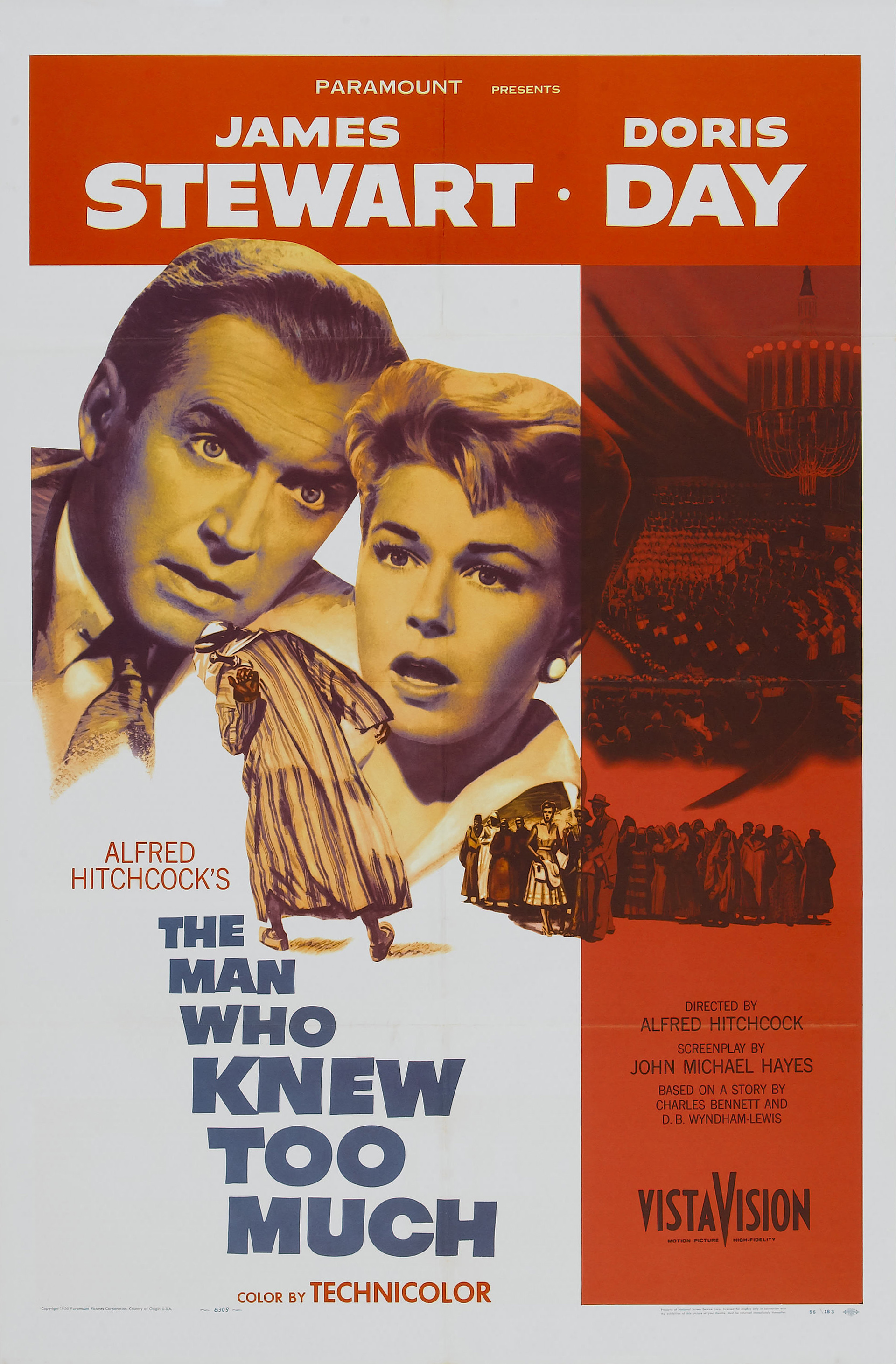
As one of the greatest filmmakers to ever work in the medium (not a revolutionary opinion, but rather very close to an objective fact), Alfred Hitchcock’s career is filled with a wide array of films of varying quality. What is most interesting is that even lower-tier Hitchcock films are still absolutely worth watching, with very little of his output being bad enough to actually not warrant any time or effort. This is the case for The Man Who Knew Too Much, the loose remake of a previous film the director made much earlier in his career. Not necessarily a bad film, nor one that lacks any merit, but instead one that doesn’t lend itself to the same brilliance of some of the director’s other work – but even with its reputation as a more middling work in his career, the director proved himself to truly embody the spirit of the nickname “The Master of Suspense”, bringing with him a wonderfully irreverent sense of intrigue and wonder that he perfected, and managed to easily convey in even the most trivial of projects. Working with an international cast, led by the magnificent James Stewart and Doris Day (who prove to be a wonderfully dynamic duo, playing off each other with great sincerity), and filled to the brim with a fascinating sense of intriguing drama, it almost seems a betrayal of our optimism that The Man Who Knew Too Much fails to meet all of our expectations. Undeniably it is still a film worth watching – it is complex, labyrinthine and always entertaining, and the intricate avenues it takes to establish this story is incredible. It comes down to the fact that both before and after this film, Hitchcock would traverse similar territory, doing it better and with more originality – and when you are as prolific an artist as he was, it seems perfectly reasonable that some of the work isn’t going to be as perfect as all the others.
Some of the director’s best work took place outside familiar locations, and roughly half of The Man Who Knew Too Much takes place in Morocco, the first and only Hitchcock film to be set in Africa. The director had a tendency to use locations very well, and even if the bulk of the action was set in London, the decision to present Africa as not only “the Dark Continent”, as it was popularly referred to throughout his, but as the stage for a fascinating and intriguing political thriller only helped normalize venturing out of familiar territory and into other corners of the world. This is only one of the several components of The Man Who Knew Too Much that bears significance, since while the film itself may feel somewhat disjointed, and many of the plot details are not adequately covered, there are many smaller elements that work well in the context of the story as a whole, and help elevate the film far and beyond the confines of the by-the-numbers thrillers to which many compare it, without actually realizing how films like this actually inspired an entire movement. It may not be in the upper-echelons of Hitchcock’s work, but it is still a film that features a lot of depth, and an endless abundance of insightful commentary that works wonderfully in tandem with the story surrounding it, even if it can sometimes come across as too simplistic as times. There are many aspects embedded in this film that feel genuinely insightful and worth our time, meaning that there isn’t really anything that can persuade us from not giving The Man Who Knew Too Much the benefit of the doubt, since its merits certainly outweigh its flaws, perhaps not enough to excuse the problems, but at least to distract from them long enough to warrant the realization that this film is offering us a truly enjoyable experience.
It certainly does help that The Man Who Knew Too Much is anchored by two strong performances from a couple of the most established entertainers working in Hollywood at the time. One of Hitchcock’s finest collaborators was James Stewart, who was arguably the actor who best defined the director’s memorable career, at least through being central to possibly his two finest films, Rear Window and Vertigo, as well as a few other collaborations that brought out the best in their partnership. The Man Who Knew Too Much takes place between these films, and just as it may not be Hitchcock’s finest film, it isn’t necessarily the best work Stewart has ever done. However, a middling Stewart performance is still more enthralling than top-tier work by lesser actors, so it isn’t surprising that he still delivers, even with slightly more paltry material. The true star of the film is Doris Day, who plays a character often mistakenly referred to under the umbrella term of the “Hitchcock Blonde” (consisting of the many femmes fatale and other significant female protagonists that were often woven into his films). While this term does technically and superficially define Day, it’s her performance that deviates from it, since she’s far more complex than just being the object of desire, and even becomes the central hero of the story, which is a fascinating accomplishment, considering how she was acting across from one of the finest actors working in the industry at the time. In a short but memorable acting career that saw Day work in every conceivable medium, it was this quaint thriller that truly showed why she was such a magnetic star – and not to mention, this introduced us to one of her signature songs, “Que Sera, Sera (Whatever Will Be, Will Be)”, which factors into the thrilling climax in a wonderful and very meaningful way.
Seamlessly combining the genre of the family vacation comedy with a chilling, complex psychological thriller structure, as well as inserting many elements of the international espionage drama, The Man Who Knew Too Much is a fascinating work, and perhaps one that works better in theory than it does in execution, since there just isn’t enough time to unpack everything that could be done with this material, since two hours isn’t sufficient to cover all the various narrative avenues that are introduced throughout the film. The main problem with this film is that it has too much content that it needs to cover – taking place over two major cities, with over a dozen unique characters woven into the narrative, and a complex plot that contains an abundance of twists and turns, the film was going to struggle to meet everything it has hoping to convey. The main reason why the film doesn’t seem to be all that effective comes from the fact that everything is too conveniently woven together – the first hour of the film is a masterful example of establishing a tone and building suspense, and it is quite effective in piquing our curiosity. The second half of the film, which is where we are supposed to get some resolution, isn’t handled all that well – there are many plot points that feel disjointed from the rest of the narrative, and the script seems to not want to give the audience the benefit of the doubt, since it believes it is making some enormous revelation, when in reality, the viewer has already made these connections from the first clue. It doesn’t invalidate the wonderfully intricate plot that is quite effective, but it just loses the mystique once the viewer is put in the position of not only being able to solve this mystery before the characters, but to have our suspicions proven right, but without any real payoff for making these connections early on in the film.
Yet, it goes without saying that even when he was playing in an undeniably minor key, Hitchcock’s films are always worth seeing, since they offer us some of the most full-bodied, honest entertainment we are likely to see. Even if the story isn’t up to scratch, or the execution is off-kilter to some degree, we’re never going to be at a loss for enjoyment. Hitchcock made enthralling films, and The Man Who Knew Too Much is not too much of a deviation. This is solid, meat-and-potatoes entertainment that Hitchcock could easily pull together from the most disparate narrative threads – and it helps that this era was defined by real-world tensions surrounding the Cold War, lending this film a degree of gravitas, even if the socio-political undercurrent is somewhat underbaked in this film, with this side of the narrative being weaker than the more compelling family dynamic that resides at the centre. Ultimately, The Man Who Knew Too Much is a very entertaining film, albeit one that doesn’t always live up to its potential – it’s a work that occurs somewhere in the lower-tier of Hitchcock’s filmography, which is hardly something to dismiss, since even his worst work tends to have some redeeming qualities, especially those produced later in his career, when he was an established and iconic filmmaker. This isn’t the defining work of his career, but its one that is still significant in its own way, and the gradual way in which Hitchcock builds the suspense to an unbearable crescendo, before having it all descend into a satisfying conclusion, proves that no one could captivate an audience quite like him, which certainly helps make The Man Who Knew Too Much a lot better than it ought to have been, considering the imperfections that often threatened to derail this otherwise captivating film.
 The Postmodern Pelican
The Man Who Knew Too Much is the film the caused the rift with great animosity between Hitchcock and arguably his greatest screenwriter John Michael Hayes. Hayes wrote Rear Window, To Catch a Thief, The Trouble With Harry and The Man Who Knew Too Much in a three year period.
The collaboration began well. Hayes understood Hitchcock’s pettiness and was able to address his the director’s pique adroitly enough for the skewering to be organic to the moment and only evident to those directly involved. Hitchcock was angry with Ingrid Bergman for her on set behavior five years earlier while filming Notorious. Bergman was deeply involved in a public love affair with war photographer Robert Capa who did not want to marry the film star. Does such a situation sound familiar to Rear Window fans who admire Jimmy Stewart as war photographer LB Jeffries and his sweetheart the beautiful Lisa Fremont who desperately wants to marry?
Hayes was also able to understand Hitchcock’s vices of food and lascivious leering. Is there a greater moment of such than in To Catch a Thief when Grace Kelly’s radiant Francis Stevens serves chicken for dinner and inquires if John Robie would prefer a breast or a thigh? Cary Grant’s wordless expression clearly answers what he desires.
By the time of the remake of The Man Who Knew Too Much came around, Hitchcock and Hayes had developed a shorthand that worked marvelously. Hayes claims he never saw Hitchcock’s 1934 original though he also claims to have seen Shadow of a Doubt 90 times before writing Rear Window. The two men had dinner. Hitchcock told a detailed scenario of the film and Hayes knocked out the updated script. The film was a smash.
Apparently Hitchcock wanted to help an old friend Angus MacPhail who was severely in debt from advanced alcoholism. He credited MacPhail as co-writer of the screenplay. Hayes filed for arbitration with the Writer’s Guild and won. Hitchcock and Hayes never forgave one another. In subsequent interviews, Hayes repeatedly remarked, “What I brought to Hitch was character, dialogue, movement and entertainment, and he supplied the suspense” while in his famed interview with Francois Truffaut, Hitchcock dismissed Hayes as “a radio writer who wrote dialogue.”