
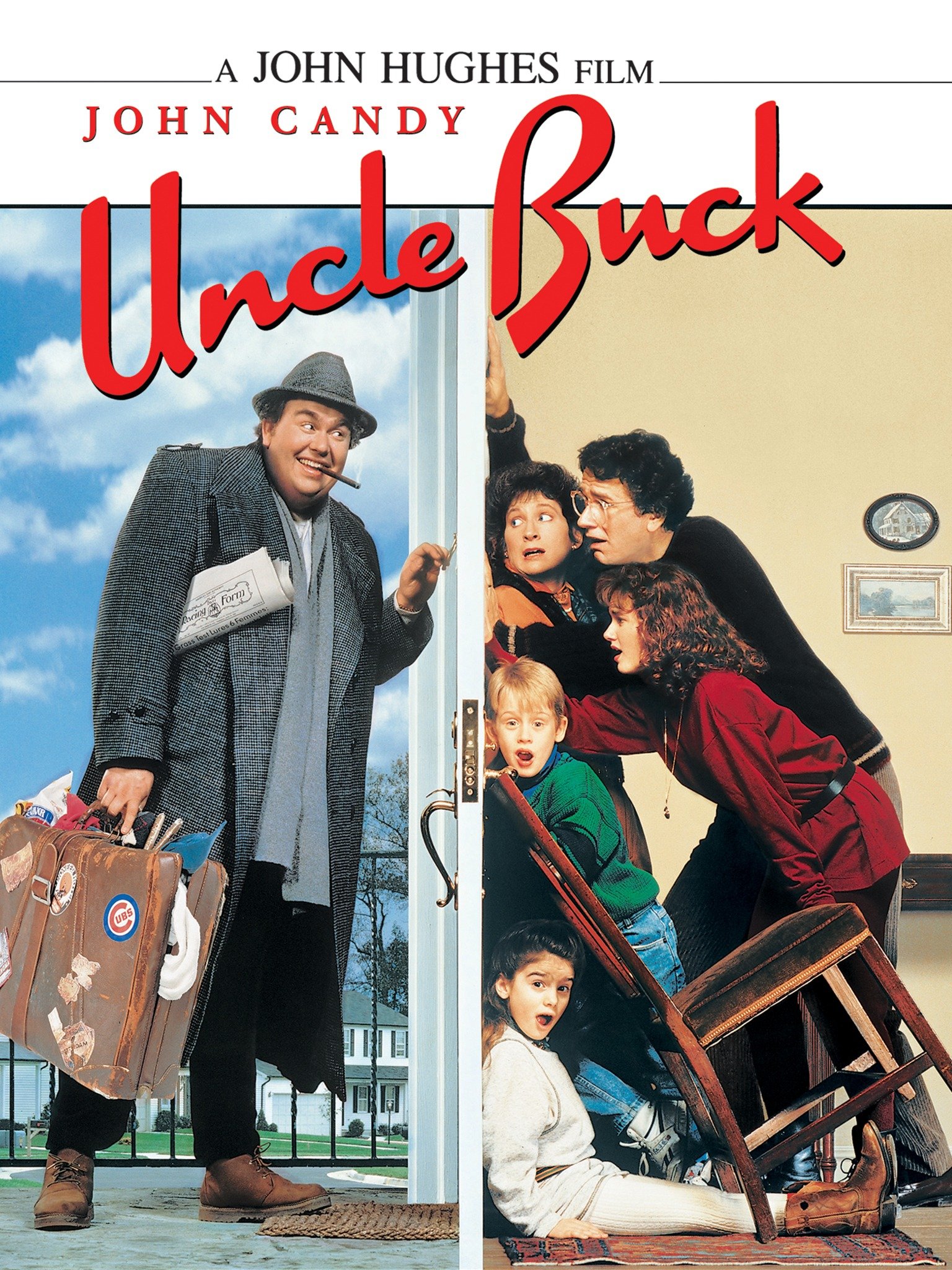
The Russells are an ordinary, middle-class family living the American Dream – to the point where they have made the pilgrimage from their home in Indianapolis to suburban Chicago, which has been a cause for great chagrin, and the reason why rebellious teenager Tia (Jean Louisa Kelly) is belligerent to all of her parents’ attempts to get her to appreciate their life. However, when a medical emergency afflicts a member of the extended family, the parents have to make the fast decision to go back to their hometown for a few days to resolve it, and are in desperate need of someone to look after their children while they’re away. They try every decent option, until they’re left with the only person capable and willing to do it – Buck (John Candy), the black sheep of the family, who is more than happy to prove his skills, especially considering how he is desperate to maintain his relationship with his longtime girlfriend (Amy Madigan), who doesn’t see him as particularly paternal. The boozing, gambling hedonist is not the traditional choice to look after a group of small children, but he is convinced that he can do it – and armed with a great sense of humour and a heart of the purest gold, Uncle Buck turns out to be quite gifted when it comes to taking care of his family, even if there are many obstacles he encounters along the way, all of which threaten to get in the way of him successfully meeting his responsibilities and proving that anyone can undergo redemption if they’re willing to work for it.
In terms of comedy legends, very few people are as iconic as John Candy. The proverbial everyman gifted with comedic timing that matched the very best, as well as the ability to convincingly play his roles in such a way that he could disappear into them (making the fact that his career was cut so tragically short even more heartbreaking, since there was an exceptionally gifted dramatic actor lurking there, ready to become someone who could essentially play in any genre). He was also someone who could take on a role of absolutely any size, being a scene-stealing supporting presence in many works, but also managing to lead films with a ferocity many of his contemporaries struggled with. Of all of his fantastic films, perhaps the most cherished is Uncle Buck, a reunion with John Hughes (who directed Candy’s finest hour in Planes, Trains and Automobiles), and a classic family comedy that has aged better than the finest wines. Perhaps very much indebted to an era where domestic comedy was en vogue and many were attempting to capitalize on this movement towards more home-based humour, Uncle Buck comes at the end of a very distinct decade for the genre, but needless to say has yet to show any signs of being all that outdated on a conceptual or thematic level (the specific socio-cultural quirks that situate this in the 1980s are entertaining, but irrelevant to such a discussion), making this an extraordinarily entertaining, and fully-engrossing slice of well-meaning joy that never takes itself too seriously, and instead seeks out to give the viewer some thoroughly compelling entertainment without bombarding us with an array of unnecessary ideas. For that reason alone, Uncle Buck is a triumph, and while it may not have ever gone out of style, it’s more than time to reconsider it as one of the most endearing comedies of its era.
A film like Uncle Buck is almost impossible to talk about in a coherent manner, since so much of what makes this a special film comes from the fact that it is exceptionally simple. There is absolutely nothing Hughes does with this film that he didn’t before – like was the case for films like Mr Mom and Baby Boom, the film uses a clever subversion of gender and familial roles and extracts a very poignant humour from them, while not neglecting the outrageous situations that are constructed for the sake of making such commentary. There isn’t much that can be dissected surrounding the film – built on nothing but the charismatic talents of its gifted lead actor, as well as a tremendous supporting cast, Uncle Buck feels like an incredibly easy film to have made (it’s certainly one that is incredibly watchable – it moves with a break-neck pace, never meandering to the point of tedium), but it’s in the intricate details that aren’t evident at a cursory glance that we understand why this is such a triumph. While his films may be known for highly quotable lines and memorable characters, it’s the small, intimate moments of incredible humanity that tend to define Hughes and give him the edge over many of his contemporaries, since a great deal of what made him such a poignant conveyor of the human condition was his ability to tap into the most fundamental aspects of our existence, and present them in an accessible, hilarious way. The meaning isn’t lost through this approach, but rather concealed under layers of buoyant, upbeat comedy that feels authentic, while still have an edge that allows us to stop momentarily and consider the message being imparted.
Perhaps trying to extract meaning from a Hughes film is a fool’s errand, since the main reason they’re so cherished is based on their most superficial, entry-level qualities – but the fact that a film like Uncle Buck not only manages to be a hilarious, quick-witted masterpiece of broad comedy, but also deriving a lot of genuine emotional resonance from its premise, is all the more reason to consider this a masterful work of 1980s comedy. To draw back to the star (since absolutely everything about Uncle Buck eventually leads to a discussion on Candy, who is such a dominant force over every frame of this film), we find meaning in how the film portrays the eponymous protagonist. Candy’s style was unique – going into this film, we expect him to be playing the lovable, absent-minded oaf that we all simultaneously adore and ridicule. This is true, but only to an extent – this is a far more complex performance than it appears to be on the surface. Candy is drawing from his armada of familiar tricks, but in a way that comes across as supplementary to the material, rather than attempting to guide it to fit his style. There are as many sequences of unhinged madness on the actor’s part as there are genuinely moving moments where his humanity comes through. Candy may have only done more dramatic work in smaller roles such as those in The Silent Partner and JFK, but very few performances have proven that he had genuine dramatic mettle than this one, which is all the more bewildering, since everything about this film would lead you to believe that it was yet another endearingly boisterous performance from an actor who may not have been known for his restraint, but was certainly able to tap into it when it was necessary, even in a film that is otherwise an absolute riot.
Uncle Buck is quite rightly considered an iconic comedy – it hits all the right notes necessary to become an important part of the culture, without bringing with it the obstacles that normally come with such broad comedies. Anchored by Candy’s terrific performance, and told with a kind of upbeat humour that sometimes disappears when trying to make comedies that try and meet certain criteria of success, the film has an enormous heart that makes up for some slight weaknesses in the story (the character of Tia is woefully under-explored, and her entire arc is an after-thought, despite it being central to the film, and the reason the final scene is so compelling), and resonates on an emotional level that we may not always anticipate, especially when coming from a film that seems to be built on a very thin, but nonetheless entertaining, premise. It doesn’t do anything revolutionary, but also refuses to play it safe – it takes a few risks, and they pay off splendidly, coming across as intricate and meaningful explorations of deeper issues that may not be regularly seen in such mainstream comedies, but are ahead of their time, and worth revisiting this film to see, since there are some ideas embedded in Uncle Buck that prove Hughes was a filmmaker who had a keen understanding of the world around him, reflected beautifully in his work – and if there is anything that this film proves is that one should never take even the most mainstream stories at face-value, since they tend to have some surprises lurking just out of sight.
 The Postmodern Pelican