
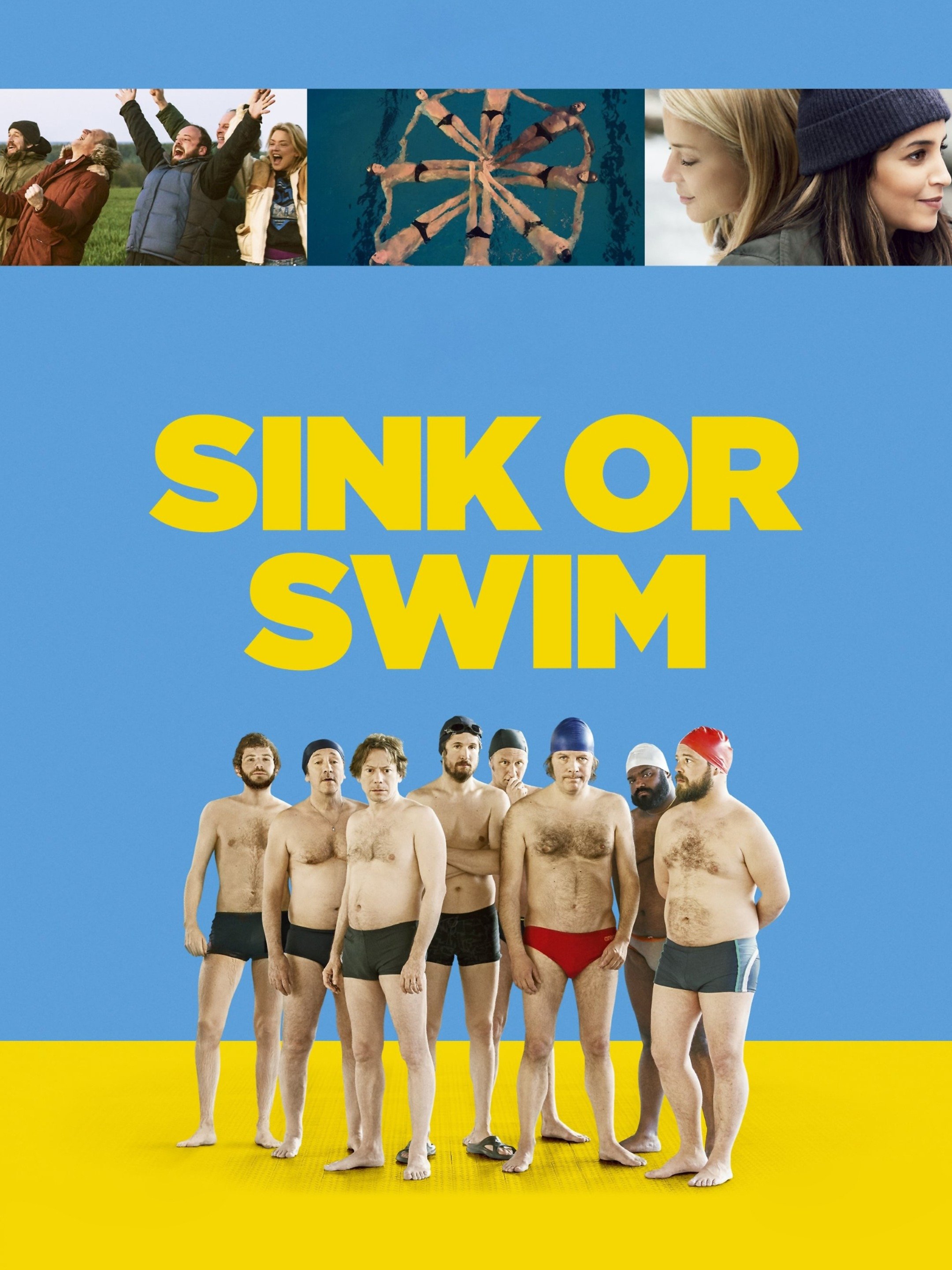
Bertrand (Mathieu Amalric) is a manic-depressive, unemployed stay-at-home father who quite literally eats medication for breakfast. Laurent (Guillaume Canet) is a bourgeois man who deals with his familial problems through unhinged anger. Marcus (Benoît Poelvoorde) is the owner of a pool business that is rapidly declining. Simon (Jean-Hugues Anglade) is a line-chef who has held onto ambitions of being a rockstar for a bit too long. Thierry (Philippe Katerine) is a mild-mannered pool technician who just wants to be a part of society, particularly amongst those who accept his various quirks. None of these men know each other at the start, but they eventually come to be in very close contact after they all join a synchronized swimming team at their local public pool. Each one of them signs on for different reasons – whether to pass the time or deal with personal and professional challenges in their everyday life, the cool embrace of the water, and the stern directions of their ruthless coach (Virginie Efira) motivate these men to keep attending training sessions. They’re initially not very good, but after a while they start to develop a rapport, which ultimately turns into an ambition to take their amateur team to an international level, as a way of becoming national heroes, something none of these men envisioned would be a possibility. However, when it comes time to actually prove themselves, they begin to realize that there is a lot more to the process than they initially imagined, but each one realizing how vitally important their ambitions, as delusional as they may be, actually were in developing them, both internally and in terms of their external performance, which gives them a sense of belonging in a world all of them felt varying degrees of alienation towards.
There are a few elements that keep Sink or Swim (French: Le Grand Bain), the charming comedy by Gilles Lellouche, afloat. One of them is its magnificent sense of humour, with the story of a group of lonely, wayward men venturing into the unknown depths of synchronized swimming being fertile ground for a funny and insightful look into the modern world. Another is the staggering cast, with a bevvy of familiar faces playing the central roles in this delightful ensemble. However, what truly makes this a special film is its heartfulness – the director set out to tell a story about people trying to find a place in the world, while atoning for their past mistakes in a way that is productive, a necessary distraction from the harsh realities of life. Logically, Sink or Swim shouldn’t be a film that works as well as it does, since there were several opportunities for it to either become derailed by its own overt sense of humour, or collapse into the absurdity of a premise that doesn’t always lend itself to coherency. However, as we’ve seen with similar stories of a rag-tag group of underdogs taking on a new hobby and finding solace in the camaraderie they form, with films like The Commitments and The Full Monty clearly being influences on it, the collision of a slightly strange story with an abundance of heart can produce pure magic, turning Sink or Swim from a minor comedy into one of the most mindful films of the past few years, one that may be predictable in some aspects, but remains filled with a genuine honesty that overcomes the small cliches that tend to appear as the story progresses, making for an enthralling, rich and evocative comedy that has as much charm as it does heart-wrenching emotion.
There’s a sense of hope that persists throughout Sink or Swim. The prologue to the film is all centred around trying to fit “a round peg into a square hole”, which we know is essentially short-hand for people who don’t fit in. This serves as the general problem statement for the film, with Lellouche taking a look at the trials and tribulations of five middle-aged men who have never quite been able to find a place in the world, other than the working-class public swimming pool where they spend their evenings practising. It gives them a sense of not only accomplishment, but belonging – and what this film lacks in narrative originality, it more than makes up for in its emotional content, which often means more when taken in context. Very few of us would want to see this material presented in the form of a straightforward, hard-hitting drama – and while the athleticism and laborious efforts of those who participate in it are no laughing matter, there’s something inherently comical about synchronized swimming, especially when done through the perspective of a group of older, out-of-shape men without any experience, but armed with a firm commitment to mastering the art, which gives the film such a sweetly humorous tone. Lellouche deserves credit for somehow taking a rather derivative story and weaving it into an absolutely captivating comedy that is both hilarious and profound, a difficult combination to achieve without a lot of work. He may not be a director who normally receives much acclaim in terms of arthouse credibility, but he does rise to the challenge of delivering a memorable two hours, and in the process leaving behind a very strong message of companionship.
The film is anchored by a series of stunning performances from a small but interesting ensemble of actors. Mathieu Amalric is the de facto lead, playing a clinically depressed man whose decision to join the synchronized swimming team is our introduction to this world. We’re promptly introduced to the rest of his colleagues, played by Philippe Katerine, Benoît Poelvoorde, Jean-Hugues Anglade and Guillaume Canet (as well as a few others that make up the team, but don’t really do much in the film) and their ferocious but well-meaning coach, played by the effortlessly delightful Virginie Efira, all of which are distinct and interesting characters. The director understands the true nature of an ensemble – it isn’t so much a matter of having a few interesting roles, but rather developing them to the point where the film couldn’t have succeeded unless each and every actor was delivering their best efforts. There is some really strong work being done amongst the cast, and it helps that the director doesn’t dwell on any of the characters more than the others – each of the principal characters have numerous moments to stand out, allowing them to both develop in isolation in their own individual scenes, as well as when they’re part of the group. The only disadvantage of this approach is that it’s difficult to choose a standout amongst the cast, and it’s likely that each viewer will attach themselves to a different character – and whether it’s Amalric’s manic-depressive charlatan, Katherine’s good-hearted dunce, Poelvoorde’s shrewd but derange businessman, Anglade’s delusionally ambitious musician, Canet’s anger-filled parent, or Efira’s brokenhearted former athlete, there’s something for everyone contained in these characters, each one of them flawed to the point where the film spends much of its time patching up their intentional shortcomings, in an effort to show us that, regardless of how much of a “square peg” we may be, there’s always a place for us, even if it takes some time to get there.
Friendship is essentially the central theme to Sink or Swim, a film that doesn’t really pay too much attention to deconstructing the art of synchronized swimming, using it only as the impetus for this poignant tale of a group of people trying to fill in the empty spaces of their lives that are plagued with a variety of personal problems with a hobby that eventually evolves into a passion when they realize how such a distraction can actually harbour healing qualities, helping them come to terms with the realities that lie beyond that swimming pool. The camaraderie that comes about as a result of these men being in close proximity is beautiful to observe, and the director makes sure to emphasize the wonderful qualities that come through when even the most wildly different individuals find themselves sharing a common interest. Sink or Swim extracts a lot of comedic value from the various situations that occur throughout the film, but it doesn’t waste any time in establishing a clear emotional basis for all of it, making sure that there is a strong balance between outrageous humour, and genuinely moving pathos, both of which are entirely necessary to the success of the film. The story itself may be relatively simple, and the conclusion is just about as predictable as we’d imagine, even if Lellouche does try to challenge the cliches to a certain point, particularly when we aren’t sure if the protagonists are celebrating because they won the world championship in which they competed, or if they were just happy to have achieved the right to say that they at least took part, with taking the leap often being the biggest challenge in itself. There’s even a brief moment towards the end of the film where we wonder whether or not it actually matters whether they won or lost – and even if we do get the answer eventually, the result doesn’t change the meaning of the message embedded deep at the heart of the film, which is all about taking a risk, and realizing that whatever the outcome, putting in the effort is more important.
Sink or Swim is the kind of film that may not be entirely original, but instead builds itself on its warmth and personability. It’s always a delight to encounter a piece of fiction that instantly puts you at ease, and while it may occasionally grasp at the low-hanging fruit, it has a certain sensibility that makes its relatively pedestrian premise come to live with a vivacity normally reserved for only the most endearing films. Gilles Lellouche is a fascinating director, and despite this being his first solo feature film effort (after co-directing two previous films, one of them a segment in an anthology), he demonstrates a very clear and concise approach to telling this story, keeping everything at the fundamentally human level while still taking a few well-placed risks at pivotal points in the story, meaning that we never truly know what to expect from the film. It’s a truly endearing comedy that has enough heart to propel it straight past a few scenes of heavy-handed, overwrought emotion, with the general atmosphere of the film being one built on alternations between exuberant comedy and quietly profound, character-driven drama. Perfectly composed in terms of both the humour and emotional content, and executed with a wry precision that proves the value of a story well told, Sink or Swim is an absolute delight, and the kind of film that is both entertaining and thought-provoking, using the platform of a populist comedy to stir conversation and remind us of the importance of realizing one’s own worth – and if it takes as much as joining a synchronized swimming team to find yourself and feel comfortable in a confusing world, there are certainly worse ways to spend an evening.
 The Postmodern Pelican