
At this point in his career, Steven Soderbergh has managed to work in nearly every conceivable genre available to him, jumping from domestic dramas to darkly comical satires to harrowing psychological horrors, and managing to accomplish great work under each of them. However, some of his best films fall under the crime genre, and whether it’s in the form of the captivating trilogy that started with Oceans 11, or more serious-minded work, there is something that the genre does to Soderbergh that is beyond invaluable. No Sudden Move is his latest offering, and is both a return to his earlier era of making slightly more sobering dramas, but also a high-concept project that sees the esteemed director not only making a period piece, but one that has many complexities, yet never feels as if it is being weighed down by them. His version of a classic 1950s noir thriller feels like it should be a major work, while still coming across as slightly more intimate for Soderbergh’s style, which is not necessarily a shortcoming, just a keen observation that has become quite prominent over the past decade, mainly since his return from a brief retirement, which seemed to unlock a tendency in the director to approach even the most intimidating stories with a razor-sharp precision, providing quality rather than an enormous spectacle. However, rationalizing it only removes the lustre that comes along with the film – so like any great thriller, it’s best to just sit back and allow the director to take us on this twisted journey, with his previous work giving us full confidence that we’re in safe hands.
Depending on how one perceives the film, No Sudden Move can either be considered a work of unhinged genius, or a convoluted jumble of ambitious ideas that never truly come to fruition. Part of realizing where you stand on the divide comes in how we understand what Soderbergh is doing here. The first act of the film is a relatively conventional thriller – three men, nothing but strangers to one another, are recruited to take part in a quick assignment, where one of them has to escort a mild-mannered bureaucrat to his office to retrieve a mysterious document, while the other two have to “babysit” his family, essentially holding them hostage until the assignment is completed, in order to make sure they don’t do anything that will expose what is clearly a very detailed operation. From here, the film begins to spin uncontrollably into the realm of the surreal, with an abundance of twists and turns revealing themselves, resulting in a third act that is one unexpected moment after another. It’s perhaps not the best approach in terms of telling a coherent crime story – but this is exactly where the genius of the director comes into play, since Soderbergh didn’t design No Sudden Move to be a conventional thriller. This isn’t merely a story of a group of low-level criminals finding themselves on the wrong side of the law yet again – it’s a multilayered character study that merges criminal psychology with mentalities surrounding social issues, which serve as the backdrop to the film. There’s a clear reason for Soderbergh setting this film in Detroit in the 1950s, when the story itself could’ve essentially taken place at any particular moment. These details only start to appear towards the end when the contents of the document are made clear, and we understand exactly what the intentions of each of these characters were initially.
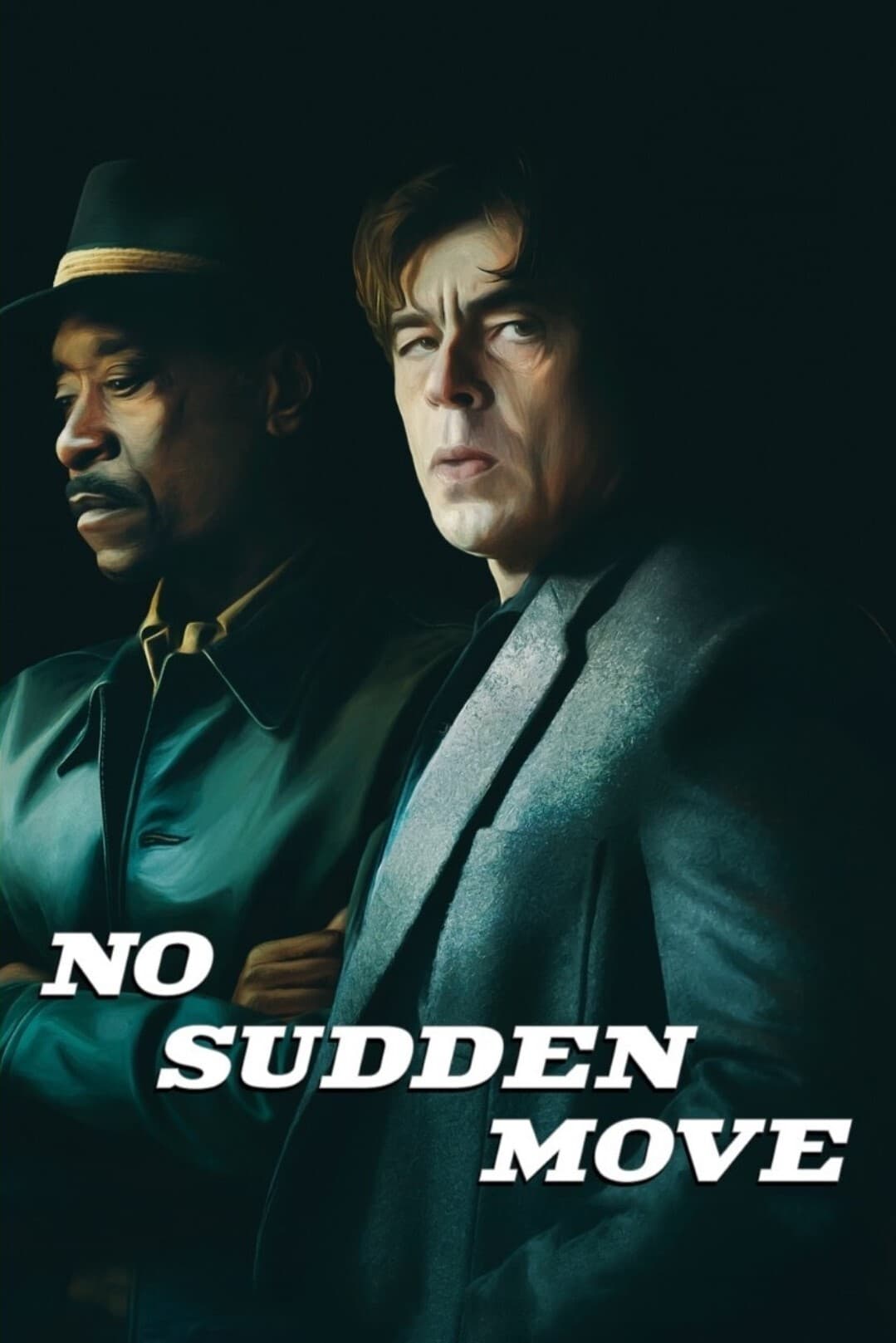
Soderbergh is not a stranger to more complex stories, and one element of his films that normally helps contextualize even the most convoluted of premises. No Sudden Move is almost entirely built from the dynamic between Soderbergh regulars Don Cheadle and Benicio Del Toro, who are doing some wonderful work as the leads of the film. Two small-time crooks with a penchant for getting into danger are not roles that we’d normally expect from either, since they’ve proven themselves to be more comfortable with smoother, fast-talking characters, rather than hesitant criminals trying to weasel their way out of a bad situation. Both are tremendous, and are as charming as ever, anchoring the film and helping to guide it through the labyrinth of twists that await it after a while. David Harbour continues to prove what a reliable character actor he is, and the film also features a wonderful supporting performance by Brendan Fraser, whose gradual return to the mainstream after being out of the public eye due to personal issues, has been long overdue, and it’s very heartening to see him not only appear in such a strong film, but given a role that may be relatively small in comparison to others, but is really pivotal to the direction the story takes. The cast of No Sudden Move is wonderful, and even in relatively small cameo roles, some of these actors are turning in strong work that reflects a keen understanding of the material, as well as a willingness to follow Soderbergh into the wilderness, knowing that he’s going to pluck out some very impressive performances from all of them.
Handling this material could have easily resulted in a frenzied, hurried jumble of missed opportunities had there not been a strong director at the helm. Ed Solomon has had a lot of experience in the industry, especially when it comes to high-concept productions – and it seemed like this (surprisingly his first collaboration with Soderbergh) would be the culmination of a long career of telling such stories. The two artists work well together – Solomon provides a solid script that alternates between meaningful dialogue that sets the foundation of the story without being too reliant on exposition (a major flaw when it comes to a lot of crime thrillers), and more ambitious storytelling devices that contribute to the deeper meanings behind the narrative, while Soderbergh brings the screenplay to life, developing a complex crime thriller that feels genuinely profound, even at its most serpentine. This is a clear case of a film succeeding through a deft combination of both broad strokes and small details, which is certainly par for the course with Soderbergh, who has proven himself to be someone who sees a lot of value in the intimate recesses of a film – we often find the most meaningful commentary hidden just out of view, and even in a relatively conventional crime thriller, he manages to invite some discussion around race relations and the class divide, which may not envelop the film, but rather stands as the backdrop for the story, proving that there is a lot more to No Sudden Move than just the main storyline, with the sobering details that occur between major scenes playing just as significant a role in this compelling drama.
Soderbergh is a remarkably prolific director, to the point where he has often made multiple films in a single year. Logically, this means that quality may vary, as well as the attention some of them may receive. No Sudden Move is one of the better films in his recent output, but it’s one that can easily fall into obscurity, since outside of the cast, there isn’t much that this film provides at a cursory glance. A surface-level analysis will tell you that this is just a conventional crime thriller, when reality it is so much more complex, a fact that can only be learned from venturing into this film and seeing how Soderbergh tackles some fascinating material. It’s not anything we haven’t seen before, especially in how it functions as part of a recent wave of taking the film noir genre and filtering it through a more socially charged, retro lens, whereby the common traits of the genre are combined with more pressing issues. In this case, race plays a considerable role, but comes through in the more quiet and intimate moments, normally residing in a throwaway comment or a brief piece of commentary that adds nuance to an already deep and layered film. It’s a masterful work of contemporary crime cinema, and Soderbergh seems to be presenting us with both a brief return to his earlier days of more simple storytelling, combined with a more progressive aspect to his filmmaking process, which creates a unique atmosphere around this film, and develops it far beyond the confines of what we’d expect it to be based on the basic premise. There are an abundance of surprises lurking within this film, and Soderbergh puts in a decent amount of effort to elevate it beyond mere cliche – and the result is a captivating, enthralling film noir with layers of social commentary and psychological thriller, which only makes it an even more engrossing experience, and further proof to the director’s endless audacity.
 The Postmodern Pelican