
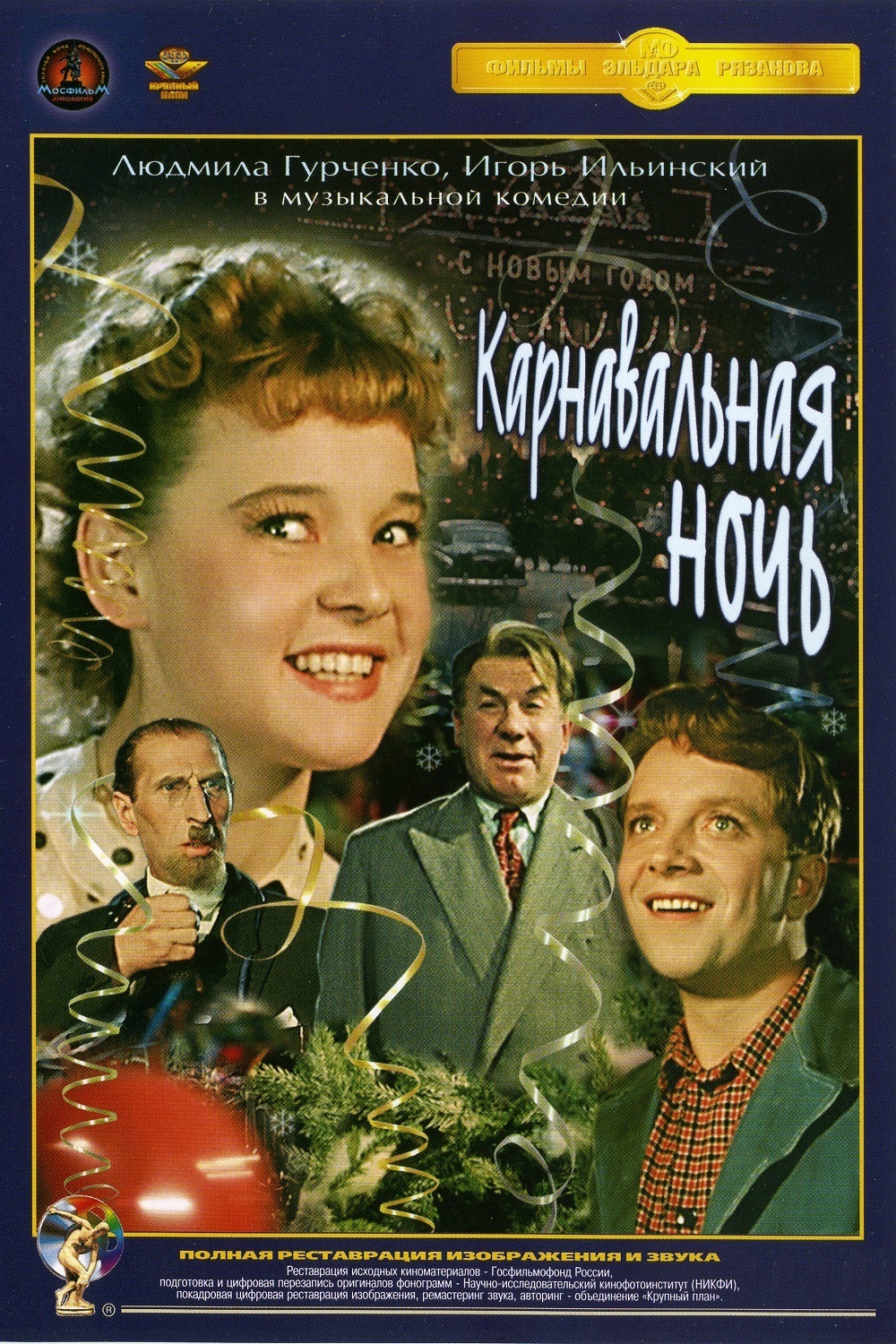
As one of the formative voices in Russian cinema, Eldar Ryazanov had quite a bit to prove them it came to defining his national cinema. His two-part film The Irony of Fate is arguably the greatest comedy to ever come out of the country, and many of his other films (such as my personal favourite, his wonderfully strange Beware of the Car) showcase a director with a very peculiar set of talents, and a willingness to take a few risks when the film called for it. He made several classics, and those with even the slightest working knowledge of Soviet-era comedy will have a particular favourite. One that has come up a few times, and for good reason, is Carnival Night (Russian: Карнавальная ночь), his hilariously comedic send-up of social mores and conventions that feels both transgressive and insightful to the general nature of Russian society, using some of their most notable traits in a way that is both funny and deeply compelling, which is a quality of the director’s films that has carried over throughout his career, right into only a few years ago, when his long career came to a conclusion. Carnival Night is a truly delightful glimpse into the way ordinary people act in particular situations, with Ryazanov plumbing the emotional depths to deliver an irreverent comedy which may function more to elicit laughter, but still has an unexpected amount of substance when it comes to commenting on and critiquing particular traditions, which the director may not have disdain towards, but is still certainly willing to employ his distinctive playfulness in order to expose the more puzzling aspects of society.
The story, which centres on a New Year’s Eve party being thrown for the members of a local country club, is one that is ripe for a few memorable moments, especially since the central conceit is surrounding the arrival of the club’s new director, a stern and humourless man who takes control of the preparations for the event, and makes sure to strip the proceedings of every ounce of joy or reckless fun, in exchange for what he determines is more appropriate for the event, such as sombre music and long, rambling speeches about science, politics and religion, which he considers to be a more pertinent choice, and which he genuinely believes will enthuse the guests. As was the case for most of Ryazanov’s films, Carnival Night is designed as a comedy that doesn’t lack a dizzying amount of jokes, but instead constructs it in a way that the foundation is formed from something more real and serious, which only affords the director the opportunity to have more fun, since rooting it within something more dire only makes his outrageous sense of humour and peculiar directorial flair all the more captivating, since not only do we not expect him to make light of certain situations or themes, but also never makes the plot predictable. Despite being a relatively simple and straightforward comedy, brimming with slapstick humour and satirical jabs, the film has an atmosphere of unpredictability, and even when it appears to be operating at its most direct, there is a sense of the unknown lurking just above it, an inability to know where the next scene will take us. It’s a bewilderingly entertaining way of constructing such a film, and it features some staggering moments that feel all the more genuine the more we look into it.
The structure of the film itself is even more fascinating, since breaking it down into components can be quite a fun exercise on its own. Unlike more Western-minded comedies, Carnival Night employs a very unique segmented approach – it’s a single story (rather than being an anthology or collection of vignettes), and there is a clear goal that the characters are working towards. Yet, the first half is dedicated almost entirely to deconstructing every minuscule detail, with the director (played magnificently by Igor Ilyinsky, whose sour-faced pessimism and glorious stupidity makes his performance a comedic delight), moving from one participant to the other, asking them to explain their act, and subsequently demanding the changes he believes they need to employ in order to make it compliant with supposed Soviet standards of decency and entertainment – one of these scenes (a discussion between two clowns and the director), remains one of the finest analyses of comedy ever put on film, a small but impactful moment that reminds us of the reasons why comedy has evolved in the way it has over the years. Then in the second half, it is one beautifully chaotic moment after another, as everything breaks loose and becomes a dizzying array of colour and imagination, almost the complete opposite of the more mannered and straightforward (but still very funny) first half. At only 72 minutes, there isn’t much space for Ryazanov to develop each and every sub-plot and give the characters a fair amount of time – so it stands to reason that his method of overlapping the stories and bringing them all into focus almost simultaneously, is very inventive and helps move this film along at a steady pace, never allowing it to outstay its welcome.
Carnival Night is an absolute delight in every way. Russian cinema has certainly not been under-represented in my own cinematic journey, and while it is intimidating, considering the wealth of content that was produced over the course of the nation’s artistic history, the more we venture into the heart of these films, the more we realize how absolutely magnificent they can be. Even at just over an hour, this film is endlessly entertaining and beautifully compelling in how it tackles some oddly endearing themes with the kind of reckless joyfulness that newcomers to Soviet-era cinema may not always expect (one of the great pleasures of venturing through Russian cinema has been discovering that they are far from dour, and that many of these films possess a sense of humour that remains unmatched, especially in breaking it down to the most fundamental components). This is not an overly complex film, and should be quite accessible for the vast majority of viewers, as well as being a terrific entry point to Russian comedy, since everything that makes it so enthralling – the irreverence, the charm and the effortless blending of broad humour with intelligent, insightful satire that is cutting but not at all mean-spirited. It’s a simple but effective approach, and it continues to be a wonderful way of telling stories and giving insights into Russian culture without becoming too heavy-handed, which is always a great advantage of these endearing little comedies that tend to pack quite a punch when made correctly.
 The Postmodern Pelican