
Undine is the kind of film that becomes more meaningful after having seen it. Christian Petzold is an undeniably gifted filmmaker, but his brand of hyper-intelligent cultural critiques often work better once the viewer has had some time to digest the work and come to terms with its innumerable themes on our own time. The story of a historian that may or may not secretly be a water nymph bound to ensure that her partner remains faithless, or else faith a watery demise, is one that is fertile ground for a director who has often proven himself as quite an impressive authorial voice when it comes to these abstract discussions that blend culture, history and folklore into unforgettable and powerful pieces of filmmaking. Undine is an imperfect film, and it takes some time to fully acclimate to its bizarre storytelling techniques, as well as the themes that are embedded in its foundation. However, once we are fully on Petzold’s wavelength, and can understand his position as both a storyteller and visual stylist, there is very little that he can do that isn’t captivating, with this film in particular being a fascinating character study that may require some deep introspection and perhaps a slight amount of foreknowledge of the subject matter to fully enjoy, but even at its most basic level, Undine is an engaging and poignant drama about individuality that may struggle at times to make its intentions known, but gradually unfurls a truly impressive story that should be embraced by any open-minded viewer willing to surrender to the quaint but compelling approach the director takes to this truly non-traditional material.
Perhaps “unconventional” is the most appropriate term to describe Undine, which seems to be quite fitting, considering the director is actively avoiding following any real narrative patterns with the telling of this story. Blending several genres together, mostly romantic drama and psychological thriller, the film is a multilayered character study that looks at two individuals thrown together almost by chance, but convinces us that their meeting was inevitable, a moment of fate coming into effect as a way of moving both of their lives along. Undine never promises to be anything other than enigmatic, and Petzold ensures that every scene, while perhaps not offering much in terms of a clarification for what we’ve been seeing all along, does move the story along, allowing it to oscillate between a variety of abstract moments that may not make much sense in isolation, but start to form into something coherent when placed alongside one another, and subjected to some thought on the part of the viewer. This film is certainly an active experience, encouraging the viewer to look deeper than what is initially presented to us – at only 89 minutes in length, it doesn’t have much time to luxuriate in its multitudinous ideas, but rather invites us to take what we need from the film, and undergo our own process of looking beneath the surface and uncovering the secrets that lie within, which can be a wonderfully compelling experience, or an absolute ordeal, depending on how much the viewer is both willing to suspend their disbelief and engage actively with the material. It’s a carefully calibrated drama that doesn’t give answers so much as it does a number of clues, leaving the most important questions up to our individual interpretation. It may not make for a satisfying film, but it does indeed create an unforgettable one.
The mythological underpinnings of Undine are clear, but still quite obscure if one hasn’t encountered the folkloric background of the film prior to watching it. While any film that requires the viewer to have done some degree of homework before in order to understand it is clearly not adequately telling its story, Petzold’s approach is one that is defined less by the viewer needing to have contextual background to enjoy it, but rather to reward those who may have been aware of the legend of Undine by enriching our experience with the material. The subtle clues and the smallest details only add nuance to the film, and help set a firm foundation that helps elevate the story beyond a simple romantic drama. Petzold is a very smart filmmaker, as well as one that knows how to draw a clear boundary between genres – and despite Undine being inspired by archaic mythology, the film never veers into fantasy, remaining very much bound to our reality throughout, only using the folklore as a way to add vaguely enchanting nuances to a mercilessly simple film about two individuals falling in love, and asking the central question as to whether this was merely a chance encounter, or an event that was always bound to happen. Mythology is often a useful tool for contemporary storytelling, and Petzold very cleverly uses it in the form of allegory to tell a very resonant story about loneliness and desire, with the abstract, celestial undertones being prominent, but rather as supplementary to what is very clearly a story firmly rooted in humanity, showing the various curious recesses of yearning that many of us endure over time, especially in moments of the most haunting isolation, which is keenly reflected in every mysterious frame of this masterful film.
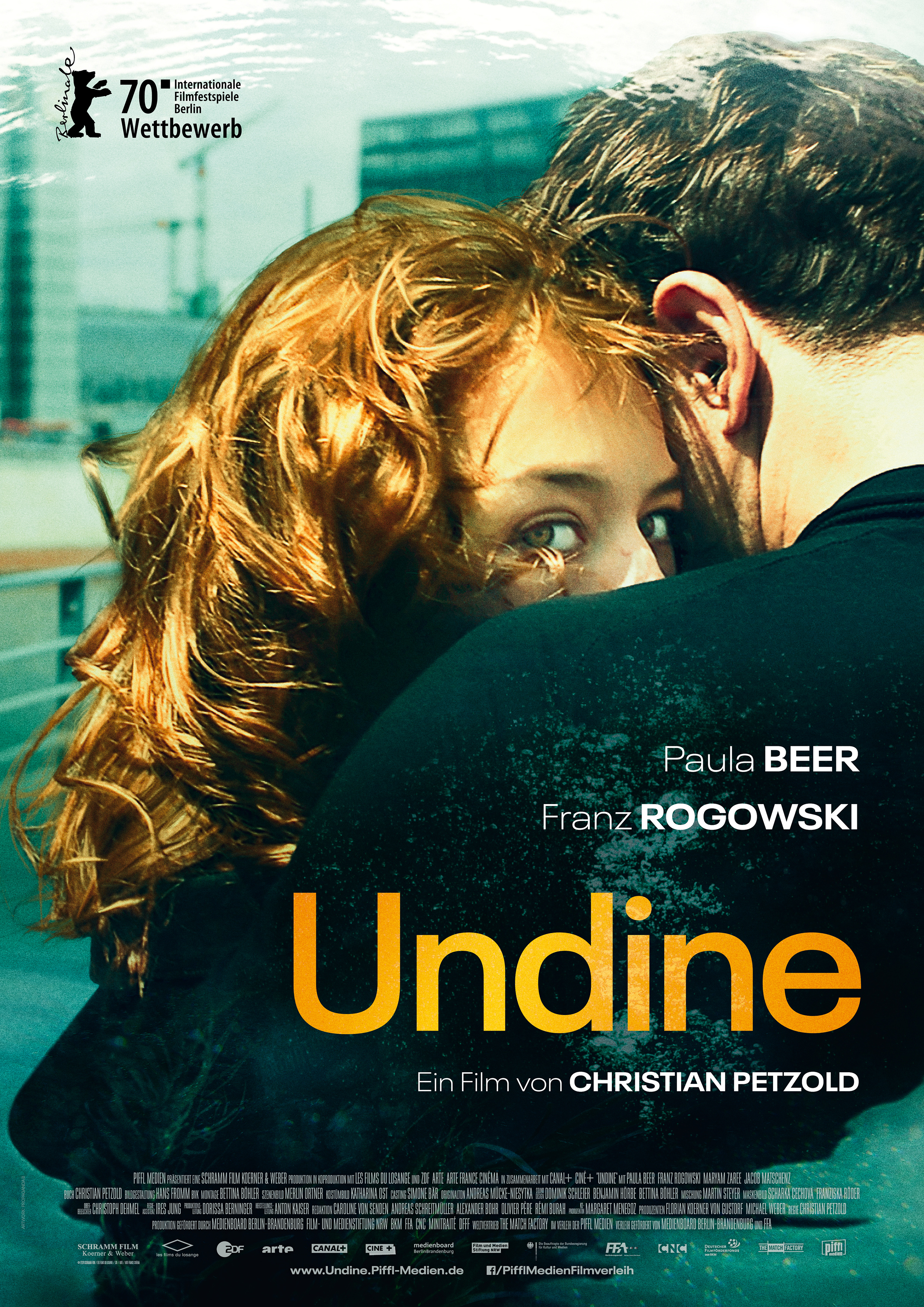
What helps keep Undine afloat are the two central performances, which keep this film grounded within reality, at least within reason. Paula Beer is an extremely gifted young actress who is proving to be one of the director’s new muses, their few collaborations proving to be fruitful for both of them. Her performance as the titular Undine is one that is brimming with a very unique energy, and whether it be in her moments of extreme self-awareness, or those where her faraway stare hints at something much deeper simmering within the character, Beer is astonishing. It’s a very simple performance, and one that is almost entirely reliant on the actress’ ability to play off the character’s internal nature, but as the film progresses, Beer becomes more impressive, commanding the screen more with each passing moment. It’s a slow-burning performance that sometimes feels overly contrived, but as we get to know the character more, we start to realize the depths to which Beer was capable of diving in realizing these fascinating quirks. Appearing across from her for most of the film is Franz Rogowski, another very promising young actor who plays Christoph, the forthright and good-natured diver who falls for Undine and causes her to question her own nature – and while he may not be as prominent as Beer in his portrayal of the character, Rogowski still manages to leave a profound impression, especially when most of the third act deals with the titular character’s unexpected disappearance, and Christoph’s frantic search for his paramour, whose mysterious absence from his life upon awakening from a coma launches him into an uncanny version of a world he used to know so well.
Undine is mysterious curio of a film, and one that isn’t always particularly easy to understand – but it’s the kind of film that rewards the viewer taking the effort to penetrate its multitude of layers. It’s a truly mysterious film, but one that takes us on a journey into another world, perhaps not literally, but through the use of a carefully curated allegory that gives us fascinating insights into traditional folklore. We’re invited into this world and given the chance to explore, with our metaphysical discoveries coinciding with a stunning romance between two wayward individuals that come from entirely different backgrounds (and perhaps even species, although the film very smartly refuses to have such discussions), finding each other, and realizing not only does the other person’s presence give them a sense of belonging, they also unlock a pivotal step in their own individual journey, which the film gradually explores, quietely deconstructing a relatively well-composed story and turning it into an absolutely unforgettable cultural odyssey that stands firmly rooted in both mythology and contemporary discourse, creating a vivid and powerful ode to the human condition, investigating the root of the yearning many of us feel, which only makes Undine an even more essential film, since it touches on deep and unflinching themes that should resonate with everyone, even if the film around it come give off the impression of being cold and distant, which is all part of the masterful approach the director took to telling this quiet but compelling story of the intersection between identity and desire.
 The Postmodern Pelican