
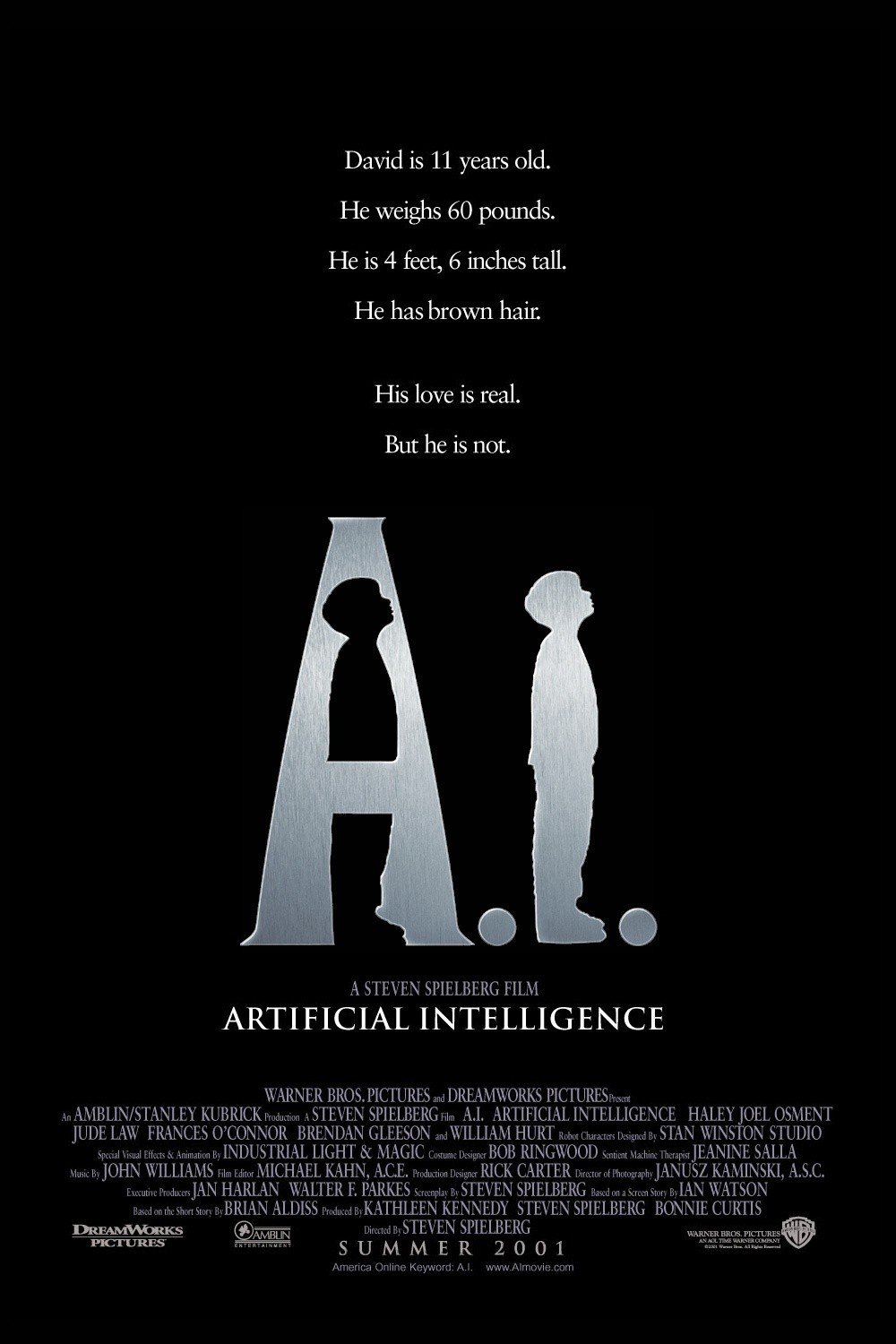
Steven Spielberg is the kind of director who, when he hits the mark, can legitimately make a case for one of the most captivating filmmakers of his generation, but can also be accused of insincerity when his work isn’t particularly strong, and clearly just the result of a small idea and a large budget. However, his reputation as one of the most profitable filmmakers to ever work in the medium is easily earned by a smaller but pivotal group of films that are very close to perfect masterpieces. Everyone may have a slightly different opinion on what constitutes his best – there are those that see his earlier science fiction films as being revolutionary (with E.T. the Extra-Terrestrial and Close Encounters of the Third Kind being cherished works of the genre), while others see his more intimate historical dramas (The Color Purple and Lincoln, amongst a few others) as his great achievement. I’ve often thought that his peak was actually one that is somewhere in the middle, which leads us to A.I. Artificial Intelligence, his adaptation of the short story “Supertoys Last All Summer Long” by Brian W. Aldiss, which tells of a child-like robot designed with the express purpose to feel love towards his adoptive family, meaning that he was the first-of-a-kind, a deviation from the more mechanically-minded creations used as labour. Taking over the reins after the death of Stanley Kubrick, who had been working on the project for a few decades, Spielberg slightly overhauls the production, while still paying tribute to the original director – and the result is a profound, moving science fiction odyssey that contains a multitude of fascinating existential quandaries, while still affording us the genuine thrills of a strong Spielberg production – when the director puts in effort and has his heart in a production, there are few experiences more enriching and magnificent.
As one of the characters mentions in the opening scene of the film, for about as long as we have been sentient, there have been efforts to create artificial humans – whether it be contained in the vaguely mythological speculations of the Antiquity, the terrifying pages of Mary Shelley’s Frankenstein, or the genuine attempts in our real world to evoke life from nothing but machinery, we’ve always been fascinated with the prospect of creating beings, whether it be as virtual assistants to help us in our everyday life (which have become increasingly common, one of them even being used slightly in the writing of this review), or through the progressive-gazing ambitions to eventually create machines that can do the work of humans and thus eliminate some degree of the working-class. It’s a layered, complex issue that has remained contentious and omnipotent for as long as any of us have been alive. Isaac Asimov set down the most substantial explorations of not only the concept of using machinery to ease our everyday efforts, but also to explore the possibilities that if a piece of technology can learn to conduct itself in the same way as a human, it’s only logical to expect some distant possibility that they can develop emotions as well. This has been the foundation for several works of speculative fiction that focus on the “evolution” of machines to a state of human-like consciousness, and serves as the impetus for most of the discussion in A.I. Artificial Intelligence, a film that blends the theoretical tenets of I, Robot with the enchanting beauty of Pinocchio (to the point where the cherished work of children’s literature is openly referenced), and in the process provides us with one of the most hauntingly beautiful explorations of the meaning of life, all contained within one of the most simple but effective accounts of existence ever committed to film.
It’s somewhat ironic in theory that a film as humane as A.I. Artificial Intelligence is about artificial beings striving to feel emotions – it’s often difficult to empathize with a robot, since there are creations borne in laboratories, and that live as long as their power supply allows them to. Yet, whether be the product of Aldiss’ beautifully poetic story of a young cyborg trying to become “a real boy”, or the fact that Spielberg had a sincere knack for infusing even the most cold and clinical stories with a deep, unflinching warmth, we’re drawn into this world, and invited to look beyond the boundaries of mere technological innovation, as the director creates a poignant collision of science fiction and philosophy, while still making it extremely accessible to even the most casual viewers. Spielberg’s ability to make us feel entirely at ease, while still showcasing some of the most complex existential discussions in the background, is certainly one of his more underpraised qualities, and perhaps one of the primary reasons his science fiction endeavours are considered to be amongst the gold-standard entries into the genre. A.I. Artificial Intelligence isn’t a film that is easy to dissect – the film not only focuses on life a few centuries into the future, but then tacks on an additional two-thousand years for the climax, meaning that this is a film taking place so distant from where we are now, all that anyone had to work from is a general, vague idea of what the future will hold. Yet, despite operating from a place of pure speculation, Spielberg (who also wrote the screenplay, a rare occurrence that was only the third time we wrote his own directorial excursion, and the first since Close Encounters of the Third Kind) manages to perfectly encapsulate this world, developing it beyond merely a series of abstract, futuristic scenarios, and instead turning it into a powerful ode to the human condition, told from the perspective of a robot.
A.I. Artificial Intelligence has such a peculiar approach to its genre, had it not clearly featured a few sequences set in the future, it would be difficult to tell that this was a science fiction film in general. Spielberg opts for a much simpler way of telling the story – rather than overloading it with special effects and computer-generated imagery to create a dazzling image of the future, he develops it through a more intimate lens, showing how, even centuries into the future, how the world is still recognizable, albeit just featuring a variety of new features that have been implemented to make our lives easier. Technological innovation doesn’t necessarily mean that the entire concept of our environment needs to be overhauled – and it’s in this distinct contrast between what we as viewers can recognize, and the subtle touches of speculative fiction, that the film truly flourishes. A.I. Artificial Intelligence is not a film about the rise of technology – there’s very little discourse surrounding the fearful idea that robots will overtake humanity (and even in the film’s coda, where we see how our species has gone extinct, the artificial beings that have taken over are shown to be benevolent and kind, rather than maniacal). This is a film built on emotion rather than innovation – scientific developments form the foundation of the film, but it’s mostly propelled by the genuine sense of human tenderness that persists throughout the film. Spielberg, for all of his faults, is a genuinely strong director when it comes to emotion, and A.I. Artificial Intelligence is not any different. What drives this film is the director’s sincere understanding of humanity, which is filtered through the lens of a young robotic boy’s journey, as he comes to wish to become human, only to realize such a desire is entirely unrealistic. It serves as the impetus for this gorgeous, intricate exploration of his journey, and Spielberg makes sure we are in good hands every step of the way, which is often forgotten when it comes to some of the more complex science fiction premises we encounter on occasion.
Spielberg has had a long and storied career, and in the process has accumulated an equal amount of highs and lows as a result of sheer volume. However, A.I. Artificial Intelligence is one of his most well-formed works. Very few of his other films seem to capture both his forward-thinking approach to science fiction and his genuine, soft-hearted understanding of human emotion – it’s not the sole representative of both, but it is the one that could embody both principles the best. It may become somewhat overwrought – certain scenes are absolutely heartbreaking (but are made bearable through the wonderful performances being given by Haley Joel Osment, Jude Law and Frances O’Connor), and it can be difficult to sit through some of the content, since so much of the film is centred around a mother-son relationship. It’s a very sad film, but it isn’t without hope – and throughout the production, Spielberg does his best to find a perfect balance between science and psychology, technology and emotion, which gives A.I. Artificial Intelligence such a unique and genuinely moving sense of humanity, which is only more interesting considering the nature of the main character and his journey that takes him across America, and ultimately entire millennia. It’s beautiful, well-made (the visual effects, both computer-generated and practical are stunning, and the film features some of the best use of Janusz Kamiński’s unique cinematography) and exceptionally written, which all converges into an immersive, quietly provocative experience that will resonate with all viewers, and be the cause of genuine excitement and rumination for anyone who has ever felt out of place in their environment. Filled with allegory, and willing to have difficult conversations while still being thoroughly entertaining, this film is a triumph.
 The Postmodern Pelican